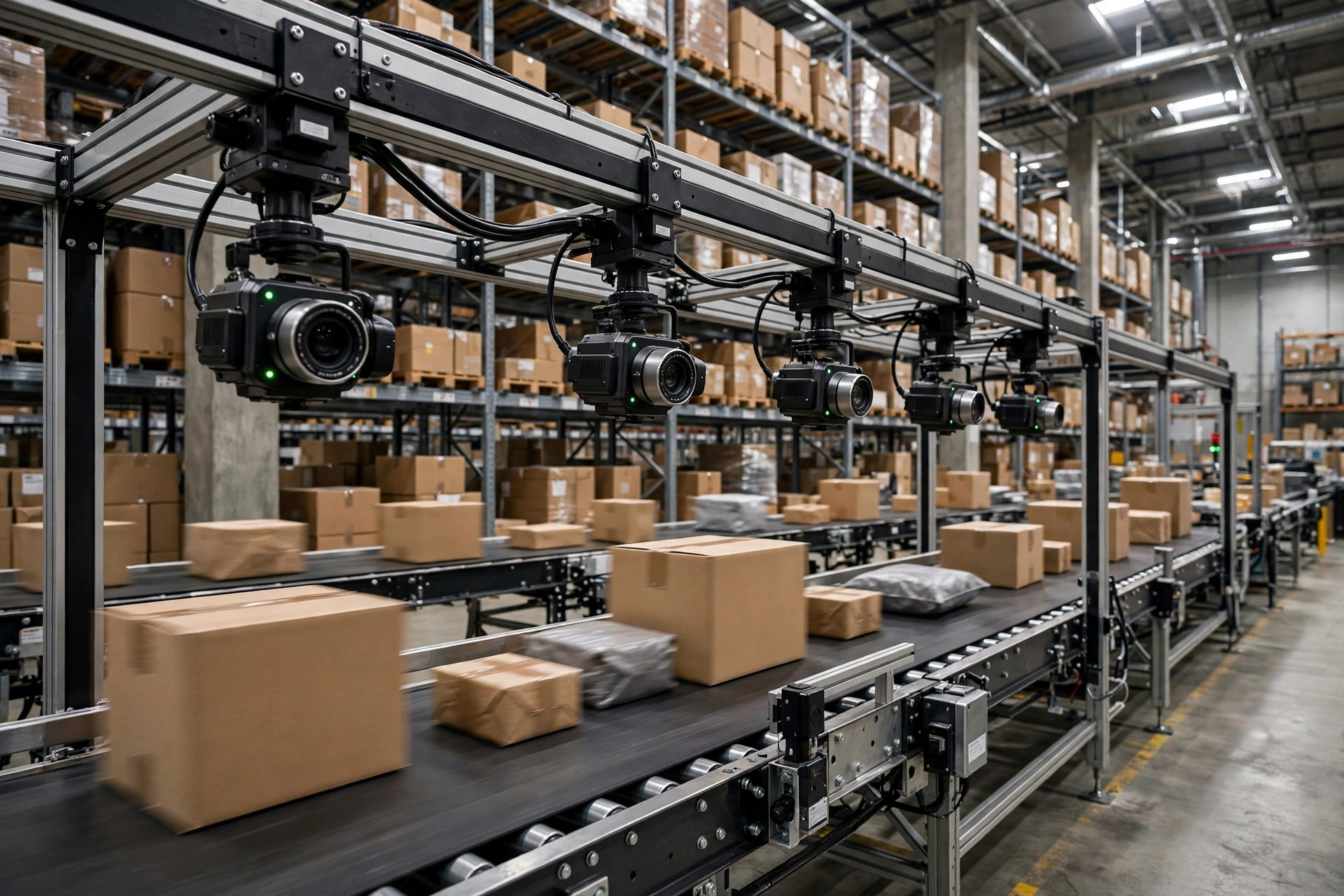
In the fall of 2024, a Midwest auto-parts 3PL deployed a vision-based AI sorting system. The contract ran a full year; the project died in month five. The algorithm wasn't the problem — the vendor's model had looked great in the demo. The real problem: the same bolt lived in the company's system under four different SKU codes, with three conflicting weight entries. Every sorting suggestion the AI made got overridden by a floor operator. Three months later, the pilot warehouse quietly went back to manual sorting. The equipment is still sitting there, collecting dust.
That is the standard script of warehouse AI stories these past two years: a dazzling demo, a failed rollout.
Why Warehouse AI Projects Fail the Same Way
According to Gartner's ongoing AI maturity research in recent years, "data and analytics governance" has consistently ranked among the top obstacles to scaling AI in the enterprise — ahead of algorithms and compute. That finding hits especially hard in warehousing, where data quality is structurally worse than in most industries.
The reason is straightforward. The warehouse is the most data-intensive link in the supply chain, yet it gets the thinnest data-governance investment. Frontline work is physical; system entry is an afterthought. SKU master data travels between departments in spreadsheets. Location codes were set a decade ago and never revisited. Pick exceptions get resolved by word of mouth, and return reasons read like "customer didn't want it." In the manual era, all of this was just efficiency drag. In the AI era, it becomes systemic poison — because AI has none of a human's error tolerance. An operator can tell that "Bolt M6×20 black" and "M6 20mm screw" are the same item. A model cannot.
The causal chain is complete: warehouse data is organized so people can read it. AI needs data organized so machines can align it. Between the two lies an entire data-governance effort — one most companies don't know exists when they sign an AI contract.
Warehouse AI Data Preparation: The Three Data Sets That Set the Ceiling
Strip the problem down, and AI in a warehouse really only consumes three kinds of data. Each one maps to a capability boundary. Miss one, and the AI is missing a piece of the puzzle.
Data set one: master data — the AI's identity system.
SKU attributes, location codes, vendor files, customer files. The dullest of the three, and the most lethal. A practical health check: pull 100 SKUs at random and count how many suffer from duplicate codes or one code covering multiple items. More than ten, and the master data isn't fit to feed an AI. Another common disease is location coding with no physical logic — codes in the same aisle don't follow the physical sequence, so any AI route optimization is wrong from day one.
Data set two: operational event data — the AI's behavior log.
Receiving, putaway, picking, verification, cycle counts, shipping — each record's timestamp, quantity, operator, and location. The killer here is after-the-fact entry: during the rush, people work first and backfill the system from memory later, so timestamps drift hours from actual work time. Forecasting AI — demand prediction, wave optimization — feeds on rhythm in time series. Wrong timestamps mean the model learns noise. In the 2023 peak season, an East Coast apparel e-commerce warehouse deployed a demand-forecasting model to staff up two weeks ahead. For two months, forecasts and actual inbound volumes fought each other daily. The post-mortem found that the receiving team unloaded first during rush hours and backfilled the system from memory at night — timestamps lagged actual arrivals by four to eight hours. The model had learned the backfill rhythm, not the arrival rhythm. It took the project team six weeks to save the forecast, starting with scan-to-confirm at the dock door. The hidden trap is off-system work: ad-hoc tasks dispatched over the radio never enter the system at all, so the AI always sees an incomplete warehouse.
Data set three: feedback data — the AI's correction signal.
Pick discrepancies, return reasons, manual overrides, exception-handling logs. The most neglected of the three, and the most valuable to AI — supervised learning is, at its core, learning "correct answers," and a human correction record is the closest thing a warehouse has to one. Yet in most warehouses, exception handling lives in tribal knowledge that never becomes structured data. Without feedback data, AI learns the normal process but never the exceptions — and the exceptions are exactly where warehouse operating cost hides. Without feedback data, AI can only learn the normal process, never the exceptions — and the exceptions are exactly where warehouse operating cost hides.

The three data sets compress into a self-test. I'd suggest warehouse managers print it out and check each item:
| Data set | Check | Pass criterion |
|---|---|---|
| Master data | Sample 100 SKUs | Fewer than 10 with duplicate or shared codes |
| Master data | Location codes vs. physical layout | Code sequence matches physical aisle sequence |
| Operational events | Pick-record timestamps | Within 15 minutes of actual work time |
| Operational events | Off-system work share | 100% of ad-hoc dispatch tasks backfilled into the system |
| Feedback data | Pick discrepancy records | Structured reason codes, not free text |
| Feedback data | Return reasons | Reason distribution trackable down to SKU level |
Fail two or more of the six, and the AI project should pause — do the data governance first.
The ROI Math: Is Three Months of Data Prep Worth It?
The math matters, because "do warehouse AI data preparation first" sounds like stalling to management. Below is an estimation framework for a hypothetical mid-size e-commerce warehouse. The figures are illustrative magnitudes, not precise quotes.
Assume the warehouse processes 200,000 order lines a month and is evaluating an AI wave-optimization solution with a two-month implementation quote from the vendor. Two paths:
Path A: deploy AI directly. Two months of implementation, data problems surface after go-live, then three months of fixing data while tuning the model — during which roughly a third of the AI's wave suggestions get overridden on the floor, a common pattern. Five months of near-zero AI contribution, plus heavy firefighting from IT and operations.
Path B: three months of data prep, then AI. The prep cost is mostly labor: one data specialist full-time for three months on master-data cleansing, plus operations cooperating on backfill discipline. After that, AI implementation may actually shrink to one month, because the vendor no longer burns cycles reworking around dirty data.
Lay both paths flat over eight months: Path A's first five months are largely sunk cost; Path B's first three are controlled, auditable investment — the self-test table above is the acceptance standard. The key trade-off: data-prep spending is controllable and verifiable, while "fix data after go-live" costs are not. They arrive continuously as overridden AI suggestions, and every override erodes floor staff's trust in the system. Once that trust is gone, no amount of money buys it back.
One counterintuitive judgment deserves its own paragraph: once data governance is done properly, you may find you don't need AI for many scenarios at all. Clean ABC classification plus a rules engine solves most wave and replenishment problems. Accurate location master data lets classical routing algorithms perform close to AI levels. The cleaner the data, the narrower AI's applicable boundary becomes — it only earns its keep where rules run out: demand-volatility forecasting, dynamic labor scheduling, anomaly pattern detection. In other words, data preparation doesn't just pave the road for AI; it shows you which money was never meant to be spent on AI in the first place.
What Comes Next: Data Readiness as a Vendor Gate by 2027
A judgment needs evidence and a timeline. Three pieces of evidence: first, leading AI vendors have already started running data-readiness assessments before signing contracts — they'd rather walk away from a project that fails the assessment than let a failed case damage their reputation. Second, the cost of data-quality tooling is falling fast; automated master-data cleansing and anomaly detection have moved from "consulting project" to "software feature." Third, "data interface and data-quality commitments" clauses are appearing with rising frequency in 3PL customer RFPs.
On that basis, my judgment: between 2026 and 2027, data preparation will shift from the buyer's self-discipline to a hard requirement in AI project bidding. 3PLs without data-governance capability will lose AI bids before price is even discussed — not because they're expensive, but because vendors won't take their projects. For brand owners, data readiness will become a new dimension in choosing 3PL partners, the way WMS capability did a decade ago.
One open question to close. Export three years of your warehouse's pick-exception records — what do you think an AI could learn from them? Or can you not even find out which orders were ever overridden? The answer to that question basically determines where your warehouse AI data preparation starts.
By Dr. Chen, Supply Chain Researcher