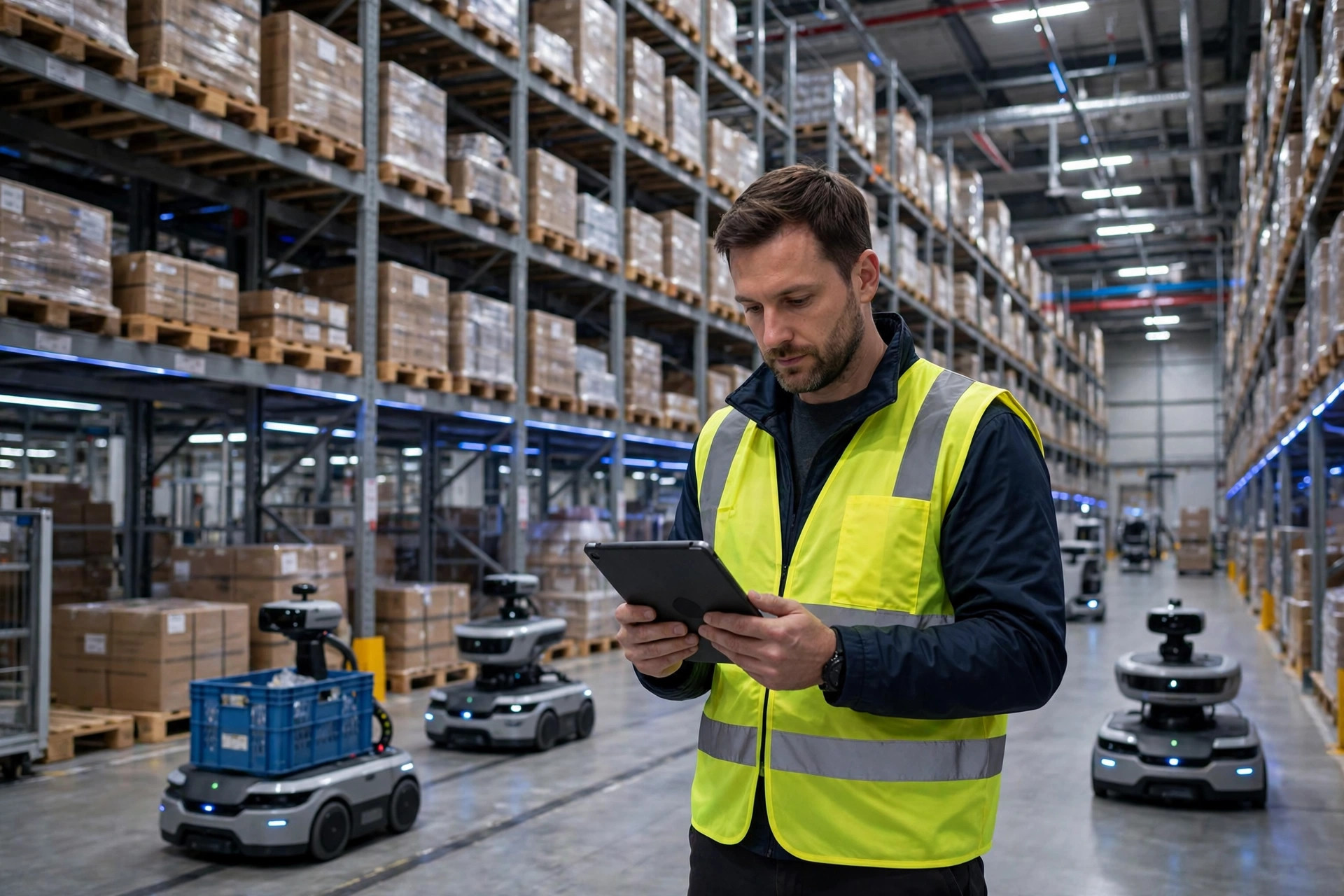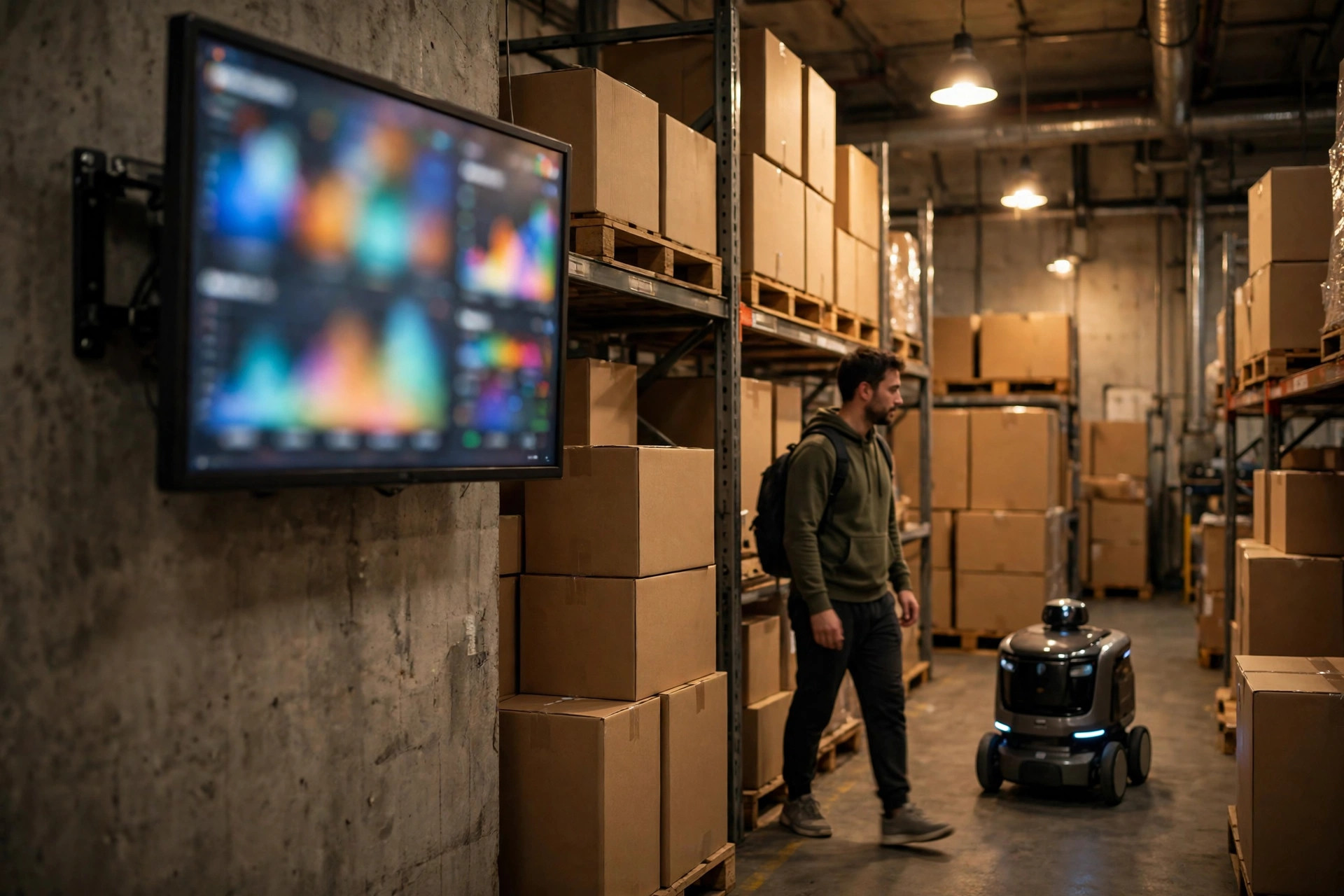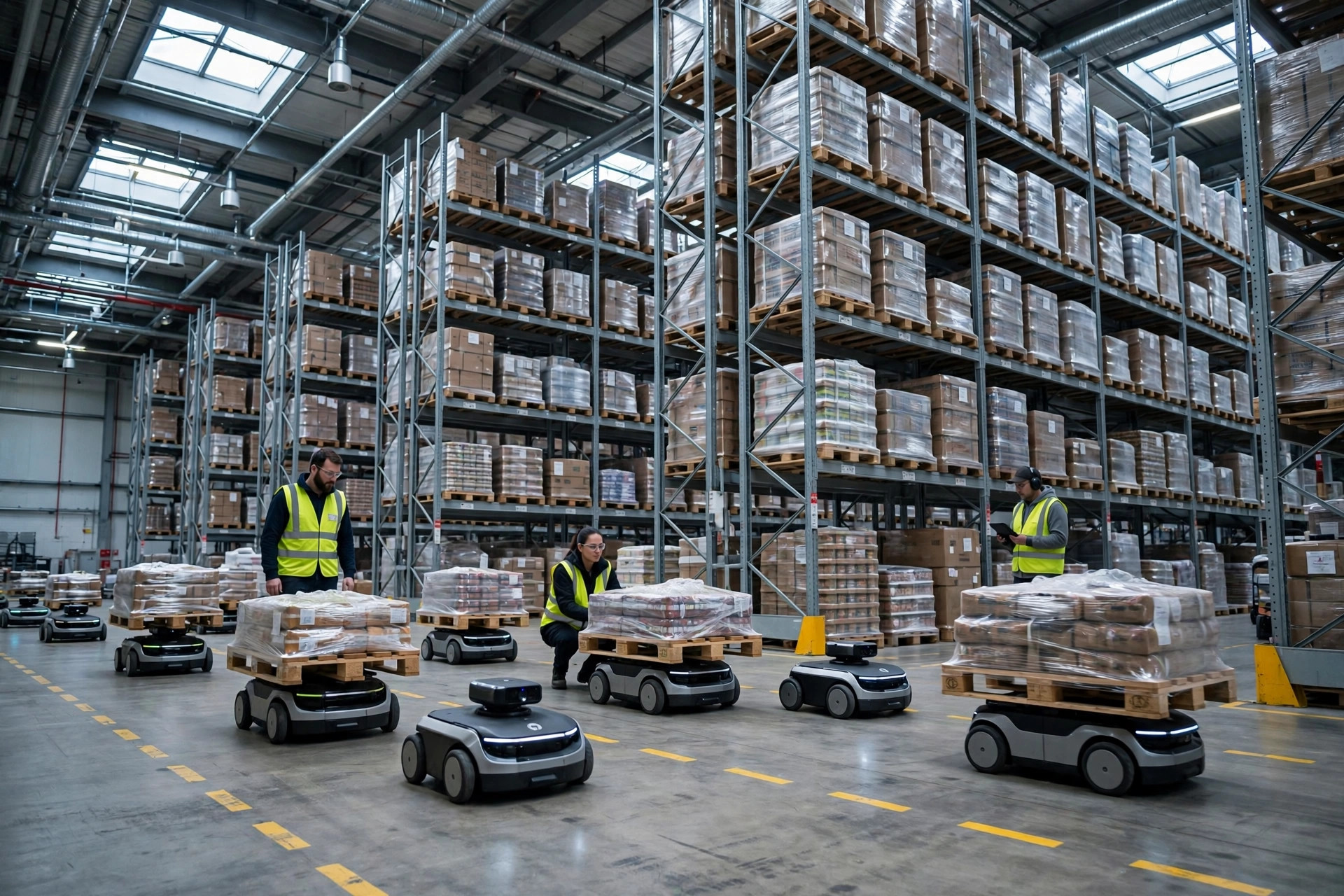
The terms Copilot and Autopilot mark two ends of a spectrum: the human drives while the AI suggests, versus the AI drives while the human watches the dashboard. One reason warehouse AI discourse feels muddled in 2026 is that people using the same word — "AI" — often mean entirely different levels of autonomy: one person means a chatbot that looks up inventory, another means a scheduling system that runs a full shift alone. Borrowing the L1-to-L5 grading logic the autonomous-driving industry worked out years ago, and applying it to warehouse AI autonomy, clears up a surprising number of arguments, because it forces the conversation onto a shared scale.
Warehouse AI Autonomy Can Also Be Graded in Five Levels
The definitions first:
L1 — Information assistance. The AI only supplies information; it makes no decisions. Ask "what was this SKU's outbound volume last week" and it pulls the number; or turn a 300-page SOP manual into Q&A so a worker can look up the freezer-zone power-outage procedure.
L2 — Decision recommendation. The AI analyzes data and proposes a plan, but execution requires human sign-off: a replenishment engine lists "37 SKUs recommended for replenishment today," and tasks are created only after a supervisor checks the boxes.
L3 — Conditional autonomy. The AI executes on its own within clear conditions and boundaries; humans handle only the exceptions it escalates. A wave-scheduling system runs waves automatically at fixed times, escalating only on stock shortages or order-priority conflicts.
L4 — High autonomy. The AI runs an entire shift or process; humans exist only as exception handlers. Picture a night-shift warehouse where receiving, QC, putaway, replenishment, waving, and shipping are all system-driven, and staff only process escalated exceptions.
L5 — Full autonomy. The AI does planning, not just operations — network layout recommendations, long-term labor planning, equipment investment decisions, the things a VP of Operations does today.
One key assumption from the autonomous-driving experience: the jumps between levels are rarely linear — each level's barrier sits in a different dimension from the last.
From Copilot to Conditional Autonomy: Where Each Level Really Stands in 2026
L1 is fairly mature in 2026: per publicly available industry research, LLM-based warehouse knowledge assistants have reached meaningful pilot coverage among 3PLs and manufacturers, and answer accuracy on structured-data queries is generally usable. The bar is clear — connect the data sources, get permissions right, and it works. But the L1-to-L2 barrier is not the model; it is trust. The most common failure mode reported in 2026 is not wrong answers but non-use: workers go back to asking the veteran on the floor, because the assistant's answers still need double-checking in the system — no time saved.
L2 is where deployment density is highest in 2026. Public reporting shows mainstream WMS vendors and 3PL digital teams concentrating here: replenishment recommendations, wave-combination suggestions, and exception alerts ("this order may miss its promised cutoff") are the three most frequent use cases, and their value is the easiest to quantify. But L2 has a crisp boundary: the AI can recommend but cannot execute across systems, because it has no write access.
Observation one comes from a real 2026 case at a 3PL in South China — a textbook L2-to-L3 integration trap. Its L2 replenishment tool had run well for half a year when management approved an upgrade to automatic execution. The blocker was surprisingly mundane: the WMS API exposed only query permissions, with writes routed through an OA approval workflow; the order system's inventory-adjustment API documentation was three years old, with mismatched fields; and IT, citing security policy, refused to grant the AI service write access. None was large alone, but together they delayed the upgrade by over four months, and the company settled on a "semi-automatic" interim: the AI generates execution orders, a human clicks confirm. The lesson: the L2-to-L3 barrier is integration permission, and that is never a technical problem — it is an organizational and security-governance one.
L3 is in early commercial deployment in 2026. Per customer stories shared at industry conferences, L3-level automatic wave scheduling is running in some large distribution centers; publicly quoted figures cluster around "wave-plan generation time cut from hours to minutes, exception-escalation rates in the single digits" (per vendors' public disclosures; actual numbers vary by site). One consistent feature: these cases are almost all in highly standardized facilities — simple SKU structures, stable order patterns, automation already in place.
Observation two comes from a 2026 L3 wave-scheduling pilot at an e-commerce warehouse in East China. An AMR vendor shared the site's data at a spring industry summit: wave-plan generation time fell from roughly two hours to under twelve minutes, with escalation rates around 5% in stable periods (per the vendor's public disclosure). Then, in week three, a promotional replenishment surge changed the order mix abruptly. The system kept running in normal mode; the anomaly detector never fired; by the time a human noticed, the adjustment window had closed. The post-mortem was not that the model was weak — it was that the definition of "anomaly" is itself dynamic: normal during a promotion and normal on an ordinary day are two different worlds. This is the L3-to-L4 barrier: completeness of exception handling. L3's logic is "I handle the normal, you handle the abnormal." The clearer the boundary conditions, the more reliable the escalation; the fuzzier they are, the more fragile L3 becomes.

L4 in 2026 remains in closed-scenario pilots. A handful of newly built, fully automated facilities (AMR plus automated sortation plus vision-based QC) approach L4-style operation during specific windows such as night shifts — but these sites were designed for autonomy from the ground up. Publicly documented L4 retrofits of existing warehouses are essentially nonexistent.
Which Processes Reach L4 First: A "Structure × Cost of Error" Framework
To judge which processes reach L4 first, I use a two-dimensional framework: task structuredness × cost of error. The horizontal axis is how structured the task is — well-defined inputs and outputs, clear rules. The vertical axis is the cost of getting it wrong.
L4 will arrive first in the "highly structured, low cost of error" quadrant: in-warehouse replenishment task generation, empty-pallet dispatching, cycle-count planning. The rules are clear, and a mistake wastes at most some labor hours — a trial-and-error cost companies can absorb. The "low structure, high cost of error" quadrant — receiving QC dispute adjudication (whose fault is this damaged freight?), priority arbitration for key accounts — will not reach L4 soon, because the cost of error includes the business relationship, and that is not something an algorithm can afford to lose.
One corollary: the same process can sit in different quadrants at different companies. At a standardized warehouse with 200 SKUs, wave scheduling is highly structured; at a 3PL with 50,000 SKUs and a 60% long tail, it may be low-structure. So "has our warehouse reached L4?" can only be answered process by process and site by site — no warehouse is at L4 overall.
Why L5 Is a Liability Problem, Not a Technology Problem
L5 means planning-level autonomy: network layout, labor planning, equipment investment — the VP of Operations' job today. My judgment is explicit: L5 is not a technology problem; it is a liability problem.
Suppose that in 2028 a system autonomously decides to "build a new 200,000-square-foot facility in Dallas," and the decision turns out wrong, with losses in the tens of millions of dollars. Whose fault is it — the algorithm vendor, the implementer, or the executive who signed off? The 2026 insurance and contracting system is not prepared for this: existing technology liability coverage covers "system malfunction," not "the system made a bad business judgment." Until liability attribution, insurance products, and contract terms are all in place, L5 will not be genuinely switched on, even if the technology is ready. That is a judgment, not a forecast: technology can arrive early; the liability regime cannot.
So the more productive question may not be "when does L5 arrive" but "what preconditions does the liability regime need." The autonomous-driving industry's path is instructive: before L4 robotaxis hit public roads came testing-permit frameworks, accident-liability rules, and dedicated insurance products. Warehouse AI's L5 will very likely travel the same road — rules first, deployment second.
Back to the taxonomy itself: its value is not in predicting which year brings which level, but in giving the industry a shared language. When a vendor says "our system is AI-autonomous," you can ask: is that L2 recommendation or L3 conditional autonomy? When a 3PL says "we go L4 next year," you can ask: L4 for which process, and which cell of the cost-of-error matrix?
One open question worth watching: the L3-to-L4 jump may be discontinuous rather than gradual — L4 demands a full shift with no human intervention, so the org chart has to change too. Does the night-shift supervisor role still exist? Most L3 pilots visible in 2026 are still staffed as L2, and that may be a bigger hidden barrier than the technology. Will 2027 produce the first publicly claimed L4 milestone at a retrofitted warehouse? If it does, how its exception-handling team is staffed will be more instructive than its technical details.
By Dr. Chen, Supply Chain Researcher