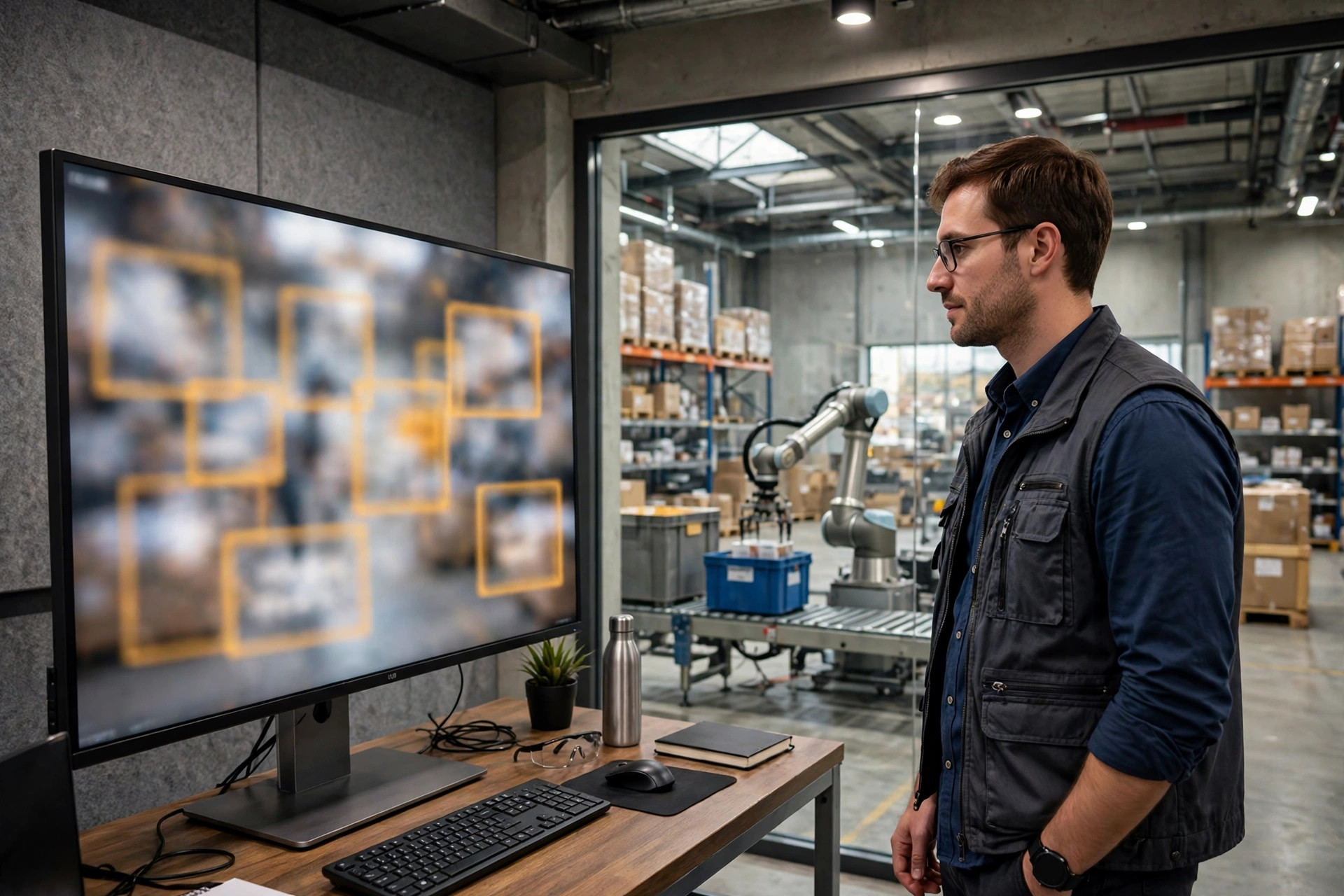
I learned the term "active learning" the hard way — staring at a labeling quote for 12,000 yuan. Last year a vision vendor came by and pitched AI verification on our sort line. "The hardware is cheap," they said. We run a 3,000-square-meter warehouse. We can't afford "cheap." My scam radar went off immediately. And sure enough, the real bill came later: 20,000 SKU photos, each needing a hand-drawn bounding box. The outsourcing quote was 0.6 yuan per image — 12,000 yuan total, rework not included. The camera cost a fraction of that. The labeling bill tripled it.
The infuriating part? After it was done, I realized the model already knew half those images. "This is a carton." "This pallet is empty." Why did a human need to label those? We paid good money for questions the AI already knew the answers to. That day I started wondering: what if the AI only handed us the questions it couldn't answer, and humans only labeled those? Turns out that trick has a proper name. It's called active learning.
First, our predicament: the labeling bill costs more than the camera
Here's how the math works on warehouse AI: hardware is the small money, a one-time purchase. Data labeling is the bottomless pit — every SKU change or packaging refresh means another labeling round. Big companies label datasets like it's nothing. For a small warehouse like ours, 20,000 SKU images at 0.6 yuan each is 12,000 yuan, and half of it turns out to be busywork. That one hurt.
Think of it this way: it's like hiring a tutor who makes your kid copy the entire workbook three times. Money burned, time gone, grades unchanged — because the kid copied the easy problems three times and still can't do the hard ones. Traditional labeling works exactly like that: grab a random pile of images, label everything, regardless of whether the model needs them.
Active learning flips it: let the AI be the tutor who knows how to pick problems. The model scans the unlabeled images first and scores each one by how unsure it is — the shakiest images go to humans first. Retrain, pick the next shakiest batch, repeat two or three rounds. Think of it as the AI's own mistake notebook: no grinding the whole workbook, only the problems it got wrong.
The actual process is embarrassingly simple. Step one: photograph everything, label nothing — photos are free once the camera's mounted. Step two: randomly label a small seed set, say 300 images, so the model has a starting point. Step three: the model pulls out the batch it's least sure about, humans label those, retrain, repeat. Two to three rounds and you're done.
How we did it: 800 labels beating 3,000
That's exactly what we did on our sort-line verification project. After the 300-image seed set, the model ran once and pulled 500 images it was most unsure about — mostly two lookalike SKUs, reflective pouch packaging, and stacked cartons with occlusion. Our veteran warehouse keeper labeled them in two afternoons. Retrain, and accuracy jumped. One more round of 300 hard cases. Total: about 800 images labeled, under 1,000 with rework — and verification accuracy matched what we'd previously gotten from 3,000 randomly labeled images. Labeling cost dropped from 12,000 yuan to under 600. The project survived.
Here's the counterintuitive takeaway, worth its own paragraph: more labels is not always better. That's an illusion. What matters isn't image count, it's the concentration of hard cases. Randomly labeling 10,000 images of "this is a carton" teaches less than carefully picking 1,000 images of "wait, is this SKU-A or SKU-B?" You think you're feeding the AI; really you're stuffing it with repeats it already digested.
And it's not just our luck. There's a published experiment worth citing: with 500 images, no active learning means labeling all 500. With uncertainty sampling, the model escalated only 132 uncertain images for human review — and the error rate barely moved. That's roughly a 75% cut in labeling. But here's the fun part: crank the threshold too aggressively, escalate only the 60 most uncertain images, and error goes back up. A mistake notebook can't contain only the three hardest problems; you still need the basics. Balance matters.
The full comparison:
| Approach | Labels | Cost (at 0.6 yuan/image) | Catch |
|---|---|---|---|
| Label everything, randomly | 20,000 images | 12,000 yuan | Tons of duplicates, slow |
| Active learning | ~800–1,000 images | ~500–600 yuan | A few extra training rounds |
Should you try it? I use a three-question test. One: more than 5,000 images? Two: more than 20 SKUs or categories? Three: are your labelers reliable? If either of the first two is yes, it's worth trying. If the third is no — hold on, read the next section first.
But here's where it blows up
To be fair, active learning isn't magic. It fails in three scenarios, and it fails ugly.
First: sloppy labelers. If the "mistake notebook" copies wrong answers, the AI gets confidently wrong — the more active, the worse. We lived this: our keeper mixed up two lookalike SKUs on a dozen images, and the model learned the mistake with total conviction. Before starting active learning, run a consistency test — 100 images, two people, cross-check. If they disagree, train the humans first. Don't blame the AI.
Second: SKUs churning too fast. Peak season hits, the SKU mix turns over, packaging changes — yesterday's hard cases are all obsolete today. Where data distribution drifts fast, active learning can't keep up; the freshly trained model is outdated on arrival. In that scenario, either label a full batch honestly or wait until the mix stabilizes.
Third: extreme long-tail oddballs. That weird-shaped package showing up twice a month? The model never gets "unsure" about it — too few samples to even make the shortlist. Those need manual top-ups: a human picks them out and labels them deliberately. Don't expect the model to discover them on its own.
And one honest confession: big companies can afford to label everything. We can't — and being forced to count every penny accidentally landed us on the textbook approach. Call it poverty-driven innovation. Call it small-warehouse survival wisdom. Their "brute force wins" playbook was never ours to copy, and that's fine.
Small warehouses have their own way of surviving. Don't compete with big players on data volume. Compete on how valuable your data is. Next time someone tells you "label 50,000 images first, then we'll talk," ask them one question: how many of those 50,000 does the AI already know? Once you ask that, you'll know exactly whether that 12,000-yuan bill deserves to exist.
By Xiao Ma, Small Warehouse Owner