Let me tell you how we used to do warehouse access control in our little warehouse: we didn't. A padlock on the front door, another one on the racking area, and the keys hanging off somebody's belt loop. That was the whole system. It worked fine right up until the week it spectacularly didn't, and that week taught me more about security than any sales brochure ever will.
It was the hottest week of last summer, and we had two temp workers in to push through a wave of e-commerce orders. On their third night, our night-shift guy noticed two cartons of earphones missing from the high-value zone. We pulled the camera footage: just after 1 a.m., someone badged in with Lao Wang's card, strolled into the high-value area, and walked out the back door with a carton under each arm. The card was Lao Wang's. The person was not. The card had been borrowed over lunch and nobody thought twice about it. We called the police, reviewed hours of footage, and changed every lock cylinder in the building. The goods never came back. What stuck with me was the simplest lesson in security I have ever learned: a badge reader checks the card, not the person holding it. The moment the card leaves its owner's hand, your door is effectively open.
Warehouse Access Control, Priced Out: Badge vs Fingerprint vs Face
After that mess, I did what any small warehouse owner does when a vendor starts talking: I went shopping, and I asked exactly three questions about every system. How much does it cost? Who fixes it when it breaks? And will my crew actually use it? The salespeople hated the third question most, which told me everything.
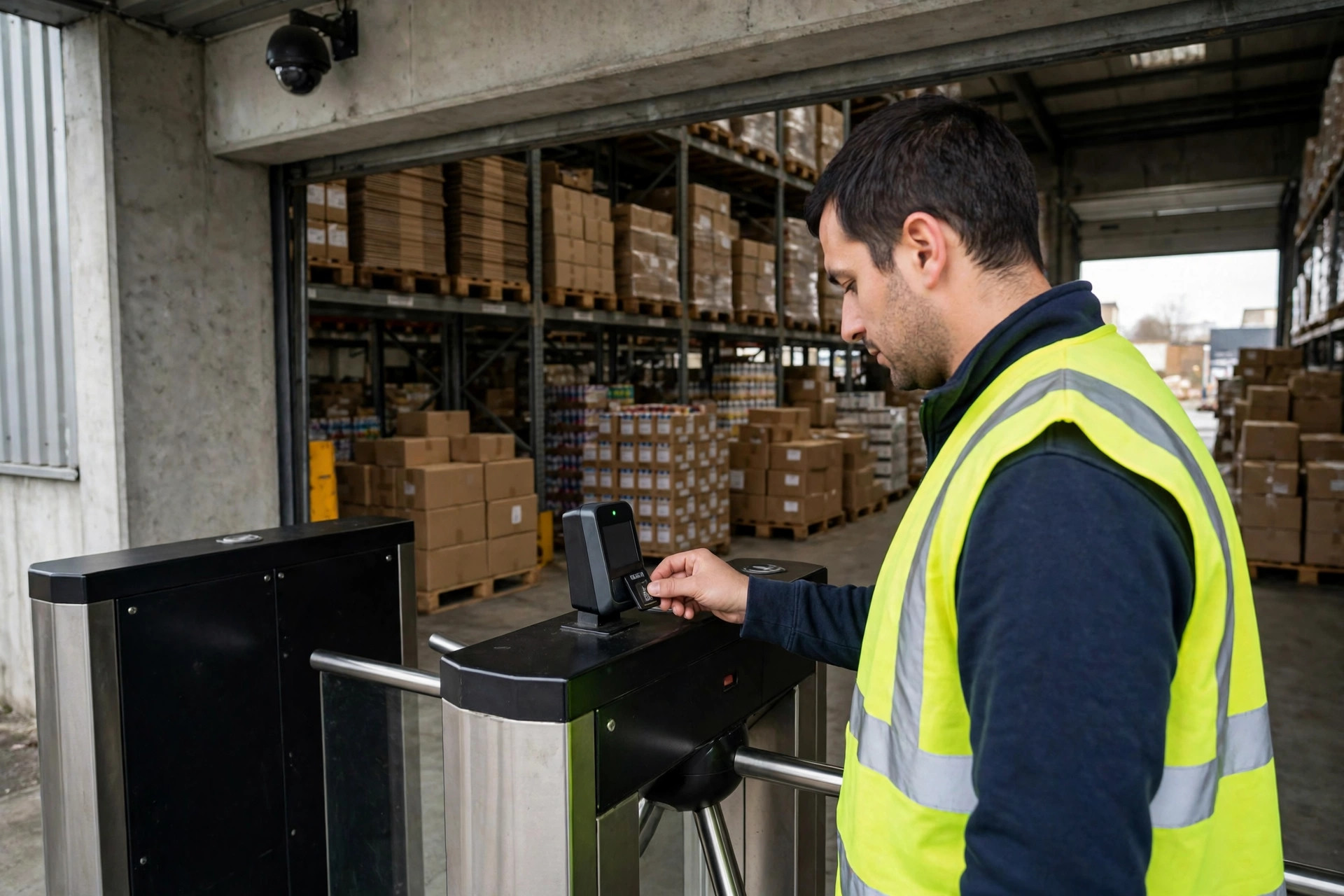
Badges are the cheapest and the most familiar. A card costs next to nothing, and a reader plus controller for one door runs in the low four figures in local currency. Tap and you're in, nobody complains. The flaw is the one we already paid for: cards get lent, lost, and copied, and if you forget to collect one from someone who quits, you have handed a former employee a key.
Fingerprint readers sound like an upgrade, and they cost roughly two to three times a badge setup per door. But here is our reality: warehouse hands are dusty, sweaty, and in winter, cracked. The reader fails, the worker tries again, and a queue of a dozen people forms at the door during the morning rush. And what does a queue produce? Someone holds the door and everybody else files in behind them. That is tailgating, and it is harder to stop than a borrowed badge, because now nobody badged in at all.
Facial recognition is the fanciest option, and the price tag knows it: several times a badge system per door, plus an annual platform fee that never goes away. We are a small warehouse; we cannot burn that kind of money on a door. And warehouse lighting is a nightmare for cameras anyway: bright at the dock, dim in the aisles, everyone in a cap or a mask, dust on their faces. Then a worker asked me where his face data would live, and I realized I did not have a good answer. A machine that fails is embarrassing. A boss who cannot answer that question is in worse trouble.
I put the comparison on the wall of our office, and I still point vendors at it before they start their pitch:
| Option | Rough cost per door | Biggest weakness | Best fit |
|---|---|---|---|
| Badge only | Lowest, four figures | Cards get lent; uncollected cards stay live | Stable crew, few restricted zones |
| Badge + PIN | Only slightly more | PINs get shared between friends | Small warehouses patching the biggest hole cheaply |
| Fingerprint | Mid-range, 2–3x badge | Dirty or sweaty hands fail; queues at peak | Clean-handed office areas, small headcount |
| Facial recognition | Highest, plus annual fees | Lighting, masks, and caps trip it; ask where data lives | Big budgets and image-conscious facilities |
Here is the counterintuitive part, and it is the whole point of this article: for a small warehouse, the most expensive option is not the most secure one. The most secure setup is usually the unglamorous combination of badge plus PIN plus a camera. Because the real enemy of warehouse access control is not weak technology, it is human convenience: borrowed cards, held doors, shared PINs. No scanner, however expensive, fixes people being people. Only process does that.
Our Warehouse Access Control Setup: A Cheap Combination That Actually Works
Our final setup would make a security vendor laugh, and I do not care, because it works and it was cheap. We split the building into three tiers instead of treating every door the same.
Tier one, the front door and the office area: badge plus PIN. You tap your card and punch in a four-digit code only you know, so a borrowed card is useless on its own. PINs rotate every quarter, and deleting a departing employee's access on their last day is an iron rule. Nobody gets to argue it, and I check it myself.
Tier two, the general racking area: badges with limited permissions. Temp workers' cards open the outer doors only. They cannot get into the high-value zone or the small room where we keep financial paperwork. Permissions should start narrow and loosen later if needed; handing out full access on day one and trying to claw it back later is how you make enemies.
Tier three, the high-value zone: badge plus PIN plus a camera over the door. The camera does not do facial recognition or anything clever; it just watches the doorway, and the footage stays on a local drive that overwrites itself when full. Nothing goes to a vendor platform. Who entered, at what time, and when they left: the log and the footage line up, and that is enough.
Two months after we switched, the system earned its keep. A former employee who had quit the previous week came back with a card he had never returned, hoping to slip into the high-value zone to collect some things he claimed were his. His card was already dead, the door did not budge, and the camera recorded the whole visit. He never came back. Add up all three tiers and the total still came in under the price of a single facial-recognition door, and we got the three things that actually matter: borrowed cards are useless, tailgating gets seen, and departures are covered.
What I Would Tell Another Small Warehouse Owner
If you run a small warehouse, do access control in this order, and do not start by comparing spec sheets. First, draw your zones: which doors genuinely need to be strict, and which ones can stay loose. Buy hardware only after that map exists. Second, write down the departure rule — access deleted on the last day, posted on the wall — because that one procedure is worth more than the most expensive lock on the market. Third, pick the cheapest gear that covers the risk: badge plus PIN where a badge alone fails you, a camera where you need a record, and save biometrics for the day you actually have a problem they solve. For product-specific compliance and data-handling rules, check the latest official guidance rather than taking a salesperson's word for it, and get any data promises written into the contract.
One more thing people forget: the stricter the door, the slower the morning. If every worker loses five minutes a day at a turnstile, that adds up to dozens of lost hours a year. So be strict where it counts — the high-value zone, and after hours — and relax everywhere else during normal shifts. Security and speed are not a choice between two extremes; the sweet spot in the middle is where small warehouses survive.
After all this fuss, my takeaway is simple. Big companies talk about access control as a system and a brand statement. We talk about it as three things: no incidents, someone to find if there is one, and a bill that does not make us wince. Cards get lent, faces get misread, fingerprints fail on dusty hands. Once you accept those flaws, a cheap combination guards the door just fine. Small warehouses have their own way of living, and on access control, good enough, working, and affordable is the best system there is.
By Xiao Ma, Small Warehouse Owner