Last year at a food distribution DC outside Chicago, the picking supervisor pointed at the 99.7% accuracy number on the wall and asked me: "Da Liu, our RF setup works great — isn't voice picking just a solution looking for a problem?" I didn't answer directly. I asked him for three numbers instead: the fully loaded cost of one mispick, the annual wage of one picker, and the quote for one voice picking station. Put those three numbers side by side and the answer writes itself. This article tears the voice picking vs RF scanning debate down to first principles, hard data, and the selection boundaries nobody talks about.
Start With the Physics: Ears Working, or Eyes Working
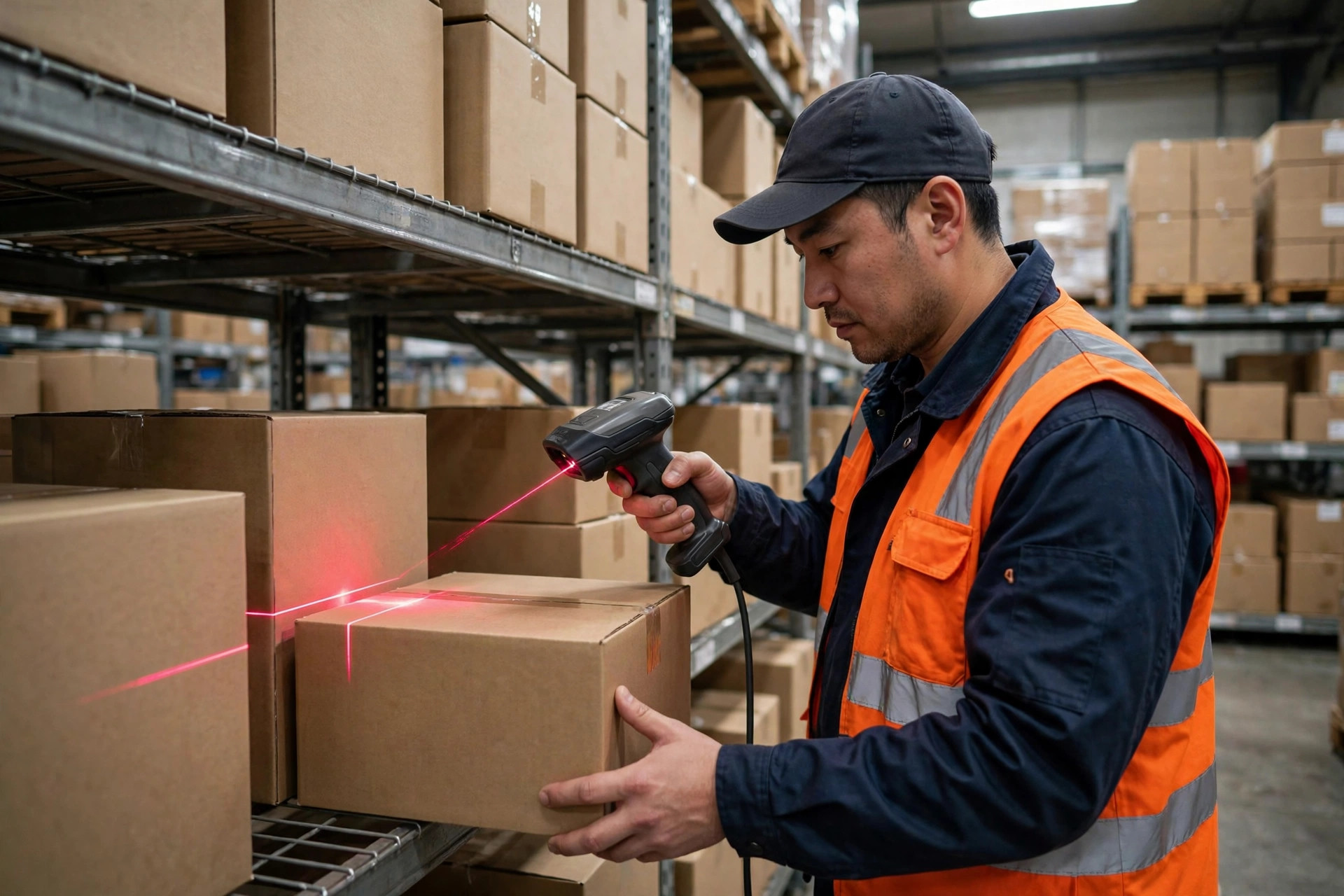
RF scanning is fundamentally "eyes plus hands": read the screen, scan the location barcode to confirm position, grab the item, scan the product barcode to confirm identity. Every step carries an optical confirmation. Think of it as "look, then act."
Voice picking is fundamentally "ears plus mouth": the headset tells you the location, you walk there, speak the check digit printed on the location label to confirm position, grab the item, speak the quantity to confirm. Both hands stay free the entire time; your eyes only hunt for product. Think of it as "listen, then confirm out loud."
Here's the analogy I use with clients: it's like driving. RF is driving with your eyes on the navigation screen; voice is driving with turn-by-turn audio. Eyes-on is more precise, audio is faster — but only if you trust the route, the instructions are accurate, and the road isn't a mess.
The Three-Dimensional Scorecard: Voice Picking vs RF Scanning on Accuracy, Speed, and Cost
Hard numbers first. Every vendor figure below is attributed to its published source; use the conservative end for budgeting.
| Dimension | RF Scanning | Voice Picking | Source |
|---|---|---|---|
| Pick accuracy | 99.5%–99.7% is typical | Up to 99.9%; even DCs already at 99.9% with RF cut errors by 50%+ more with voice | Lucas voice selection guide, published figures |
| Accuracy gain vs RF | Baseline | Up to 25% improvement | Honeywell voice white paper, published figures |
| Productivity gain vs RF | Baseline | Published up to 35%; budget conservatively at 15%–25% | Honeywell voice white paper, published figures |
| Hardware per picker | Rugged handheld around $3,000 per unit | Voice headset roughly $2,000–$3,000 per set, plus software licenses | Industry published price ranges; check current vendor pricing |
| Fully loaded cost | Lower tier (device + implementation) | $4,000–$8,000 per picker including software, implementation, and training (early industry figures) | Industry media reports; current quotes per vendor policy |
The table makes voice look like a clean sweep. What the table doesn't tell you: first, those numbers come from DCs with their fundamentals in order; second, every point voice wins has a corresponding price tag.
Two Real Deployments: Where the Numbers Come From
Case one: a North American dental and animal-health distributor, 14 fulfillment centers, 25,000 orders a day, moved straight from paper to voice. Result: orders completed 25% faster, line error rate fell from 1 in 300 to 1 in 1,000, and new-hire training collapsed from "weeks" to "hours." (Source: Modern Materials Handling.) Note the baseline: they came from paper, so the gains look dramatic.
Case two: a food distributor that already ran RF and layered voice on top. Within two months, mispicks fell from above 0.1% to below 0.02% — an 80% reduction — and picking productivity rose 24% in the first year, with another 5%–6% annual improvement after that. (Source: Modern Materials Handling.) This one is the more honest reference point: it pins the real voice-over-RF gain at roughly the 20%–25% range, which lines up with Honeywell's published figures.
Case three takes me back to that Chicago food DC. They ran 8,000 lines a day at 99.7% accuracy — that's 24 mispicks a day. At a typical fully loaded mispick cost of $25–$40 (re-pick, reship, customer service, chargebacks), they were burning $600–$960 a day. Cutting the error rate in half with voice would save enough in a year to cover voice stations for about 20 pickers. That was the math I asked the supervisor to do himself.
The Counterintuitive Part: RF Can Slow Down Your Best Pickers
Two judgments the vendor sales reps will never volunteer.
First, RF can be a speed penalty for your top pickers. I've seen it more than once: the veteran who topped the UPH chart in the paper era, who knew every location by muscle memory. After RF went in, every location demanded a mandatory scan confirmation — three seconds to grab, two seconds to scan — and his UPH dropped 10%. RF isn't bad; the cost of the confirmation step just landed on the people who needed it least. Voice has the same dynamic: speaking check digits is a speed bump for veterans. So "the system improves productivity" carries a hidden condition — your crew needs enough rookies for the math to work.
Second, a voice check digit verifies the location, not the product. Two nearly identical SKUs in adjacent slots, picker grabs the wrong one — voice can't catch it, because the check digit was spoken correctly and the system thinks everything is fine. RF scanning the product barcode catches exactly that class of error. So "voice is more accurate" has a big precondition: your slotting discipline has to be clean, with look-alike SKUs physically separated. A sloppy DC that deploys voice just makes mistakes faster and more confidently.
The Selection Boundaries: Where Voice Picking and RF Scanning Each Belong
Stop asking "which is better" and ask "which fits my building." Three boundaries:
Order profile. Multi-line small orders — five-plus lines per order, heavy each-pick work — is where voice shines brightest. Case and pallet-dominant operations with under three lines per order? RF is plenty, and voice's ROI gets ugly fast. The rule is blunt: the more fragmented the pick work, the more voice is worth.
Noise environment. Sustained ambient noise above 85 dB — freezer fan rooms, next to packaging lines, on the dock — and voice recognition starts dropping. One misrecognition cascade and both speed and accuracy die. RF doesn't care about noise. Don't fight physics.
Catalog complexity. If your operation requires scanning serial numbers, lot codes, or expiry dates, RF is mandatory; the more verification dimensions, the clumsier voice's "speak to confirm" gets. Conversely, a catalog of visually distinct SKUs lets voice run at full speed.
And one shot at the fake requirements I keep seeing: location barcodes half-applied, no ABC slotting done, WMS location accuracy below 95% — and management wants voice as a "leapfrog." Wake up. Voice is an amplifier, not a corrective lens. Get your RF confirmation discipline solid first; when accuracy plateaus at 99.5% and won't budge, then voice is the legitimate next step.
The Maintenance Traps: Affordable to Buy, Expensive to Own
Principles and selection covered — now the maintenance traps, where most DCs actually bleed.
First, headsets are consumables. Snapped cables, moisture-dead microphones, cracked headbands — an industrial headset lives about two to three years. Budget 20%–30% of your deployed count annually for spares, and don't discover half your fleet has flaky contacts the week before peak season.
Second, software licenses are per-user annual fees. The upfront purchase is the down payment; the recurring per-head fee is the mortgage. Run your three-year TCO with the license renewals included before comparing against RF — the conclusion can flip entirely.
Third, every WMS field change forces a reconfiguration of the voice dialogue flow. Add a verification dimension, change the location coding scheme — RF needs a screen tweak, voice may need its dialogue scripts rewritten. Ask upfront who owns that hidden integration cost.
Fourth, seasonal temps. RF takes thirty minutes of training to get a temp productive; voice needs voice-template enrollment plus dialogue practice — half a day at minimum. In a DC with high labor churn, multiply that training cost by annual turnover and watch the number grow.
Whether the Money Is Worth It Comes Down to One Number
After all that, it converges on a single ratio: one picker's annual mispick savings, plus the value of the extra volume picked, divided by the annualized total cost of the voice station. Above 1.5, deploy with confidence. Below 1.0, get your RF process tight and your location accuracy above 99% first.
Technology selection was never about picking "the best" — it's about picking the best fit. Voice and RF are both excellent tools. The mistake is copying someone else's homework without checking your own fundamentals.
By Da Liu, Automation Engineer