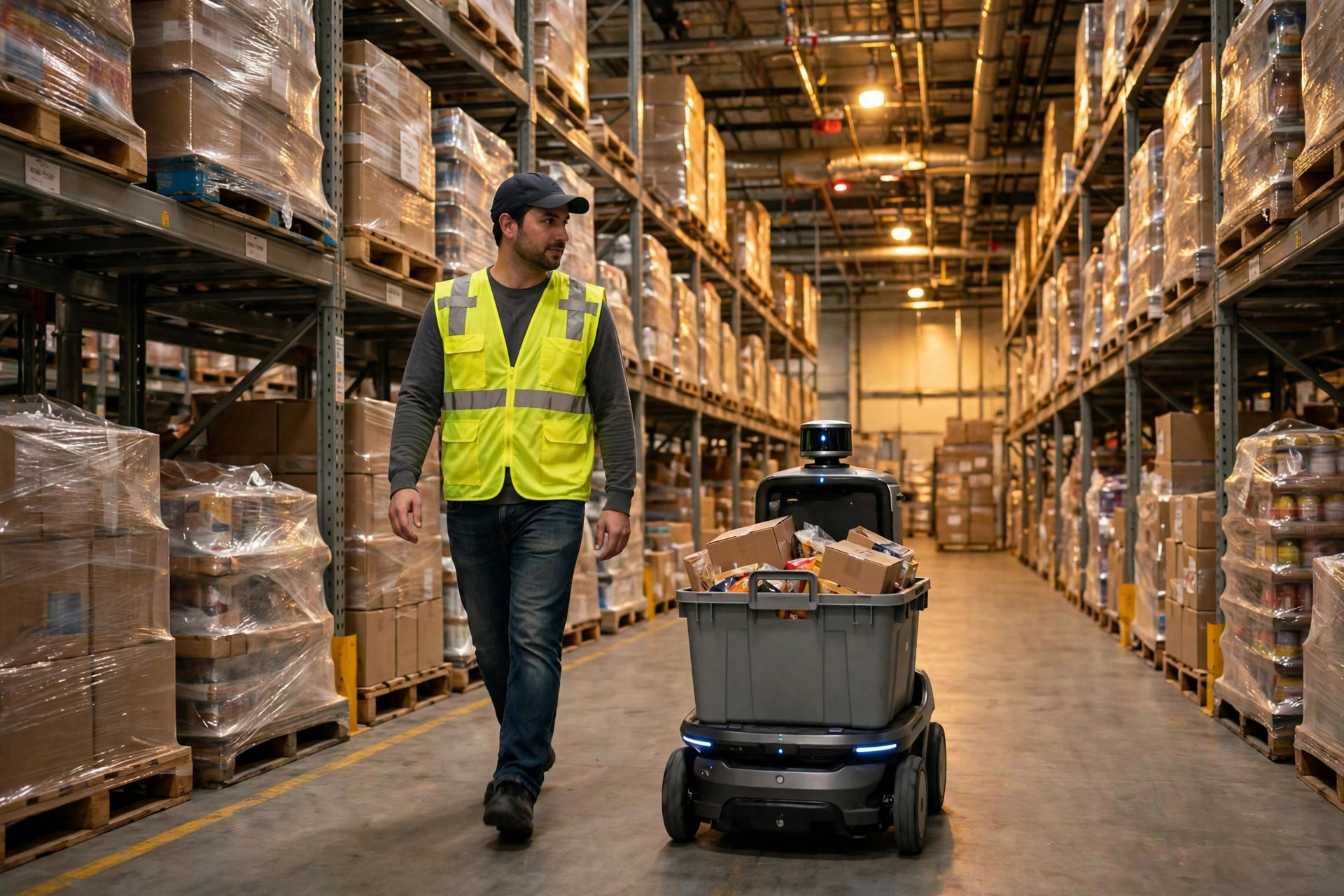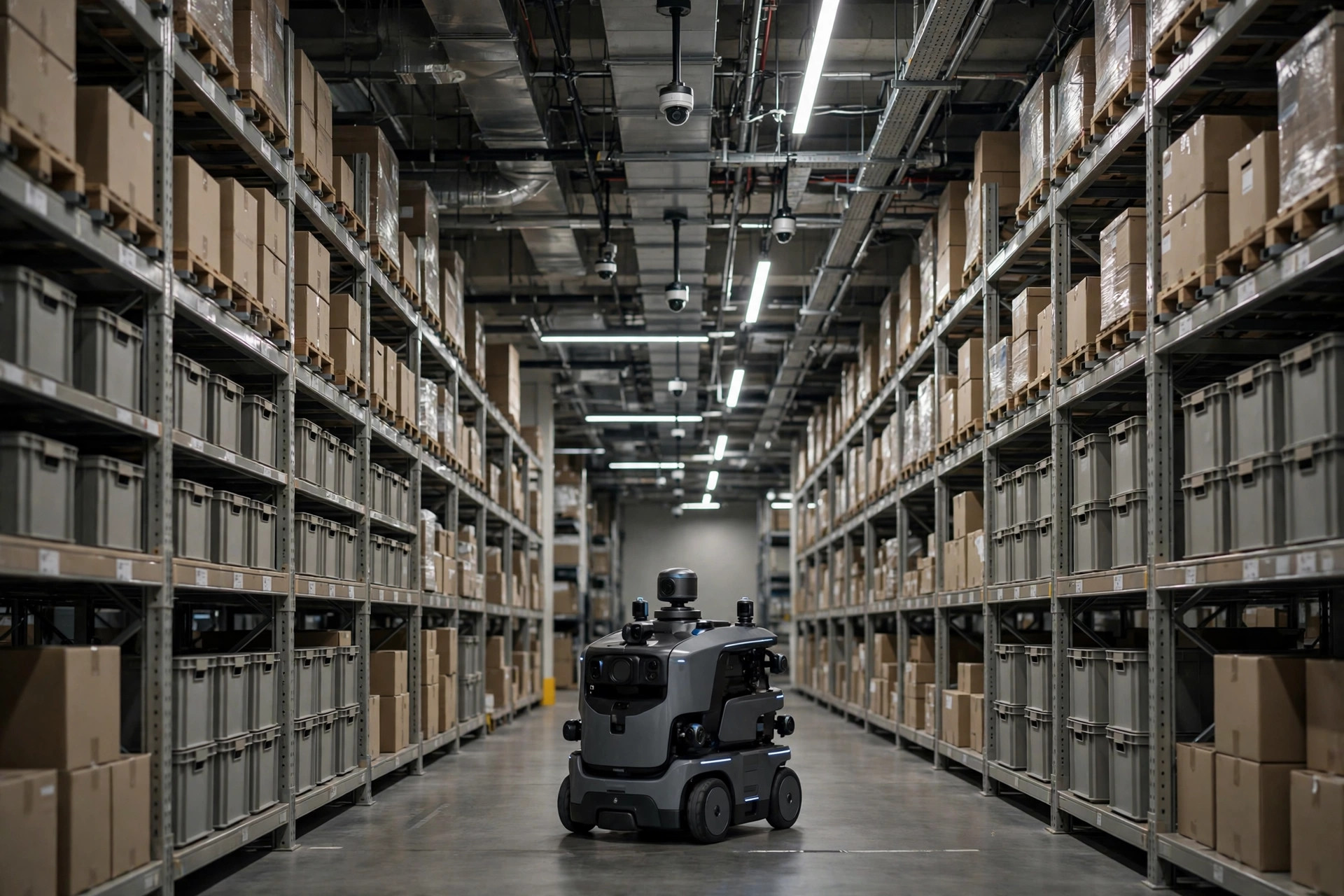
VLA models — Vision-Language-Action — can already take a spoken instruction like "take that pallet to Zone B," look at the scene, and figure out the moves on their own. Here's my verdict up front: the tech works in principle, but it's at least three hurdles away from carrying real warehouse volume — safety compliance, cycle-time precision, and total cost of ownership. Don't expect it to replace your dispatch logic before 2027. But put it on your technology radar now, because the first thing it rewrites isn't the scheduling algorithm — it's the interface between humans and machines.
What VLA Actually Is, in One Sentence
A conventional AMR runs on work orders: the WMS says "go to point A, pick, deliver to point B," and the robot follows a fixed script. Tip one pallet sideways in its path and it freezes. A VLA model feeds the camera feed and the natural-language instruction into one large model, which outputs the action sequence directly. One sentence: yesterday's robots performed a script; VLA lets them read the room, understand plain speech, and improvise.
This is no longer a research concept. Figure shipped Helix in February 2025, Google DeepMind has its RT line, Physical Intelligence has π0 — all VLA. Amazon has been piloting Agility's humanoid Digit for tote handling in its fulfillment centers since 2023, and Figure's robots ran material-handling pilots at BMW's US plant in 2024. Treat vendor specifics as "per their latest materials," but the signal is unmistakable: serious capital is betting on vision plus language plus action in one model.
I've Seen This Movie Three Times
Thirty-plus go-lives teach you the pattern. Act one: AGVs, a decade ago. The vendor demo ran buttery smooth, the client signed on the spot — and in week one a five-centimeter floor seam stopped the whole fleet cold. The demo hall had epoxy flooring; the warehouse had twenty-year-old concrete. Act two: the AMR hype wave. A 3PL owner came back from a trade show demanding "full lights-out." Three questions stopped him: who covers Wi-Fi roaming dropouts, who's liable when a robot blocks a fire lane, and what happens to charging queues when peak volume triples? Act three: vision picking. 99% recognition in the lab, 80% on the customer floor the moment SKUs changed and the lighting dimmed — and the takt time fell apart.
VLA is now running the same script for the fourth time. In the demo, an operator says "put the red carton on the conveyor" and the robot glides through it. In a real warehouse, the carton is taped shut crooked, half the label is scraped off by a forklift, and a pallet jack rolls into the aisle mid-task. Demos answer "can it." Go-lives answer "can it, every day, at 2 a.m., in December." I've seen this pitfall three times. VLA gets no exemption.
Three Warehouse Scenarios Where VLA Could Land First
Hype aside, three use cases have a genuine shot at landing first:
1. Voice dispatch for AMRs: the one-sentence re-task. Today's exception flow is: spot the problem, radio it in, a dispatcher edits the task in the system, re-dispatch. Long chain, easy to garble. The VLA version: a supervisor speaks into a terminal — "Unit 3, skip aisle C, there's water on the floor, reroute via aisle D" — and the robot understands and replans by itself. This doesn't replace the dispatch system; it hands the last mile of translating WMS instructions to the model. The win isn't a few seconds — it's exception response dropping from minutes to seconds.
2. Pick coaching: temps learn from the robot. Peak-season temp training is every warehouse's nightmare. One of my clients hired 40 temps for peak and burned two full weeks of capacity on training and error correction. A VLA robot can narrate as it works — calling out the SKU and quantity at each slot, correcting mistakes on the spot. Every rookie gets a tireless mentor.
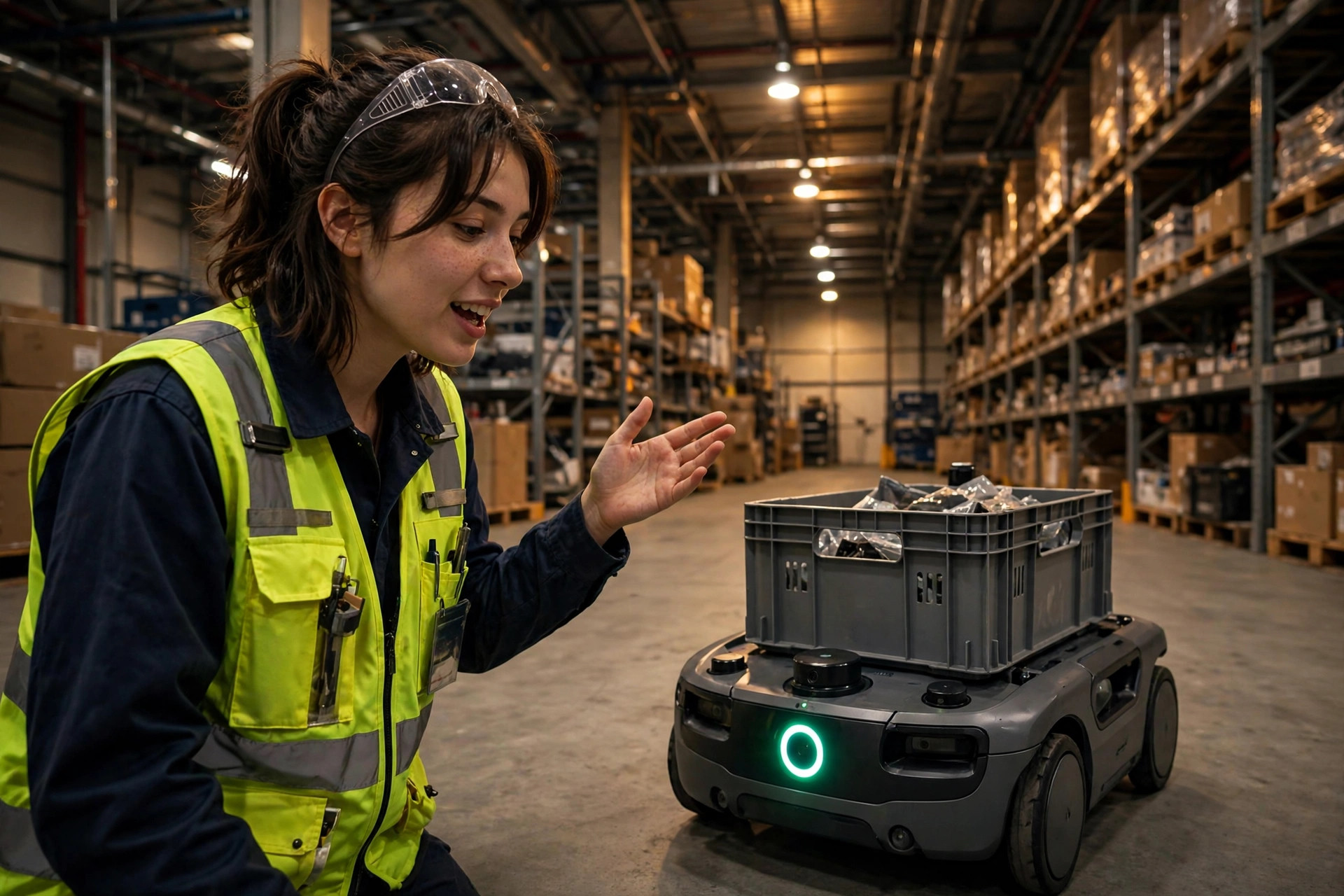
3. Closed-loop exceptions: when it's stuck, it calls for help. Today a stuck robot is a dead robot until someone walks over — ten-minute stoppages are routine. A VLA robot can describe its own situation: "I'm blocked by a fallen empty pallet, there's clearance two meters to my left." A remote human replies "go around on the left," and it moves. Downtime goes from "wait for a person" to "one sentence."
The Night-Before-Go-Live Checklist: Five Readiness Tests
If a vendor tells you today that their VLA robot is warehouse-ready, pull out my go-live checklist and score each item 0–2. Below 8 out of 10, don't talk pilots:
- Safety fencing (2 pts): Is there a hard constraint layer independent of the model? Large models hallucinate. If it misreads an instruction and drives at a rack, is there a separate e-stop and electronic fence? Fail this and the rest doesn't matter — it's the first question OSHA and your insurer will ask.
- Latency budget (2 pts): From spoken word to robot motion, what's the end-to-end delay? Cloud inference runs hundreds of milliseconds to seconds; AMR obstacle avoidance needs millisecond response. Ask directly: does inference run on-device or in the cloud? If the network drops, does the robot stop or degrade gracefully?
- Exception fallback (2 pts): What happens when the model is unsure — does it stop and wait, or "guess" and keep going? In a warehouse, a wrong guess can mean a smashed rack bay. You need a confidence threshold plus a human-takeover chain, written into the SOP.
- The cost math (2 pts): What's the per-unit premium? Don't stop at the price tag when you run TCO: the compute (edge chips or cloud inference fees), the network retrofit, and the hidden cost of maintaining a model version. I've watched too many projects die on "we could buy it but couldn't afford to run it."
- The data loop (2 pts): When the model makes a mistake in your building, does that mistake become a lesson it won't repeat? Is there field-data feedback and continual fine-tuning? Intelligence without a loop peaks on day one.
The Counterintuitive Call: VLA Replaces the Radio, Not the Dispatcher
Everyone asks whether VLA puts dispatchers out of work. My call is the opposite: VLA's first warehouse job is killing the translation layer between humans and machines, not the humans. A dispatcher's real value was never clicking "assign task" — it's judgment during exceptions. VLA automates the step of turning judgment into machine instructions, so one dispatcher covers a bigger fleet: twenty AMRs per person becomes sixty, because the "relaying messages" work got eaten by voice interaction.
There's a trade-off worth sitting with: VLA's generality and the warehouse's need for determinism pull in opposite directions. The more general the model, the less predictable its behavior; the warehouse demands "same instruction, same motion, every single time." So the realistic architecture for the next few years is a hybrid — VLA handles understanding and planning, battle-tested deterministic control handles execution. Pure end-to-end VLA at warehouse scale? I wouldn't bet on it before 2030.
A Timeline for Warehouse Owners: What to Do Now
My timeline (grounded in public pilot progress; treat vendor specifics as "per their latest materials"):
- Now through 2027: fenced pilots. Low-risk tasks like sortation and simple material handling, supervised, small batches. Talk PoC, don't sign big contracts.
- 2027–2029: narrow tasks at small scale. Fixed jobs inside safety fencing, with the first real ROI data. This is the window to evaluate a purchase seriously.
- Around 2030: watch the cost curve. Edge compute gets cheap enough, one or two lighthouse customers run a full year without incident — then we talk scale.
Three things you can do right now, in priority order:
- Put VLA on the tech radar and scan it quarterly. No budget needed — assign someone to track public progress from Figure, Agility, and Physical Intelligence.
- Fix your exception-response chain first. VLA amplifies your process capability; it doesn't substitute for it. A warehouse where the radio goes unanswered gains nothing from a talking robot.
- Scope any PoC to exception scenarios, not labor replacement. Have the vendor pilot on your most painful exception — say, night-shift stalls — and measure "downtime hours reduced." That's the only ROI number that holds up.
The technology will be late, but it won't be absent. VLA is still a distance from the warehouse floor, but the direction is right — verdict first: don't chase the hype, but don't miss the boarding call either.
By Lin Xiao, WMS Implementation Consultant