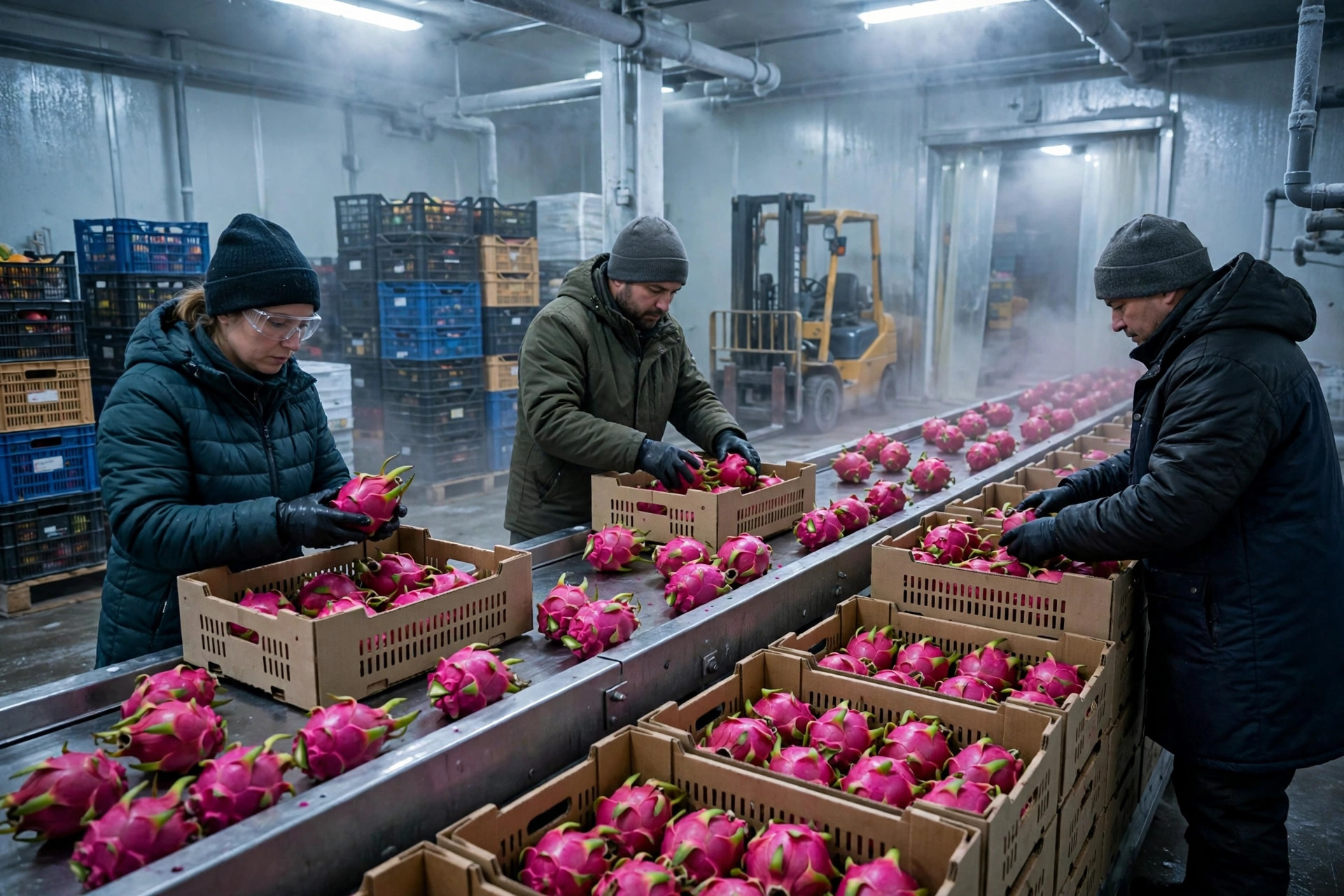
My warehouse is 3,000 square meters, which in this business counts as small. When peak season hits, trucks queue up outside my gate all the way to the neighboring factory. Last year a friend in fruit export asked me to handle part of his Vietnam dragon fruit export cold chain, and I said yes out loud while quietly panicking. Dragon fruit has thin skin, bruises easily, and hates being stuffy. One weak link in the cold chain and the whole container arrives at Cat Lai Port looking sorry for itself. A small warehouse like mine cannot afford to burn that kind of money. Big players throw equipment at the problem. Small players have to throw brains at it.
The First Lesson of the Vietnam Dragon Fruit Export Cold Chain: Pre-Cooling Is a Race Against Time
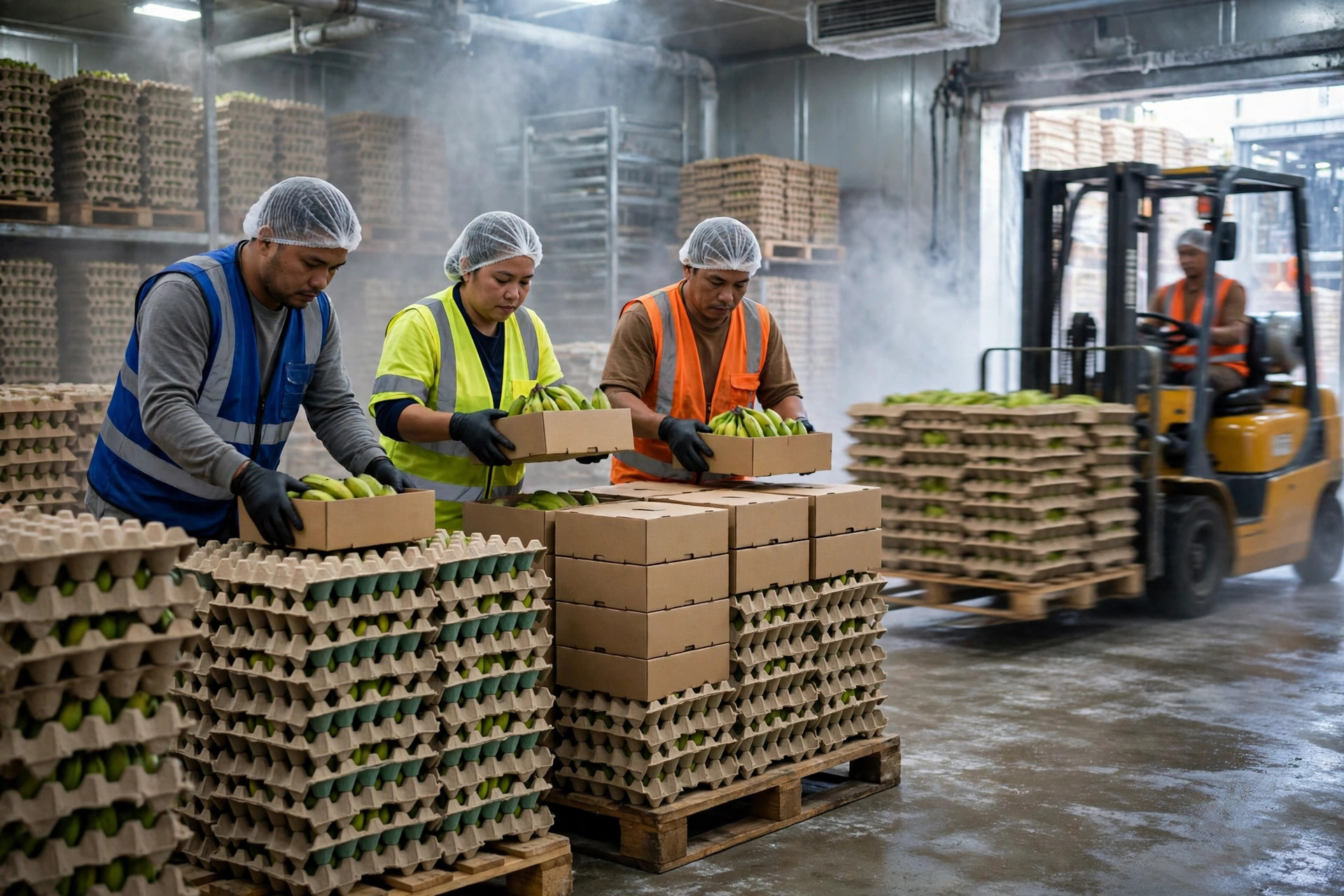
Here is the thing nobody tells you when you start: pre-cooling is not about making fruit cold. It is about getting field heat out fast, before the fruit starts working against you. Our low-budget method sounds almost embarrassing. Picking moves to early morning, before the sun gets serious. Harvested fruit rests in the shade for a while instead of baking in the sun. Once it reaches my warehouse, the pre-cooling room fans run full blast, blowing through the gaps between crates so every crate gets airflow, not just the ones on the outside.
I learned the gap rule the painful way. One crew, trying to save time, stacked crates wall to wall. The outside felt cool to the touch, but the crates in the middle were still warm inside. That shipment kept sweating on the road, humidity built up in the container, and the skins started going dull. After that I made a rule nobody is allowed to argue with: pre-cooling crates must leave air channels. Better to load a few fewer crates per run than to block the airflow. A small warehouse cannot afford rework. Doing it right the first time is the cheapest option there is.
Timing is the other half of pre-cooling. Fruit left sitting at ambient temperature loses quality by the hour. Our rule is simple: picked today, pre-cooled today, loaded today. No overnight waiting. That sounds like common sense, but it means coordinating the orchard, the trucking team, and my own crew, and if any one of them slips, the whole line wobbles. Small warehouses have one real advantage here: with a small team, one phone call reaches everybody.
Crush Damage: The Money You Save on Boxes Comes Back as Claims
Crush damage is where I paid the most tuition. Dragon fruit cannot take weight. Stack too high and the bottom layer deforms, fruit presses against fruit, one broken skin drags down the whole box. We started with softer boxes, and the bottom layer paid for it. My fix was not to buy the most expensive box on the market. It was to buy a stiffer box, add a soft liner inside, and cut the stacking height by one layer. People laughed and said I was giving away capacity. I showed them the math: the freight on those few dozen extra boxes costs almost nothing next to a damage claim and a lost customer. Which one is really expensive?
Loading the container has its own rules. Workers used to stack heavy boxes low and light boxes high, which sounds right, but if boxes sit flush against each other, cold air cannot circulate and the container turns into a stuffy box. We changed to leaving ventilation gaps between layers, so cold air can travel around the load, and added a cushion layer near the container door to absorb bumps when the door opens and closes. Damage dropped visibly after that one change.
Ventilation matters just as much, because dragon fruit gives off ethylene as it sits, and a sealed container basically ripens itself. The reefer vents must stay clear. Nothing gets stacked in front of them. Door seals get checked every single time. We do not own fancy monitoring gear, so we use a handwritten card on every container: loading time, sealing time, who checked the vents. The card costs nothing, but when something goes wrong, it tells you exactly who to ask.
One night during peak season I caught the rule being broken in real time. It was past two in the morning, the crew was rushing to finish, and someone had parked a stack of empty crates right in front of a vent, figuring nobody would see it once the doors closed. I found it on my night round and lost my temper on the spot. Block that vent and half the container loses airflow, leaving ethylene a cozy corner to build up. I made them unload and reload that container. It cost us over an hour. It passed inspection at the port without a single complaint. Since then, nothing gets stacked within a meter of a vent. Break the rule and you buy drinks for the whole crew. That is my Vietnam dragon fruit export cold chain warehouse rule: vents clear, every load.
A Small Warehouse Budget for the Dragon Fruit Cold Chain: What to Pay for First
Small warehouse money has to go where it hurts most. Here is the order I would spend in, based on what actually cost me money:
| Spending item | What we do | What it saves |
|---|---|---|
| Pre-cooling airflow | Leave gaps between crates, aim fans at the gaps | Fruit that stays cool to the core and does not sweat on the road |
| Boxes and liners | Stiffer boxes, soft liner, one less stacking layer | Damage claims, straight up |
| Vent checks | Clear vents, check door seals, card per container | A whole container lost to ethylene buildup |
| Loading gaps | Ventilation channels between layers, door cushion | Cold air that actually circulates, stable appearance |
Every line in that table was paid for with a real loss first. And here is the counterintuitive part: most people assume cold chain success means buying better equipment. Our experience says the opposite. Get the process right and modest equipment performs just fine. Get the process wrong and the most expensive reefer in the port will not save fruit that has already been suffocated. Equipment is the bonus. Process is the foundation.
There is also a genuine trade-off to be honest about. Thorough pre-cooling takes time, and the orchard side hates delays at loading. Our compromise splits the difference: containers heading out through Cat Lai Port on long routes get the full pre-cooling treatment, no shortcuts. Shorter transfers can trim pre-cooling slightly, but crush protection and ventilation never get cut. Different cargo gets different treatment. One rigid rule for everything is how you lose money.
Fresh and Frozen Are Two Different Businesses
Later we took on frozen fruit work, and that taught me something I should have seen sooner: in the Vietnam dragon fruit export cold chain, fresh and frozen are two entirely different lines. Fresh fruit is a race for freshness and appearance, with time pressure on every step. Frozen fruit is about stability and volume, where pre-processing, packaging seals, and steady freezer temperatures matter most. Run both lines with the same crew and the same rules, and people will mix them up. Ventilation rules for fresh fruit applied to the frozen line are just wasted effort.
My solution was to split the lines completely: separate shifts, separate ledgers, separate performance reviews. Splitting things up actually lowered my management cost, because when something goes wrong, you know immediately which line owns it. There is less arguing, too. In a small warehouse, clear division of labor beats everything else.
Advice for Other Small Warehouses
So can a small warehouse run a Vietnam dragon fruit export cold chain? Yes, but only by playing the small warehouse game. First, do not try to outspend the big players on equipment. Outperform them on process. Pre-cooling airflow, crush-proof boxes, and vent checks will cut your losses more than any machine will. Second, do not take more volume than you can handle. Start with what you can genuinely manage, and expand only when your crew can keep up. Taking orders for show and failing on delivery is the fastest way to kill a small business. Third, track every container in detail: how long pre-cooling took, how many boxes were crushed, whether vents were checked. After a few months of that data, you will know exactly where your money is leaking.
Small warehouses have their own way of surviving. Big players win on scale. We win on care and flexibility. I still would not call myself an expert on this route, but every container that arrives intact and every customer who comes back is proof that the small-warehouse way of doing things works. Getting one container safely to Cat Lai Port, that is our skill, and honestly, it is enough to be proud of.
By Xiao Ma, Small Warehouse Owner