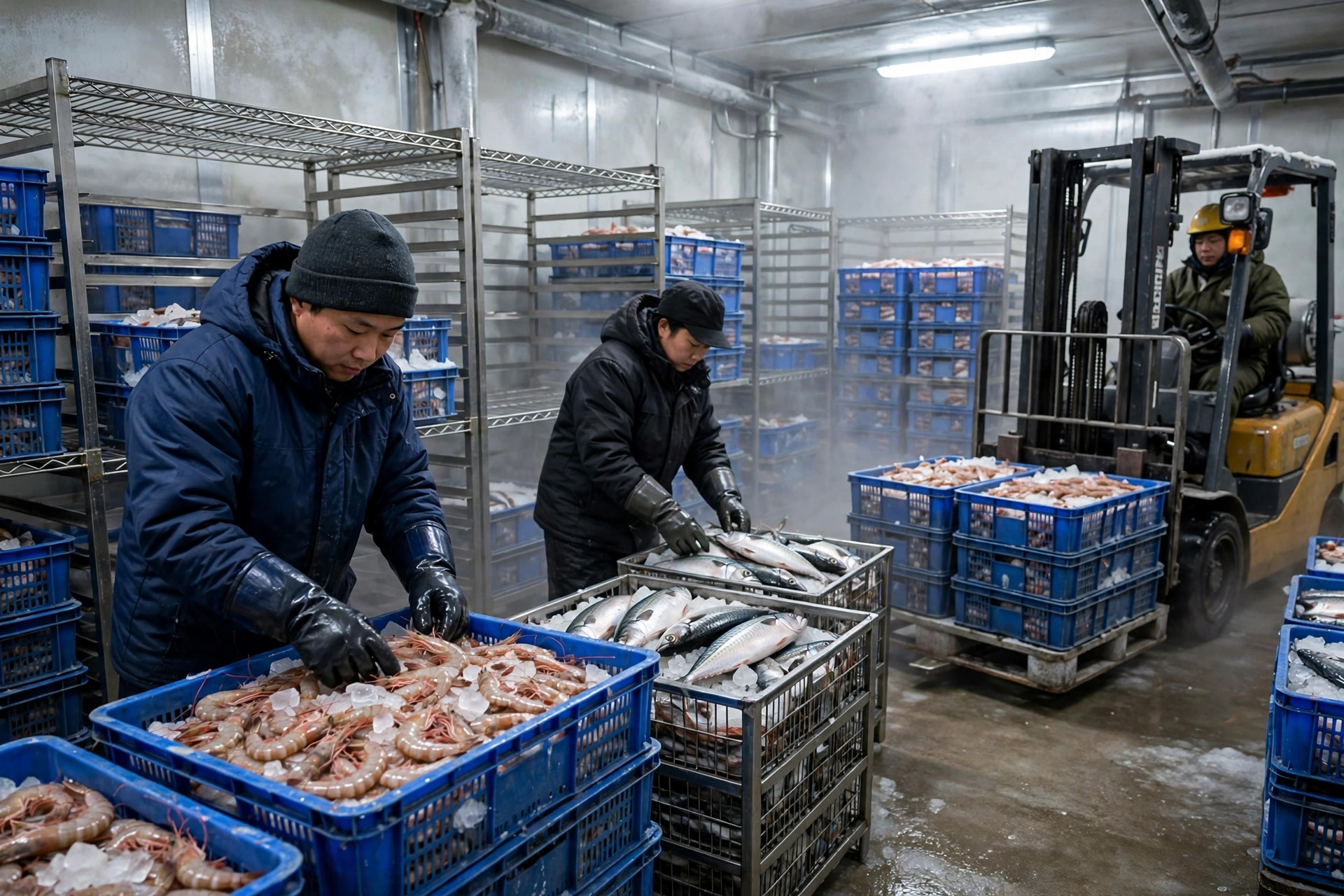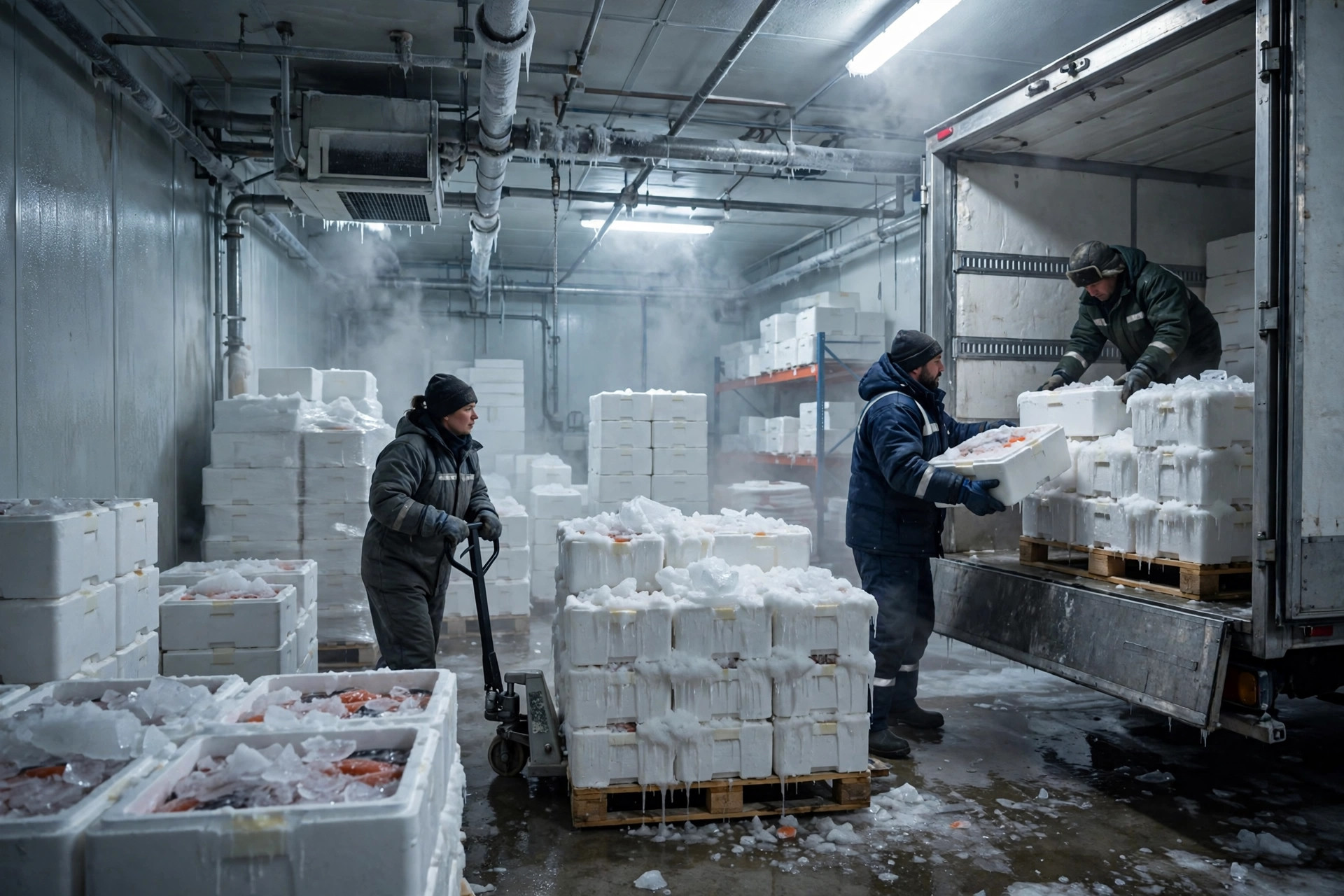
Ask how much it costs to move Norwegian salmon to market, and most people will answer with a freight rate. That answer is not wrong, but it leaves out the part of the journey where the most value is quietly won or lost. The Norway salmon export cold chain begins long before a truck or an aircraft takes over, at the water's edge, where fish are harvested, graded, packed in foam boxes with ice, and stacked for transfer, and it continues through handling steps on land that determine what condition the fish will be in when the long-haul leg finally starts.
Picture a spring morning at a fjord-side harvesting point. Work starts before dawn. Freshly harvested salmon are graded, boxed, iced, and palletised while transfer vehicles are still on their way. If a vehicle arrives even slightly behind schedule, the boxes wait a little longer at the quayside, and that extra wait consumes part of a freshness window that cannot be bought back later. Contrast that with a night shift at an Oslo consolidation cold terminal, where dozens of pallets arrive in waves, staff check batches, separate them by destination, and stage them for the next day's departures. The terminal is not simply a place to store fish. It is the scheduling centre of the whole chain, the point where scattered volumes from different farming areas are brought together and reorganised into loads that make sense for onward transport.
Norway Salmon Export Cold Chain, First Ledger: How Far Fish Travel on Land
The stretch from farm to Oslo consolidation terminal is the most underestimated part of the Norway salmon export cold chain. Outside observers tend to focus on fjords and flight routes, yet the time fish spend on land is far from trivial, and the number of handling steps on land is high. Every loading, every vehicle change, and every movement in and out of a cold store is a moment when temperature can drift and information can break. A consolidation terminal earns its place by reducing that disorder before long-haul transport begins: it gathers dispersed volumes under one roof, applies uniform stacking, batch discipline, and departure sequencing, and thereby takes some of the uncertainty out of everything that follows.
Consolidation, however, is not free. It involves waiting, and waiting costs time, which for chilled fish rarely shows up cleanly on a freight invoice. Common practice treats the consolidation stage as a buffer rather than a warehouse: fish arrive in order to leave at the right time in the right combination. If departure order is arranged badly, the first vehicle may wait for a late batch while a later batch misses its departure, with knock-on effects most visible in peak season. Oslo terminals therefore sit at the centre of any serious discussion of Norwegian salmon exports, not only as a geographical waypoint but as the place where time and batches are reorganised. In other words, the Norway salmon export cold chain warehouse stage is where time is either saved or lost before a single long-haul mile is run.
A Land-Led Chain to Europe: Connections Matter More Than Speed
Europe is the principal destination for Norwegian salmon, and the transport structure serving it has a feature worth pausing over: land transport carries the main volume, with air freight playing a supporting role. That structure can look counterintuitive at first, because chilled fish are time-sensitive and aircraft are obviously faster. The explanation lies in volume structure and connection costs. Road transport can move several container loads at once, runs on dense schedules, and reaches dispersed distribution points across Europe, which suits the steady, high-volume rhythm of everyday orders. Air freight does offer a genuine speed advantage, but it moves smaller batches, and once the fish land they still have to be broken down, sorted, and loaded onto trucks again, so part of the time saved in the air is given back on the ground.
The table below is not a rate quotation. It is a decision framework for understanding where each mode belongs:
| Mode | Role in the chain | Best suited to | Main cost |
|---|---|---|---|
| European road transport | Everyday backbone, large batches on stable schedules | Regular orders with clear destinations and stable volumes | Long transit time, heavy reliance on en-route connections |
| Air freight | Supplement and contingency, small batches with fast response | Urgent top-ups, distant markets, tight delivery windows | High unit cost, with ground distribution steps still unavoidable |
| Reefer containers with live temperature monitoring | Not a transport mode, but a shared assurance layer for both | Temperature-sensitive, higher-value batches | Equipment and monitoring investment, repaid in traceable certainty |
That framework leads to a counterintuitive judgement: for chilled salmon, faster does not always mean fresher. What usually determines the condition of fish on arrival is not the speed of a single vehicle, but the number of temperature breaks across the whole chain and the length of each break. A smooth road journey, with stable temperatures and tight connections, can deliver fish in better condition than a fast flight followed by a long wait on the ground. Air freight should not be dismissed either: its value lies less in daily operations than in the option it provides when a batch must meet a particular delivery window or a market suddenly needs replenishment. A land-led structure with air freight in support is therefore a division of labour, not a choice between rivals.
Live Reefer Monitoring Is Quietly Changing Who Gets to Decide
The spread of real-time temperature monitoring in reefer containers is quietly changing who holds authority in this chain. In the past, the temperature history of a shipment was only truly known when boxes were opened at destination, and when something went wrong it was difficult to say where the problem had occurred, so responsibility tended to circulate among several parties. Now containers record and transmit temperature data throughout transit, which means shippers, carriers, and receivers are looking at the same set of facts. The room for argument shrinks, and the direction for improvement becomes clearer. Common practice in the industry has already moved beyond investigating failures after the fact: temperature curves are treated as part of everyday management, so that a segment with unusual fluctuation draws attention to its loading and handover practices.
That shift changes how decisions are made. Consider a departure sequence at an Oslo terminal, where dozens of pallets must be split across several vehicles. Staff once relied mainly on experience to decide which batch should leave first; they can now sequence departures with time in store, destination, and temperature records in view. Done well, the result is more uniform condition across the load and fewer grading disputes at market. At a deeper level, live monitoring turns the cold chain from an arrangement based on trust into one that can be verified with data: not the disappearance of trust, but a change in its basis, from believing a partner will do the job well to being able to see how well it was done. That matters most for small, frequent shipments, which cannot absorb one major temperature incident.
Where This Chain Goes Next Depends on Three Variables
Looking ahead over the next few export seasons, the direction of the Norway salmon export cold chain is likely to depend on three variables rather than on a single breakthrough in any one transport mode. The first is organisational capacity at the consolidation stage: how tightly an Oslo terminal can sequence arrivals, departures, and distribution will decide how far the stability advantage of road transport can be pushed. The second is the quality of connections within the European road network: trunk transport itself is already relatively mature, so the remaining room for improvement lies in handover points, waiting time, and information synchronisation between distribution nodes. The third is how far live temperature data are actually used: the data already exist, and the open question is whether the parties will turn them into a shared management language or keep them merely as evidence for disputes.
These three variables also reinforce one another. Tighter consolidation makes the volume advantage of road transport more visible; better connections reduce the need for air freight in routine work, even though its value as insurance remains; and the more thoroughly data are used, the easier it becomes to verify and replicate gains in the first two areas. For a newcomer considering entry into this chain, the interesting question is whether the barrier to competition sits in the vehicles themselves or in the capability to organise farms, consolidation terminals, road networks, and market distribution points into one unbroken system. The current pattern points toward the latter, which suggests that simply chasing a faster or cheaper segment may not produce a better chain overall. Which of these variables moves first, and how the balance between them shifts, is a question worth watching over the coming seasons rather than settling in advance.
By Dr. Chen, Supply Chain Researcher