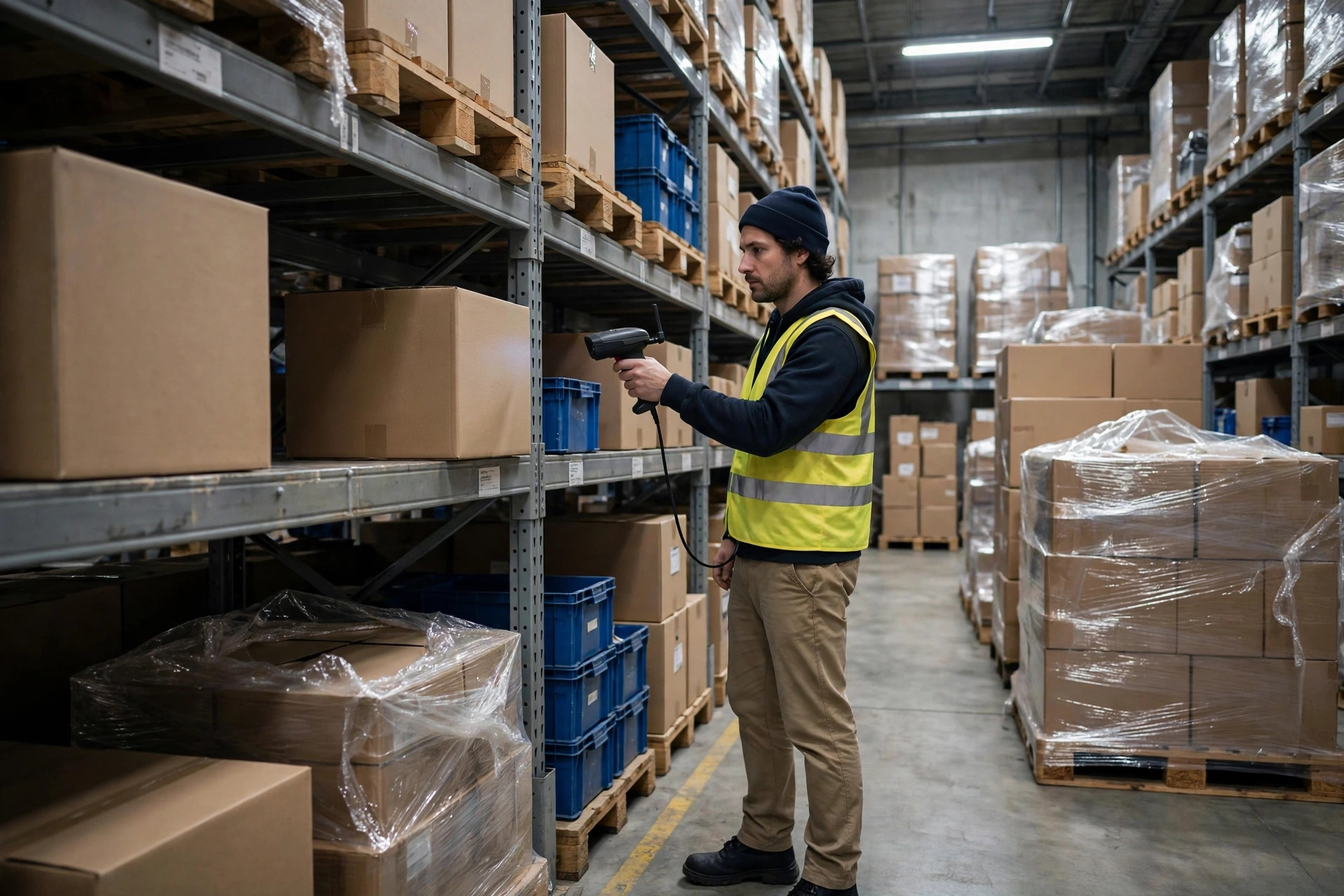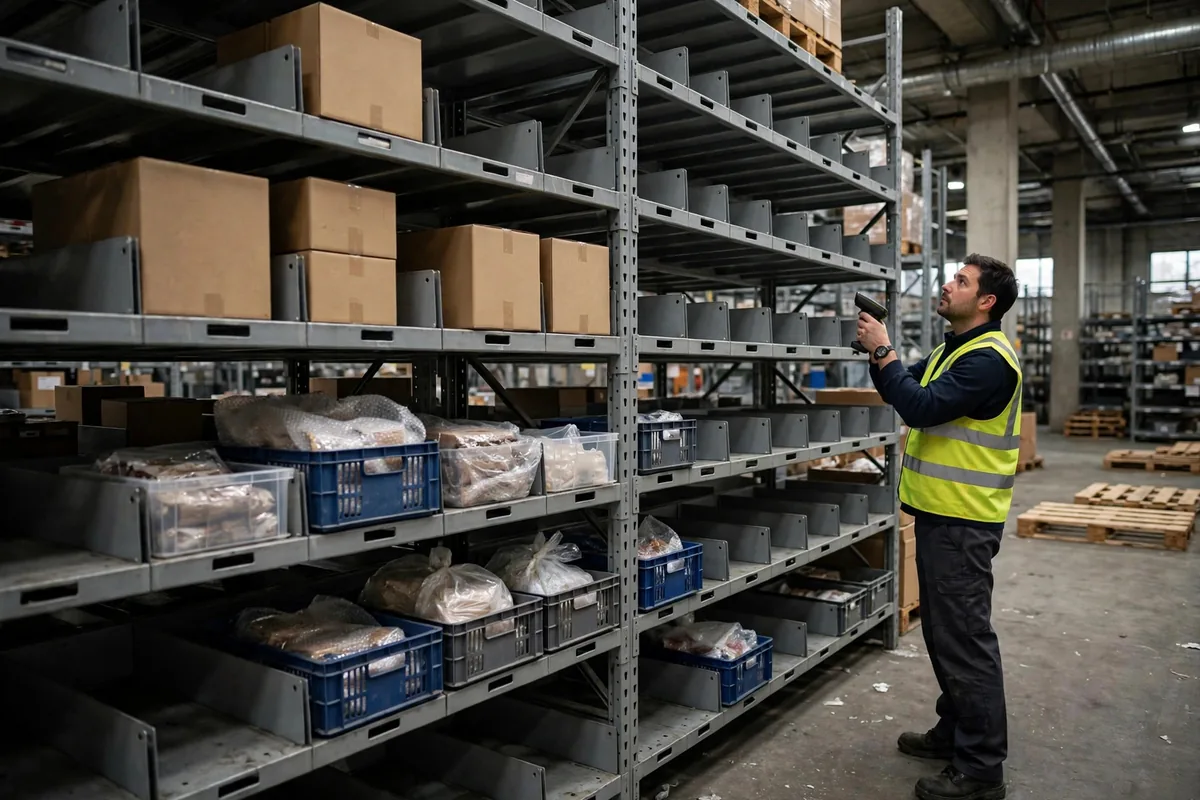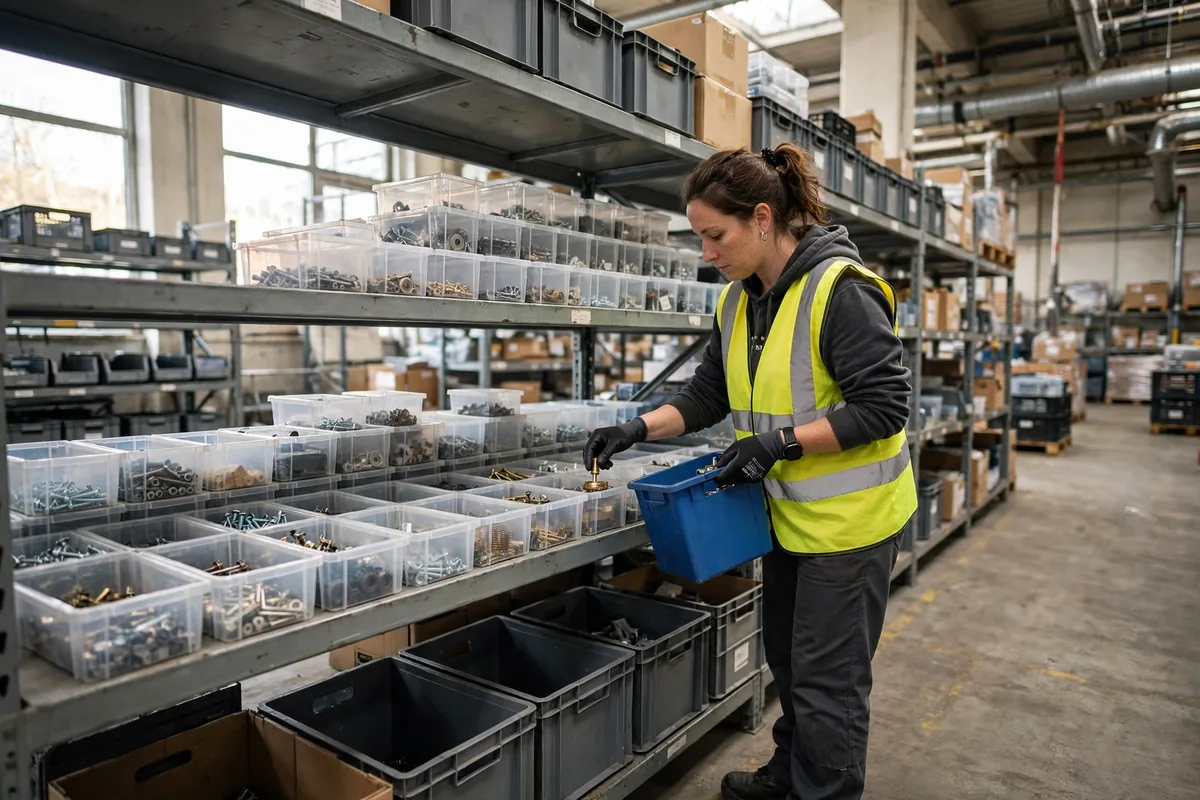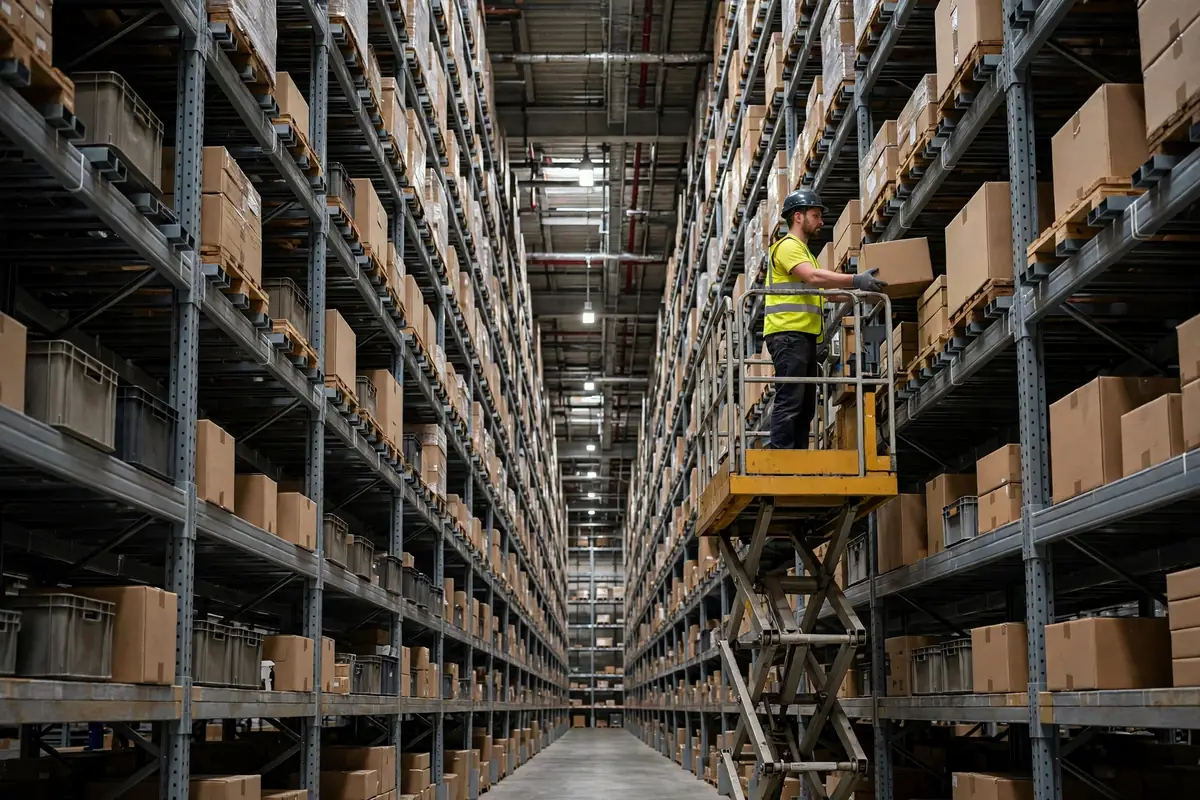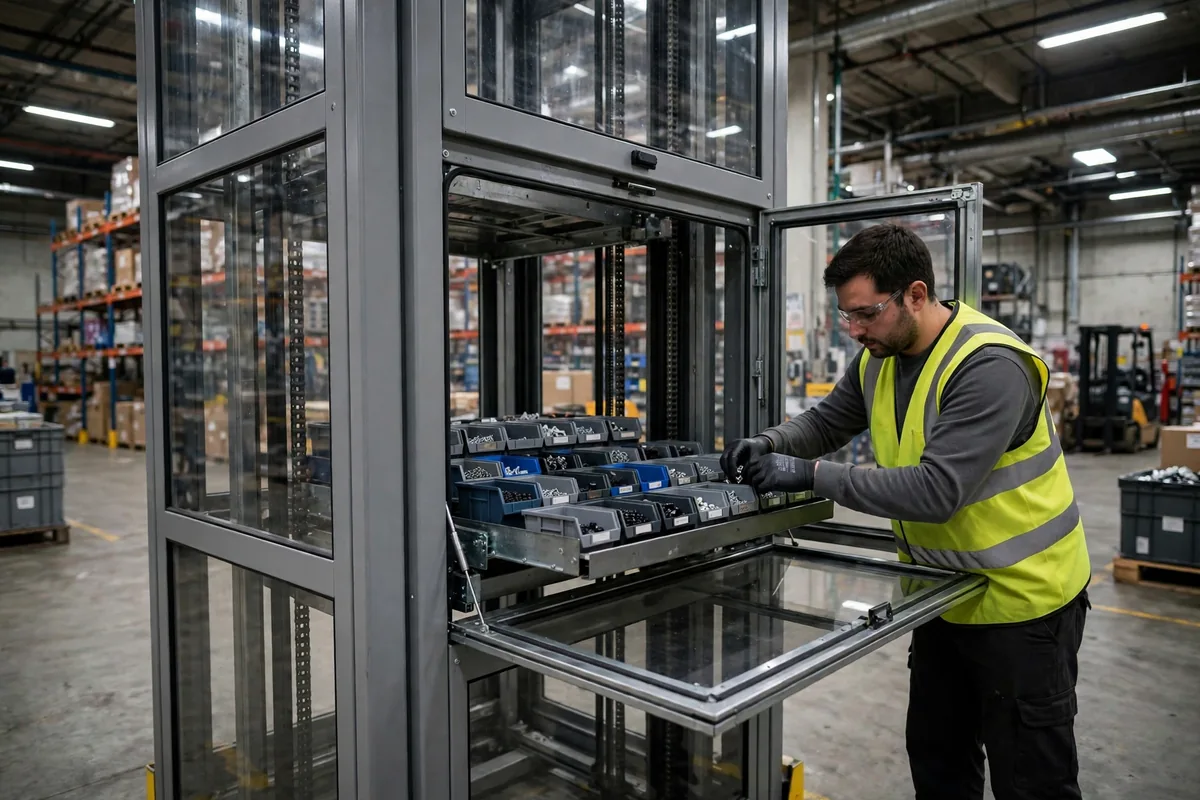
Think of a vertical lift module as a giant vending machine, except instead of drinks it holds thousands of small parts. The operator stands still at the access window while a tray rides up or down, a light comes on, and the picker grabs the item. That is the entire working logic of a vertical lift module (VLM) for small-parts picking. The principle is simple. What is not simple is the number of warehouses I have seen buy one and then use it as an expensive storage cabinet — not because the machine is bad, but because nobody did the math before signing.
In 2023 I worked on a project at an auto-parts warehouse in East China with close to 8,000 SKUs: screws, clips, seals, all palm-sized. The old setup was three rows of medium shelving and four pickers who spent peak season walking back and forth just looking for things. After two VLMs went in, pickers stood in one place while the system delivered trays to them, and daily pick lines rose from roughly 400 to more than 900 (illustrative figures from that project; your numbers will differ). That is what a VLM is best at: many SKUs, small items, high pick-line volume. One machine can replace a whole row of shelving.
I have also seen the opposite. Around the same time, a small e-commerce accessories warehouse with fewer than 800 SKUs and two or three hundred orders a day bought a VLM because everyone else seemed to be doing it. The result? Each tray cycle took well over ten seconds, the machine spent more of the day idling than working, and pickers stood waiting for trays when walking two steps to a shelf would have been faster. Six months later the unit was only powered up for stock counts. That is a textbook pseudo-requirement: not enough SKUs, not enough volume, and the VLM's advantages never show up.
What a Vertical Lift Module for Small-Parts Picking Actually Saves
Let me take the concept apart. A VLM does not really save headcount. It saves search time and floor space. A machine with a footprint of a few square meters stores vertically, so in a warehouse with 8 meters or more of clear height, one unit can hold what used to fill an entire row of shelving. Think of a multi-story car park: one ground-level parking space becomes ten by stacking upward. Picking works the same way: the goods come to the person, walking and searching time drops to zero, and error rates fall because a pick-to-light display tells you exactly which compartment and how many.
But there is a condition: your volume has to be high enough for the machine to actually run. A VLM works in fixed cycles — one lift, one pick — and when order volume is low, that cycle is slower than a person walking to a shelf. So the decision comes down to two numbers: SKU count and daily pick lines. My rule of thumb is that once you pass about 3,000 SKUs and 800 pick lines a day, a VLM starts to earn its keep. Below that, fix your shelving and location coding first; it costs a fraction of a VLM (illustrative thresholds; validate against your own data).
Running the Vertical Lift Module Numbers
Take a hypothetical example. Say a small-parts warehouse carries 5,000 SKUs and picks 1,000 lines a day. The shelving option needs six pickers and roughly 300 square meters of storage area. The VLM option needs two machines, three pickers, and about 60 square meters. The equipment, installation, and software integration are one-time costs, and then there is annual maintenance and spare parts every year after. Amortized over five years, whether the VLM option comes out cheaper depends on two things: how expensive your rent is, and how hard pickers are to hire. In a market where rent is high and labor is scarce, the math wins easily. Where rent is cheap and labor is plentiful, it is a much harder sell.
| Factor | Shelving + manual picking | VLM |
|---|---|---|
| Floor space | Large, needs multiple shelving rows | Small, trades height for storage |
| Picking speed | Depends on walking and searching | Goods-to-person, walking eliminated |
| Error rate | Relies on experience and re-checks | Pick-to-light, lower error rate |
| Upfront investment | Low | High: machine, software, installation |
| Maintenance cost | Low | Annual service contract plus spares |
| Volume fit | Flexible even at low volume | Needs enough volume to pay off |
The table makes the point: a VLM is not a fancy shelf. It is high investment traded for high density and high cycle speed. If the return works, buy it. If it does not, buying one is tuition. Here is the counterintuitive part: the more SKUs you have, the more a VLM is worth; a warehouse with few SKUs, even with high volume, may be faster with flow racks and zone picking. People assume more expensive automation is always better. In reality, automation only rewards three conditions — enough scale, enough variety, and low enough volatility. Miss one of the three and the numbers do not work.
The Vertical Lift Module Maintenance Trap Costs More Than the Purchase
This is the part salespeople do not volunteer. A VLM is an electro-mechanical system: chains, motors, sensors, controls. If any one of them fails, the whole machine stops. And when it stops, the thousands of SKUs stored inside it become unreachable and orders stall. So before buying, get three things in writing. First, the maintenance response time: four hours on site and 48 hours on site are two different worlds. Second, whether critical spares are stocked locally or shipped from overseas, and how long that takes. Third, your contingency plan for downtime — for example, keeping a safety stock of fast-moving SKUs on regular shelving.
I have also seen buyers ignore ceiling height. A VLM needs at least 6 meters of clear height to deliver its space-saving advantage; below that, the savings shrink while the price stays the same. Fire protection and floor loading matter too. The machine's own weight plus a full load puts real demands on the floor slab, and an older building may need reinforcement before installation. Discovering that after the machine arrives can cost as much as half another unit.
Here is the honest take. A VLM is a good machine, but it only rewards people who have done the math. Before you buy, count your SKUs, count your daily pick lines, and ask one question: if this machine stops for an hour, what happens to my orders? If you can answer all three, then talk price. If you cannot, no sales pitch should close the deal.
Is the money worth it? Look at one number: daily pick lines multiplied by the time saved per line. If that pays back the machine and its maintenance within three years, buy it. If it does not, get your shelving in order first.
By Da Liu, Automation Engineer