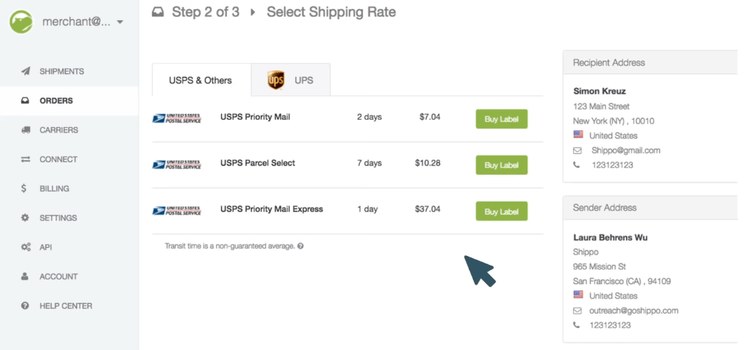
Last month I audited a seller's shipping invoices. More than 800 small parcels a month, and I went through the bills twice, because the same shipment could cost nearly twice as much with one carrier as with the other. Nobody's system was broken. The seller had simply never split shipments by weight.
Here is the short version: light parcels usually travel cheaper on USPS Ground Advantage, while heavy and bulky parcels are steadier on UPS Ground. The dividing line is not a feeling. It lives in your own shipping data. Let me open up the bill.
What USPS and UPS Actually Charge You For
USPS Ground Advantage launched in July 2023, replacing Retail Ground and Parcel Select Ground. Transit runs 2 to 5 business days, with a 70-pound per-piece limit. UPS Ground generally runs 1 to 5 business days, depending on the zone. On transit time alone, neither carrier crushes the other. The difference is how they price.
USPS prices by weight and zone, which favors light, small parcels, and only adds money when dimensions cross a line. UPS leans harder on dimensional weight and size, so its per-piece price gets competitive exactly where parcels get heavy and bulky. I am not printing specific rates here. Carriers adjust prices more often than the seasons change, and any number I wrote down would be wrong within months. Check the latest rates on each carrier's official site, and price your own real shipments.
| Factor | USPS Ground Advantage | UPS Ground |
|---|---|---|
| Transit | 2-5 business days | Generally 1-5 business days |
| Per-piece limit | 70 lbs | See the carrier's official site for the latest policy |
| Pricing favors | Light, small parcels | Heavy, bulky parcels |
| Saturday delivery | Included in regular delivery days | Usually an add-on service |
| Commercial pricing | Commercial rates differ sharply from retail | Commercial rates differ sharply from retail |
| Lost-package claims | File per the official process, latest policy applies | File per the official process, latest policy applies |
Take a hypothetical case. Suppose a seller ships 800 parcels a month: 70 percent under 3 pounds, 30 percent over 10 pounds. Send everything through one carrier and the light parcels pay for a heavy-parcel pricing logic, while the heavy parcels pay for a light-parcel one. Split the flow, light parcels to USPS Ground Advantage and heavy ones to UPS Ground, and the monthly saving covers half a hire. That is not a number I invented. It comes from pricing that seller's actual prior-month shipment records on both carriers' sites and finding the split.
Look at the delivery calendar too. Saturday is a regular delivery day for USPS, so weekend orders keep moving without waiting for Monday. With UPS Ground, Saturday delivery is usually an add-on service, and whether it costs extra and how much depends on the latest official policy. If a big share of your orders lands on weekends, that line alone is worth real money. Do not judge transit time on weekdays only. Count Saturday and Sunday as well.
Then there is the cost nobody puts in the spreadsheet: tracking and customer service. The two carriers update tracking information at different speeds, and every time a buyer asks where their parcel is, someone on your team spends minutes looking it up or calling in. At low volume you never notice it. At scale, those service hours are real money. Before you pick a carrier, ask one question: when something goes wrong, who do I call and how long does it take to fix?
Remote-area surcharges are the line item that quietly steals your margin. How many of your orders go to remote areas decides what that line adds up to over a year. The two carriers define remote areas differently and price the surcharge differently, so check the latest official policy for the exact numbers. My method is to pull orders by postal-code zone and price the remote slice separately, so ten ordinary parcels do not end up subsidizing one remote one.
The Cheapest Label Is Not the Cheapest Total Cost
Most people pick a carrier by the label price. That money is wasted. The label is only the first line of the bill. Remote-area surcharges, oversize surcharges, address-correction fees, and the cost of reshipping a lost parcel all wait behind it.
Here is the counterintuitive part: the carrier with the lowest quote often ends up the most expensive overall. One lost parcel wipes out the few dollars saved on ten labels, and then you still pay for the reshipment and the customer-service argument. Some remote surcharges on a single shipment can eat the savings from ten others. Before you choose, ask one question: if this parcel is lost, late, or hit with a surcharge, can I absorb it?
Another hypothetical: a home-goods shipment at 65 pounds per piece, just inside the 70-pound USPS Ground Advantage cap. It fits on paper, but once the dimensions trigger surcharges and transit runs a beat slower than UPS Ground, the total cost flips. Do not force that freight into a light-parcel channel. Send it UPS Ground. The label may cost more, and the total bill costs less.
Lost-package claims are another place where money hides. Both carriers lose parcels. The difference is the claims process: what paperwork you need, how long reimbursement takes, and what the payout ceiling is. All of that is in the latest official policy, not in anything a sales rep tells you over the phone. I have seen a seller pick a carrier for the cheaper label, lose a dozen parcels in a year, wait months on claims, and end up with payouts that did not even cover the reshipment cost. Every cent saved on the label came back on the claims form.
One more lever people overlook: commercial pricing. Retail rates and commercial account rates are two different things. Negotiate the commercial account first, then compare. Comparing a retail rate against a commercial rate is comparing full price against a discount. It means nothing. And when you negotiate, do not stare only at the discount percentage. Surcharge waivers, a faster claims lane, and payment terms can be worth more in money than the discount itself.
Find Your USPS-UPS Break-Even Point in Three Steps
Step one: export last month's shipment records, weight, dimensions, and destination zones, every single parcel. Step two: price that whole list on both carriers' sites, label price, surcharges, and claims terms included. Step three: plot cost against weight. Where the two lines cross is your dividing line.
That line is yours, not anyone else's. Where someone else's break-even sits has nothing to do with you. Yours depends only on your own weight mix and your destination mix. Until you have run the numbers, do not sign an exclusive discount with either carrier, and do not put all your freight on one lane.
Peak season is the other reason to recalculate. When peak surcharges land, the dividing line moves; when they lift, it moves back. My routine is monthly recalculation, every two weeks in peak season. You do not need to redo the whole exercise. Take a small sample of the month's new orders, reprice them on both carriers, and you have the answer in half a day.
The calculable conclusion: everything below your break-even point goes USPS Ground Advantage, everything above it goes UPS Ground, and you recalculate monthly. Rates change, peak-season surcharges come and go, and your weight mix shifts, so the line moves with them. Once the math is done this way, the choice is no longer a matter of feeling. It is arithmetic.
By Lao Zhou, Logistics Cost Analyst