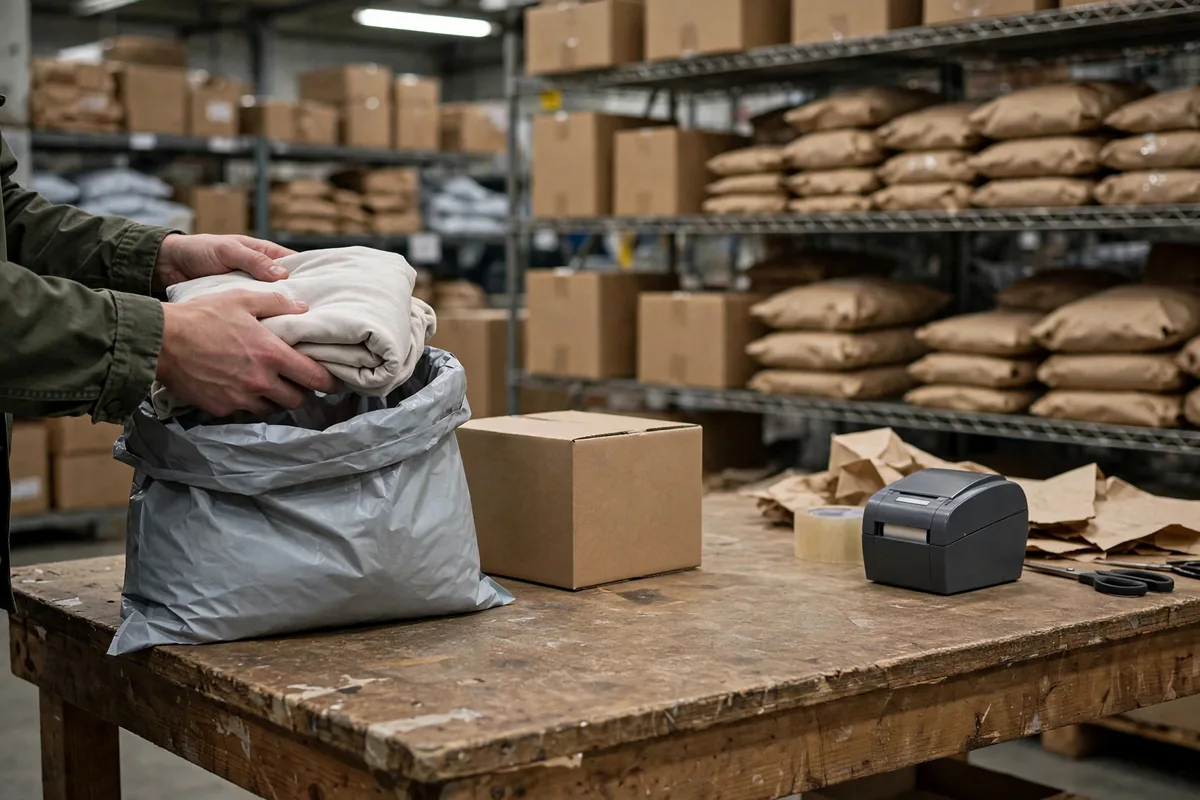
Carriers lose your package, and then they act like it's your problem. Let me tell you, I have filed more than 20 parcel shipping claim lost damaged package process cases in the past two years. Some paid out. Some vanished into a black hole. The worst one wasn't the lost package itself. It was the time I waited two months before filing, and the carrier rejected me in one sentence: too late. Over 300 dollars of goods, gone. Since then I learned the rule: when a package goes wrong, check the calendar first, gather the evidence second, and only then go argue.
In March 2026, I shipped a batch from my California warehouse to Texas, more than 30 parcels, and one customer's order sat stuck at a transit hub for 9 days. I called, they said they would check, and two days later they told me it was gone. The goods were worth 180 dollars, two home items. I reshipped to the customer first, then filed the claim with photos, the label, and the packing list. Fifteen days later it paid out at the default liability cap: 100 dollars. Goods worth 180, payout 100, I ate 80 dollars of loss, because I never declared a value. Lesson one: without a declared value, the payout caps at 100 dollars per piece, and all three carriers play by the same rule.
Lost, damaged, and short-shipped are three different claims
Most sellers think a parcel shipping claim is just filling out a form and waiting. Wrong. Lost, damaged, and short-shipped packages follow different paths, and mixing them up wastes weeks.
Lost packages are the slowest grind. The parcel shows no movement, and you have to wait for the carrier to confirm it is actually gone, which can take days or weeks. For USPS domestic losses, you must file between 15 and 60 days after mailing, and for Priority Mail Express it is 7 to 60 days. File too early and they won't take it; file too late and they reject it outright. UPS wants notice within 60 days of the scheduled delivery date, with the formal claim due within 9 months for domestic and 60 days for international. FedEx allows 9 months for lost packages. Watch out for the UPS trap: that 60 days is a notice deadline, not the claim deadline. Plenty of sellers treat the notice as the claim, then try to file on day 61 and get nothing. Always check the carrier's official website for the latest policy, because these windows can shift.
Damage and shortage move faster, and the deadlines are harsher. USPS lets you file damage or shortage claims immediately, up to 60 days. FedEx allows 60 days for domestic damage and only 21 days for international damage. That 21-day international window is a killer: the customer takes a week to send you photos, you take another week to gather documents, and by day 22 the carrier can legally say no. My rule for the support team now: when a customer reports damage, we get the photos within 24 hours.
Shortage is the hardest to prove. The box arrives, one item is missing, and the carrier's first instinct is to suspect you never packed it. That is when your packing records save you. In November 2025, during peak season, an order arrived missing a 40-dollar kitchen gadget. The customer sent photos showing the box intact and the seal unbroken. I pulled the packing weight record and the packing photos, the weight matched, and the claim paid out in 20 days. Without those two photos, that 40 dollars would have been my loss. Shortage claims are won or lost at the moment you pack the box.
The four rejection traps I have fallen into
Missing the deadline is number one. Those day counts are hard lines, not suggestions. I set a 45-day alert on every parcel: if it hasn't delivered by day 45, the claim process starts that day. Forty-five days sits safely inside the USPS 60-day ceiling and leaves 15 days to prepare documents.
Weak evidence is number two. Carriers want the label, the packing list, proof of value, damage photos, and packaging photos. Miss one and they ask you to supplement, each round costs a week, and after two rounds you feel like giving up. My worst loss was proof of value: I had lost the supplier invoice and only had a handwritten ledger, which the claims agent refused. Now every purchase invoice is filed by month, ready to pull.
Non-compliant packaging is number three. For damage claims, the carrier's favorite line is "packaging did not meet requirements." Original box plus bubble wrap, photographed, is the minimum. For fragile goods I add another layer and a fragile sticker, not because the sticker stops rough handling, but because the photo proves I did my part.
No declared value is number four, and the most expensive. The default liability cap is 100 dollars per piece at all three carriers. Skip the declared value on high-value goods and you cap your own payout. Now I declare value on every order over 100 dollars and treat the declaration fee as part of shipping cost, baked into the price.
Here is the cheat sheet taped to my desk. Check the carriers' official sites for the latest policy before you rely on any number:
| Carrier | Lost | Damage (domestic) | Damage (international) | Default liability cap | | USPS | 15–60 days after mailing (Express 7–60 days) | Immediately up to 60 days | 90 days to 6 months depending on service | $100 per piece | | UPS | Notice within 60 days; formal claim 9 months domestic, 60 days international | Notify within 60 days | Within 60 days | $100 per piece | | FedEx | Within 9 months | Within 60 days | Within 21 days | $100 per piece |
The claims ledger: photos, records, and a 45-day line
A parcel shipping claim is not won with arguing skills. It is won with a ledger. Mine has four columns: order number, ship date, 45-day alert date, and claim status. Every morning I spend 10 minutes scanning it, and any parcel hitting its alert date gets action that same day. Packing means three photos every time: the goods before packing, the packed box, and the box with the label on. Photos are filed by order number and backed up to the cloud. Labels and packing records are kept for 90 days after delivery, and 12 months for international shipments.
Refund the customer first, or wait for the carrier
This is a trade-off with no standard answer, only math. Refund first, and the bad-review risk disappears immediately, but you pay out of pocket and a carrier rejection means a double loss. Wait for the carrier, and you avoid spending money you might not need to spend, but a customer left waiting two weeks can leave a review that eats the whole order's profit and drags your listing ranking down.
My rule splits by value. Under 100 dollars with a reasonable customer, reship first and file the claim after; 100 dollars is cheap insurance for a good review. Over 100 dollars, or a customer already threatening a review, I reassure them with a clear timeline, like a reship plan within 3 days, and start the claim the same day, running both tracks in parallel. The worst move is stalling on both sides: no reply to the customer, no documents to the carrier, and then the bad review and the rejection arrive together.
Here is a counterintuitive one: damage claims succeed more often than lost-package claims. Why? Photos. A damage claim has the most complete evidence chain, and the carrier has the least room to argue. A lost package lets the carrier keep saying "we're still looking." So never skip the process on damaged goods because it feels like a hassle. Photos, keep the box, file the form, twenty minutes of work, and the odds are better than you think.
A quick hypothetical example to show how the numbers stack up (illustrative scenario, not real statistics): suppose you ship 500 parcels a month and 2 percent go wrong. That is 10 problem parcels. If you file on 8 of them at an average recovery of 80 dollars, that is 640 dollars a month you would otherwise have written off.
Final word: filing a claim is not gaming the system. It is getting back money you are owed. Carriers lose thousands of parcels a day, and their claims process is designed to make you give up out of frustration. If you refuse to give up, the money is yours. Build the ledger, set the 45-day line, take the photos, and next time a parcel goes wrong, you won't need luck.
This one I tested myself, and the claims I recovered in the past six months came to more than twice what I paid in declared-value fees.
By Ah K, E-commerce Seller (5 yrs)