Folks, at a little past three in the morning, the lights were already on in an orchard in Chanthaburi. The picking crew moved through the rows in the dark, and the mangoes in the crates still held the warmth of the day. You could feel it through the skin. Standing at the edge of that orchard, I had one thought: in the thailand mango export cold chain warehouse business, the ledger starts the moment the fruit is picked, not when it reaches the cold room door.
Let me be straight with you. A lot of people think a cold chain just means putting fruit into a cold room. After years in a packing house, I have learned the opposite. The earlier you do the work, the less you pay for it later. One more hour in the sun at the orchard means more work at every step after that. Precooling, ripening, and loading each have their own temper. Cut a corner at any one of them, and it will come back to you when the fruit arrives.
The 3 a.m. Orchard: Field Heat Has Not Left Yet
Mangoes do not fear heat alone. They fear uneven heat, and cooling that comes too fast. Freshly picked fruit carries field heat. Packed tight in a crate with no airflow, the fruit in the middle starts to stew. It may look fine on the outside. By the time it reaches the buyer, the flesh can soften unevenly.
Our fixed practice is simple, and it works. We pick in the early morning. We do not fill crates to the brim, so air can move. At the shaded shed by the orchard, the fruit is spread out first. It does not go straight onto a truck. The truck itself is precooled before loading. An empty hot truck does not carry hot fruit. Yet rushed teams still load hot fruit into hot trucks.
One May, a cooperative learned this the hard way. Picking finished after ten in the morning, and the fruit waited more than two hours in the sun before loading. At the packing house, spot checks still looked acceptable. Three days after loading, the buyer reported a clearly higher share of soft fruit. Every step was just a little late, and the fruit paid for all of it.
Thailand Mango Export Cold Chain Warehouse Starts with Precooling
Precooling is not about freezing the fruit solid. It is about taking field heat out first, so the fruit settles into a steady state. Cool too hard, and the skin can suffer. Cool too slowly, and the fruit sits warm for too long and ripens unevenly.
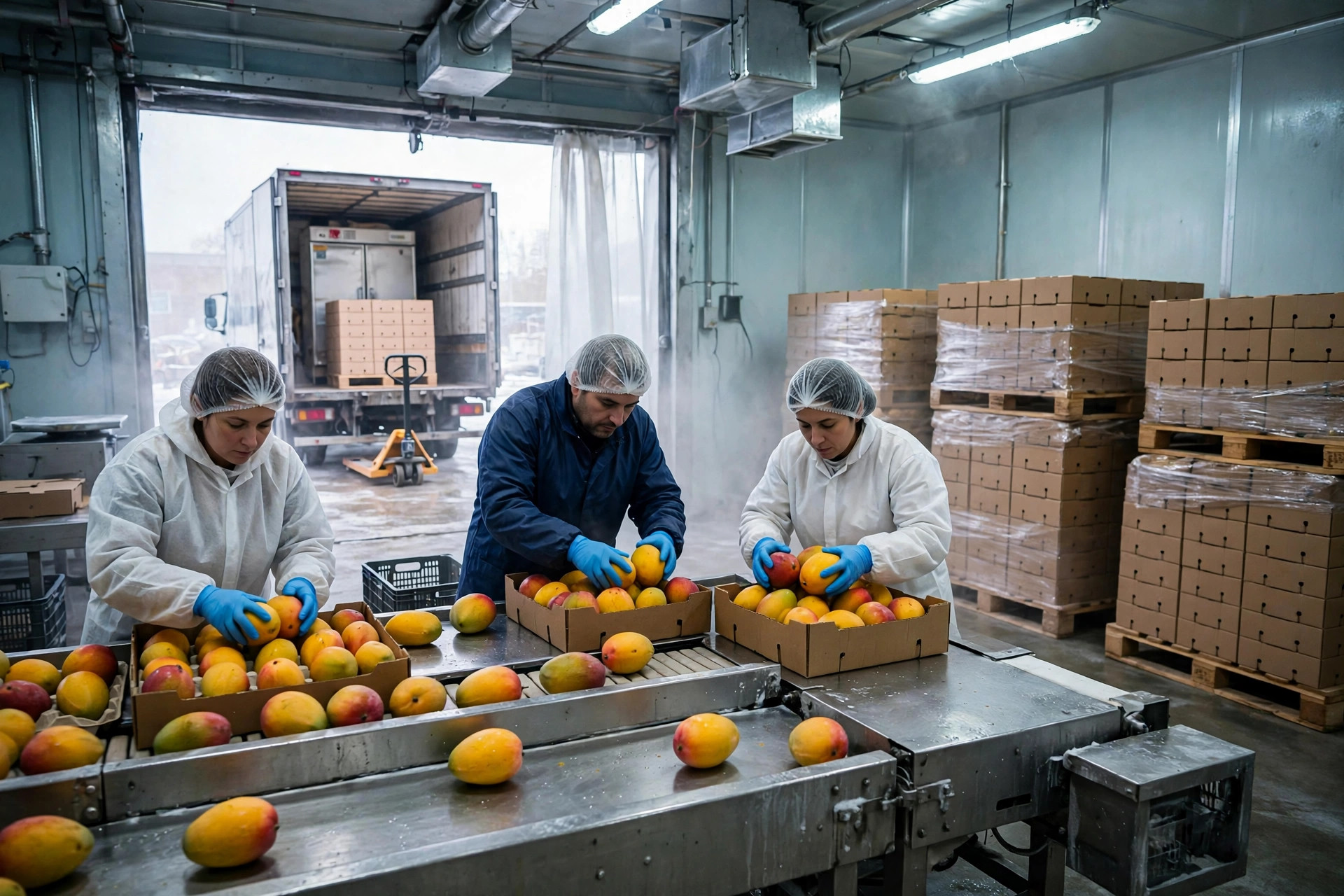
In our warehouse, we work in stages. When fruit arrives, we check three things: fruit temperature, bruising, and maturity. Fruit in different states does not travel together. Fruit with very different maturity is split into separate runs. Precooling time is set by the condition of the arrival, not by a fixed clock. The night crew knows this best. Fruit that arrives in the morning and fruit that arrives at midday never need the same rhythm.
Here is a counterintuitive lesson: the fastest precooling job is not always the best job. Some teams push the temperature down hard to save time on paper, and they plant a problem for ripening. Ripening needs evenness, not shock. When precooling is steady, every later step becomes easier to manage.
During peak season, the night shift tests your rostering more than your equipment. One June night, three trucks arrived around two in the morning, and only six people were on shift. They had to unload and take temperatures at the same time, and it nearly became too much. We did not try to rush everything. We pulled the worst-conditioned truck forward first, spread the better two loads out for airflow, and let them wait their turn. The shift leader told me later that the lesson was not technical. It was about choice. When hands are short, protect the riskiest fruit first, not the schedule that looks good on paper. Since then, handover includes one line: which pallet needs watching.
Ripening: You Cannot Rush It, and You Cannot Drag It
Ripening is where many teams lose patience. The buyer wants the shipment. Sales is pushing. Someone in the ripening room wants to turn things up a notch. But mangoes ripen on their own rhythm. Push too hard, and the outside softens while the inside lags behind. Go too slow, and the shipping window slips away.
We treat ripening like a roster, not like a switch. Every day, at fixed times, we measure firmness and color and write the results down. We do not guess by feel. Fruit in one room should be close in maturity. Fruit that is far apart does not get forced into the same room. Door openings matter too. Every time the door opens and closes, the temperature moves. Too many moves, and the whole room loses evenness.
When I train new staff, I tell them one thing: you are in a hurry, the fruit is not. Your job is to set the conditions, keep the records complete, and let it follow its own pace. The worst thing in a ripening room is not slowness. It is missing records. Without records, the next problem has no trail, and you cannot even tell where to start checking.
One peak-season shipment stays with me. Sales said the buyer was waiting, and someone suggested pushing the ripening rhythm faster. We said no. We kept that room on its normal rhythm and shipped a closer-maturity room first. The first shipment arrived with steady feedback, and the later room did not suffer from rushed work. Afterward, the team agreed on something simple. That shipment did not save time. It saved rework and arguments. In ripening, half a step slower is sometimes the fastest route, because you do not have to go back and clean up a mess.
The Warehouse Ledger: Counted Pallet by Pallet
At loading, the ledger comes down to each pallet. Before loading, we always check three things: whether fruit temperature is stable, whether cartons are crushed or damp, and whether one pallet holds fruit of the same maturity. If any one of them fails, that pallet comes out. It does not ride along with the rest of the container.
On the loading floor, two habits worry me most: signing without looking, and looking only at the outside of the carton. When we train new staff on loading, the first lesson is not how to stack a pallet. It is how to sample: open a random carton, check the middle layer, feel the fruit temperature, smell for mustiness, and check carton corners for damp softening. New staff often find it tedious at first. After they catch two bad loads, they understand. Ten extra minutes before loading beats ten days of explaining after arrival. Before closing, the shift leader walks around once to confirm nothing is missing or mixed.
This is the table we now keep on the warehouse wall. Nobody has to renegotiate it every time:
| Stage | What we watch | Where we check first when something goes wrong |
|---|---|---|
| Precooling | Whether field heat is out, and out evenly | Arrival time, stacking airflow, precooling rhythm |
| Ripening | Whether firmness and color move together | Maturity mix in the room, door openings, record completeness |
| Loading | Whether temperature is stable and cartons are sound | Mixed pallets, carton damage, pre-loading sampling |
Let me be straight: there is nothing fancy in that table. Its value is that every problem has a place to start checking.
In the thailand mango export cold chain warehouse ledger, the final lesson is simple. Act one step earlier, and you do one less round of rework. One less hour in the sun at the orchard, one less pallet pulled back at the plant, one less claim on the container. Transport temperatures are generally in the teens in Celsius, and precooling must remove field heat first. Exact temperature ranges and times should follow the buyer specification and destination requirements. Do not apply another buyer's sheet to your own shipment.
Here is my reminder to fellow warehouse people: do not only watch the cold room thermometer. Watch the condition of the fruit when it arrives at the plant. A good-looking thermometer does not guarantee good fruit. When the fruit arrives in the right condition, the rest of the ledger becomes much easier to balance. When the orchard, the plant, and the loading team each keep a different ledger, the whole chain never balances. Only when everyone works from the same table and the same rhythm does the mango arrive steady in the buyer's hands.
By Chen Feng, Warehouse Operations Manager