In the Peru avocado export cold chain warehouse, most exporters start their math at freight. That is the wrong starting point. The money is decided in the first hours after harvest: whether field heat was pulled out of the fruit, whether precooling was done properly, and whether the controlled atmosphere was set to the buyer's specification. Skimp on those steps and the loss is not a small cost overrun. It is a downgraded container, and a downgraded container costs you the cargo value plus the freight you already paid.
Field Heat Left in the Fruit Is Debt, Not Savings
During the northern Peru harvest season, Hass avocados picked in the afternoon carry substantial field heat. Pack them warm into cartons and pallets, push them into a cold room, and let the temperature drift down slowly, and the fruit keeps respiring and ripening unevenly. The outer layers of a pallet cool first. The core stays warm. By arrival, maturity is scattered across the load, and one bad sample during the buyer's inspection drags down the grade of the whole container.
Packhouses around Olmos typically move fruit into precooling as soon as possible after harvest, aiming to bring pulp temperature down toward the storage range quickly. The publicly referenced storage range for Hass is roughly 5–7°C with relative humidity around 85–90%, but that is a reference, not a prescription. Buyer specifications and destination requirements govern: different buyers want different arrival maturity and shelf-life windows, so setpoints must follow the spec, not a number copied from a guide.
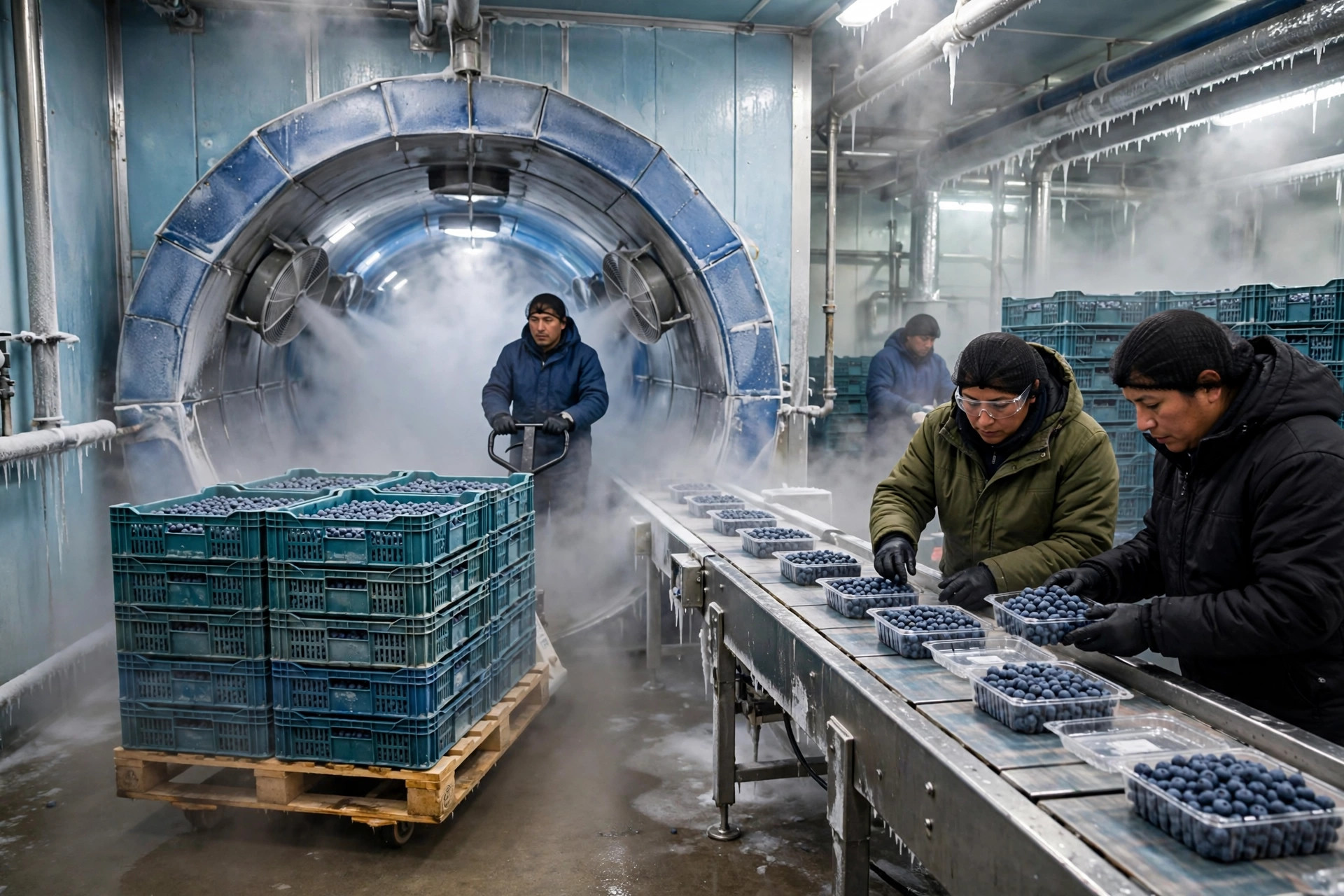
Here is the counterintuitive part: the fastest precooling is not automatically the cheapest, and the slowest is not automatically the most economical. Forced-air cooling costs real money in equipment, power, and shift scheduling. But it turns cooling time from "wait and hope" into a controlled few hours. A packhouse that relies on a cold room to cool fruit gradually saves on equipment and pays three hidden bills instead: fruit lost to extra respiration at high temperature, downgrades from uneven ripening, and price concessions when an importer must move ripening fruit fast. I only count the total ledger, not the savings on any single line.
Peru Avocado Export Cold Chain Warehouse: What Precooling and Controlled Atmosphere Are Worth
Break a container's cold chain ledger open and the big numbers are never the unit price of one step. They are the difference between "done properly" and "almost done." The table below is not a price list. It is a decision framework, and every row asks the same question: what does this money buy?
| Step | Where the money goes | What skipping it costs | My call |
|---|---|---|---|
| Rapid postharvest precooling | Equipment depreciation, power, labor scheduling | Residual field heat, uneven ripening, arrival downgrades | Non-negotiable; cooling time belongs in the SOP, not in someone's memory |
| Cold storage temperature and humidity control | Refrigeration, humidification, inspection | Water loss and shrivel, chilling injury, or overripening | Set parameters to the buyer spec and keep the records |
| Controlled atmosphere (MA/CA) | Atmosphere bags or containers, gas management | Shorter shelf life, fruit ripening in a rush after arrival | Match it to voyage length and buyer needs; no long voyage, no hard sell |
| Unbroken chain to port | Reefer trucks, port plug-in, pickup timing | A few hours of breakage discounts arrival quality | Every handover gets a temperature sign-off |
Controlled atmosphere is where the math most often goes wrong. Its job is to slow respiration and buy time on a long voyage. On a short voyage with fast buyer turnover, paying for atmosphere control is buying insurance you will not use. On a long voyage followed by days of distribution, skipping it means the fruit spends its shelf life at sea. The only test that matters is how many saleable days remain at arrival. If you cannot calculate that number, you cannot judge whether atmosphere control is worth it.
There is a second trade-off exporters get wrong: colder is not safer. Below the suitable range, Hass fruit can suffer chilling injury, with darkened skin and discolored flesh that kills its appearance. Above the range, it ripens fast and shelf life shrinks. The ledger does not reward "as cold as possible." It rewards "steady inside the specification." A temperature curve that swings up and down damages fruit more than a curve that sits slightly high but stable. Buyers look at the whole temperature log, not just the arrival reading, and a gap in the curve weakens your position in any claim discussion before it starts. In the Peru avocado export cold chain, the temperature log is your evidence at that table, and an incomplete log loses arguments no matter how good the story is.
Peru Avocado Export Cold Chain: The Chain Breaks at Handovers, Not on the Road
From an Olmos packhouse to the port of Paita, the road itself is rarely the biggest cold chain risk. The risk concentrates at handovers: fruit leaves the precooling room for a reefer truck, the truck plugs in at the port, the container waits before loading. At any of these points, a warm truck, an open door during a long loading window, or a missed plug-in quietly undoes the precooling work.
A usable checklist for exporters in the Peru avocado export cold chain: first, write the maximum harvest-to-precooling interval into the SOP, and require an explanation whenever it is breached. Second, judge precooling complete by pulp temperature, not room temperature and not "hours in the cooler." Third, verify the reefer truck is precooled before loading; loading fruit into a warm truck charges the fruit for the truck's heat. Fourth, download and archive the temperature logger data immediately after arrival, so any dispute starts from data, not from memory. Fifth, confirm atmosphere settings against this container's buyer specification, never by copying the previous container's settings.
Consider two containers from the same growing area, harvested in the same week. One follows the SOP: rapid precooling plus a complete temperature record. The other skips the post-precooling temperature check to catch a vessel cutoff. Freight and packaging cost the same on both. At arrival, the first sells at its normal grade, while the second is downgraded for uneven maturity. The difference is not equipment. It is execution in a few hours that nobody wanted to pay attention to.
The bottom line is computable: weigh precooling and atmosphere costs against the container's cargo value and total logistics cost, not against the power bill alone. A single grade downgrade caused by cold chain execution wipes out more than a season's precooling spend. In the Peru avocado export cold chain, the rule is therefore simple. Get temperature and atmosphere right to the buyer's specification, keep the records, and only then look for savings. Any saving taken before "done right" is not a saving at all.
By Lao Zhou, Logistics Cost Analyst