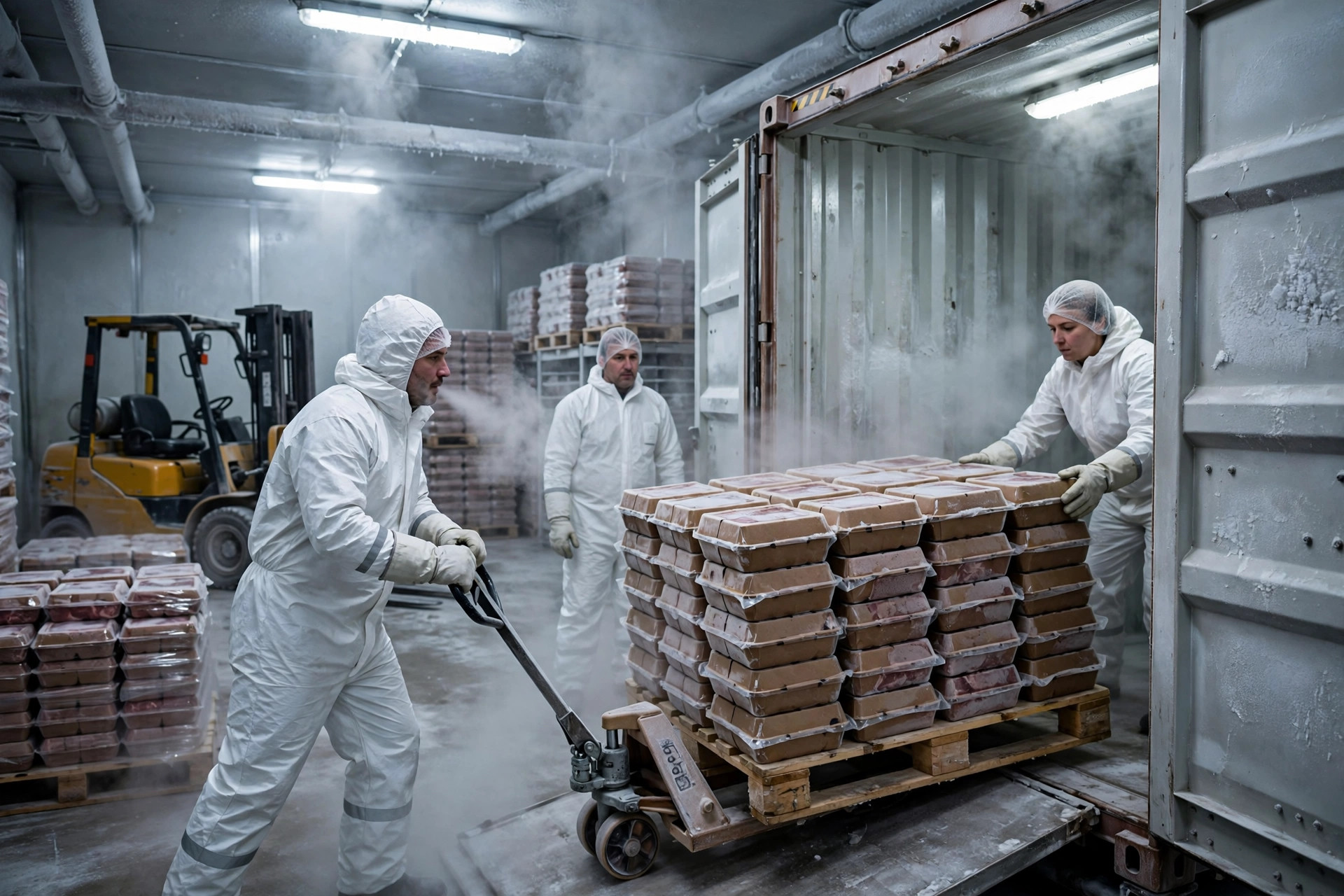
A container of chilled beef leaving Botswana carries two bills. One is visible: slaughter, packing, cold storage, trucking, and ocean freight. The other is invisible until something goes wrong: the value lost when quality slips. I once reviewed a shipment for an exporter where cartons at the edge of the load had softened and leaked at the destination port. The buyer did not reject the whole container. They repriced it downward. That single downgrade cost more than several containers' worth of cold storage rent. Ever since, I have priced the Botswana beef export cold chain warehouse chain from the loss side first: what does one break in the chain cost, and what spending prevents it?
Botswana's beef export chain is short, which is exactly why it is unforgiving: ranch, abattoir, pre-cooling, cold storage, reefer loading, and port shipment leave nowhere for an error to hide. I have seen careful exporters lose money at handovers, where each party was confident about its own leg and nobody owned the joint between two legs.
Price the container before you price the cold chain
Do not start by comparing daily cold storage rates. The largest costs in beef exports often sit inside product value, downgrades, and lost time. I break one container into five blocks: slaughter and packing, pre-cooling and cold storage, inland transport and loading, ocean freight and port charges, and destination clearance and delivery. For each block, ask one question: how much product value does this spending protect?
| Cost block | Where it is usually underestimated | The question to ask before paying |
|---|---|---|
| Slaughter and packing | Torn vacuum bags, damp cartons | Will the saving on packing cover even one downgrade? |
| Pre-cooling and cold storage | Product stored before it is cooled through | Does this day of storage buy stability or risk? |
| Inland transport and loading | Waiting at the gate, loading in the sun | Whose temperature record covers each waiting hour? |
| Ocean freight and port charges | Inspection delays, container detention | Who pays for power and time when the sailing slips? |
| Destination clearance and delivery | Incomplete documents, re-freezing after inspection | How much does one late document raise the value at risk? |
I deliberately give no fixed percentages for these blocks, because season, destination, and contract terms move them a lot. The method matters more than any single number: divide each block by the full container value, express it as a share, then express a plausible downgrade loss the same way. When both sides are in percentages, the decision becomes obvious. Storage rent is often a small share of container value, while one temperature excursion can wipe out a far larger share. That comparison is the discipline of a botswana beef export cold chain warehouse budget.
Pre-cooling: the cold chain step you cannot hurry
Pre-cooling is the step most often squeezed when a sailing date gets tight. After slaughter and cutting, beef still carries body heat. It must be brought down through its core before it goes into longer storage. The rushed version merges pre-cooling and storage into one move: cartons are pushed into the cold store, the room thermometer looks acceptable, and the centre of the cartons is still warm. The outside feels cold while the inside is still falling. After a few days in storage, cartons start weeping, and quality declines from the inside out.
I worked through a case at a cold store near a southern Botswana abattoir where pre-cooling time was cut by roughly half to meet a sailing. Spot checks at intake looked fine, because they measured carton surfaces. At loading, a deeper check found several cartons still above the target range at the core. Nothing was condemned, but the exporter had to reorder the load, run extra checks, and nearly missed the vessel. Half a day saved in pre-cooling was repaid with a full day of rework and a week of anxiety about the buyer's inspection.
The correct order runs in reverse: set the rule that no carton enters long storage until its core is in the target range, then work slaughter and delivery times backwards from that rule. Sailing dates can be negotiated and truck slots can be changed. The physics of cooling cannot. As a broad operating practice, chilled beef is generally handled near zero degrees, while frozen beef is generally handled well below zero; check the latest official policy and the buyer's current requirements before fixing any set point. The numbers can stay general. The principle cannot: product that has not cooled through does not go into storage, and that is a rule, not a preference.
An unbroken chain lives on the handover sheet
An unbroken cold chain is worthless as a slogan and valuable only as a handover record. At every transfer, I want three things recorded: time, temperature, and a named responsible person. When beef leaves the abattoir, the driver signs that the truck was pre-cooled. When it arrives at the cold store, the storekeeper measures carton temperature and logs it. When it leaves for loading, the loading team confirms the reefer was pre-cooled and set correctly. If any of those three items is missing, the next stage has the right to refuse the load.
A second case shows why records matter more than equipment. In a dry season, a truck carrying beef from an inland cold store toward the port developed a small refrigeration fault. The driver felt the air was still cool and kept driving instead of stopping to report it. By the time the container was loaded at the port, spot checks showed the temperature had drifted out of range. The repair bill was small. The real loss was the argument that followed: the buyer had reason to doubt the shipment, and the seller had no continuous temperature record to prove otherwise. Afterwards, the exporter did not buy a better truck first. They fitted temperature loggers, and they made "stop and report any temperature anomaly immediately" a hard rule. In a botswana beef export cold chain warehouse operation, that rule is cheaper than one disputed load. That spending felt wasteful after the fact. It would have been cheap before it.
Here is the counter-intuitive point in this whole business: the most valuable cold chain spending is often not refrigeration equipment at all. It is the proof that the chain held. Loggers, signed handovers, and loading photographs create no product value, yet when something goes wrong they decide who bears the loss and how much can be recovered. A cold chain without records is, for commercial purposes, no cold chain at all. In a dispute, it will be priced at the worst plausible outcome.
Loading day is where the margin is decided
Loading is where a good chain most often fails in half a day. The reefer must be pre-cooled; you cannot load chilled beef into a warm container and expect the refrigeration unit to rescue it. Loading should happen in shade, cartons should not queue in direct sun, and door openings should be kept to a minimum, because every opening lets warm air in. After loading, check the set temperature, the ventilation settings, and the logger position, then photograph the sealed door. A container holds tens of tonnes, so a shortcut at any step is priced across the whole load.
Before loading, I ask exporters to work through a short checklist and tick each item: reefer pre-cooled, carton temperatures sampled and passed, cartons undamaged and dry, loading order matched to the discharge sequence, temperature logger started, and door-seal photographs kept. Every item on that list corresponds to money once lost in real life. Checklists are not for beginners. They are for experienced people who need protection against a rushed moment.
Before accepting an order, run one calculation that can be done on a single page. Divide the extra money needed to keep the chain unbroken by the full container value. That gives the maximum loss rate you can accept before the extra spending stops paying. If that share is small, while a single break can cost a much larger share through downgrading, the spending is justified. If an upgraded option costs a large share and only protects against a theoretical risk, cut it. A botswana beef export cold chain warehouse does not win orders in the ranch alone. It wins them when the container arrives with its quality and its accounts both intact, and when the exporter can prove it.
By Lao Zhou, Logistics Cost Analyst