Let me open with a bill, not a thesis. One 5,000-foot roll of machine stretch film. Pre-stretch ratio set at 150%: it wraps 96 pallets. Dial it to 250%: 135 pallets. Same roll, 39 more pallets, 29% lower film cost per pallet. That is stretch film pre-stretch ratio savings per pallet in a single number — and almost nobody I meet has ever touched that dial.
In 2025 I walked into a 3PL warehouse in Ontario, California for a cost audit. The manager was complaining that film spend was up 20% year over year. I glanced at the wrapper's pre-stretch head: 150%. The machine was bought in 2019 and nobody had changed that setting since. Five years of overpaying for film — enough to buy two new wrappers. That money was not spent. It was thrown away.
First, the Math: Pre-Stretch Ratio Savings Per Pallet
Quick definition, no jargon fog. A 150% pre-stretch ratio means one foot of raw film gets stretched into 2.5 feet before it touches the load. At 250%, one foot becomes 3.5 feet. The amount of stretched film a pallet needs stays the same — only the raw film consumed changes.
Assumptions on the table first, so nobody accuses me of cooking numbers: standard 48x40-inch pallet, about 130 feet of applied film per wrap (the industry range is roughly 100-150 feet; I take the upper-middle because heavy loads need extra revolutions); a 5,000-foot machine roll at $40 (the common range is $30-55, so raw film costs about $0.008 per foot). Your supplier's quote will differ — the method travels.
| Pre-stretch ratio | 1 ft raw film becomes | Raw film per pallet | Film cost per pallet | Pallets per roll | Savings vs 150% |
|---|---|---|---|---|---|
| 150% | 2.5 ft | 52 ft | $0.42 | 96 | — |
| 200% | 3.0 ft | 43 ft | $0.35 | 115 | 17% |
| 250% | 3.5 ft | 37 ft | $0.30 | 135 | 29% |
| 300% | 4.0 ft | 33 ft | $0.26 | 154 | 37% |
From 150% to 250% you save $0.12 per pallet. A warehouse shipping 200 pallets a day, 300 days a year: 200 x 300 x 0.12 = $7,200 a year. Not earned. Recovered. That is the core of stretch film pre-stretch ratio savings per pallet: one parameter, one table, no mystique.
There is a second, quieter saving: 39 more pallets per roll means 29% fewer roll changes. Every change costs 5-8 minutes of downtime plus re-threading. Two fewer changes a day buys back nearly 4 hours of productive time a month. Film saves material money; fewer changeovers save time money. And a third: 29% less film consumed means 30% less safety stock of film rolls sitting in your warehouse — less space, less cash tied up.
Film Cost Is Only One Line Item — Here Is the Full Structure
Most people stop at film cost. I never stop at one line item. Move the pre-stretch dial and four costs move with it:
First, film. Covered above — 29% down going from 150% to 250%.
Second, rewrap labor and downtime. Stretch film too thin and it snaps. Every snap means the operator stops, re-threads, restarts: 3-5 minutes gone. At $18 an hour for a US warehouse operator, one break costs about $1.20 in labor alone, before counting the line stoppage. Ten breaks a day in peak season is $12 a day — $3,600 a year. Film saved you $7,200; breakage eats $3,600. Your net just got cut in half. So before touching that dial, answer two questions: what is your break rate today, and what is it after the change? Track neither and your savings math is fiction.
Third, in-transit damage claims. Thin film means weak containment force. A pallet arrives at the customer collapsed or shifted, and one claim runs several hundred to over a thousand dollars — wiping out half a year of film savings in a single incident. Real case below.
Fourth, equipment. A wrapper with a powered pre-stretch head costs a few thousand dollars more than a fixed-stretch unit. But at $7,200 a year in film savings for a 200-pallet-a-day operation, the payback lands inside year one. The ROI is positive before you finish the spreadsheet.
Real savings = film saved minus breakage cost minus claims. Anyone quoting only the film line is selling you a fantasy.
The Counterintuitive Part: A Higher Pre-Stretch Ratio Does Not Always Mean More Savings Per Pallet
Early 2025, a small-appliance e-commerce warehouse near Los Angeles heard that higher pre-stretch saves film and cranked its machine straight from 200% to 300%. Film spend dropped about 15% in month one. In month two, two inbound shipments arrived damaged at the downstream warehouse — one collapsed stack, one with cartons abraded through. Claims and rework ran close to $2,000. Half a year of film savings, gone in one shot.
Three things went wrong:
First, film has a limit. Standard 80-gauge machine film (about 20 microns) stretched to 300% is one-quarter its original thickness, and its puncture resistance falls off a cliff. Heavy goods, sharp carton corners — straight through. The film was saved; the freight was not.
Second, pre-stretch heads lie. Worn rollers and slipping belts mean the panel says 250% while the machine delivers 200%. Plenty of people do their savings math off the panel number, which makes the math wrong. The fix is crude but effective: once a quarter, mark the raw film, feed 10 feet, and measure what actually comes out. Ten minutes, one calibration.
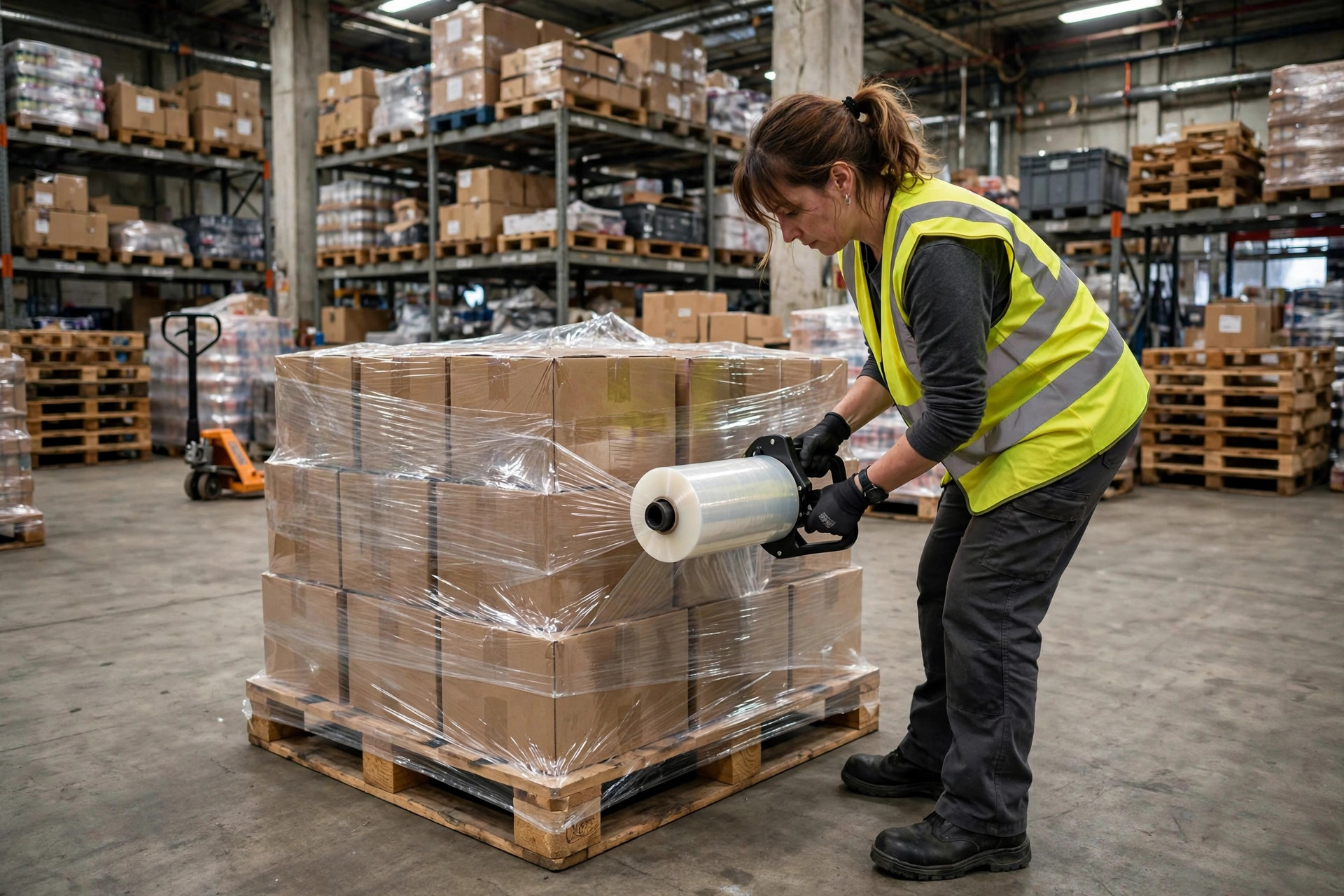
Third, hand wrap and machine wrap are different universes. Hand-applied film, stretched by arm strength, tops out around 10-20% real pre-stretch. Applying machine-film numbers to a hand-wrap operation is nonsense. For a small warehouse under 30 pallets a day, the right question is not the pre-stretch ratio — it is the payback on a semi-automatic wrapper. At $3,000-5,000 for the machine (the common range), hand wrap at roughly $0.55 a pallet versus $0.30 machine-wrapped at 250% pre-stretch: $0.24 saved per pallet, 25 pallets a day, 300 days — $1,800 a year, payback in just over two years, pure savings after that. Small warehouses should not fuss over hand-film pre-stretch. Change the game instead.
Three Levers to Land in the Sweet Spot
Lever one: aim for the sweet spot. For most warehouses, 220-250% is it — the practical ceiling for stretch film pre-stretch ratio savings per pallet. Push higher and each extra 50 points of ratio only shaves about 12% more film while damage risk climbs steeply. Not worth it. A rule of thumb from the table: starting at 150%, each 50-point step cuts film use by 17%, then 14%, then 12% — diminishing returns, rising risk. 250% is where most operations should stop.
Lever two: match the film to the ratio. Standard 80-gauge film — do not go past 250%. Want 280% or more — switch to high-performance film under 55 gauge. It costs 20-30% more per foot but consumes less, and the total math can still win. Run the table yourself; never take a salesperson's word for it.
Lever three: put the actual pre-stretch ratio on your quarterly checklist. Measure it, replace worn rollers. A roller set costs a few hundred dollars; a year of phantom film waste from a lying head costs ten times that.
One more ledger entry, for procurement: high-performance film at 300% pre-stretch runs about $0.34 a pallet versus $0.31 for standard film at 250% — 10% more on film. But its break rate can be half, and so is the damage-claim exposure. For heavy or irregular freight, paying 10% more on film to halve breakage and claims is a winning trade. For light carton freight, standard film at 250% and stop overthinking it. Buyers who compare only unit price always end up buying the film that is cheap and expensive at the same time.
The formula — calculate your own number in 30 seconds. Do not trust any one-size-fits-all recommendation, including mine. Take this formula, plug in your numbers:
Savings per pallet = applied film length x [1/(1+old ratio) - 1/(1+new ratio)] x raw film cost per foot
With the example above: 130 x (1/2.5 - 1/3.5) x 0.008 = $0.12 per pallet. Multiply by your daily pallets and operating days and you get the money you are throwing away — or keeping.
One line to close: never adjusting the ratio is throwing money away; cranking it blindly is burning money; setting it at 220-250% and calibrating quarterly is spending money where it counts. That is the complete answer to stretch film pre-stretch ratio savings per pallet — it was never about the film. It was always about the ledger.
By Lao Zhou, Logistics Cost Analyst