We have a client, an imported spirits distributor, who learned the most basic lesson in this business the expensive way. He assumed that renting a lockable warehouse and putting bottles on racks was enough to run a spirits warehouse. Before the first shipment left the building, he was told the bonded-area paperwork was wrong, and the whole lot sat unmovable. It stayed in the warehouse for two extra months, tying up cash, rent, and customer orders. He told me later that if he had known how many gates a spirits warehouse has, he would never have rented space on his own in year one.
I tell that story to everyone considering spirits storage, because the logic of a spirits warehouse is different from a general warehouse. A general warehouse manages goods. A spirits warehouse manages goods plus tax plus licenses. If the tax is not accounted for and the license is not protected, good product does not help you.
Gate one: TTB permits — a rented building is not a spirits warehouse
Spirits in the United States are federally regulated, and the regulator is the Alcohol and Tobacco Tax and Trade Bureau, the TTB. Storing and distributing spirits requires the right permits and bonded premises arrangements, with the facility, the record system, and the bond all meeting the requirements. Without them, product can enter the building and then go nowhere: every outbound move, transfer, and tax filing stalls.
That was our client's mistake: he signed the lease and brought product in first, then tried to fix the paperwork. The correct order is the reverse. Confirm the permit path and the bonded-premises requirements first, then choose a warehouse, then bring product in. When choosing a warehouse, ask before signing whether the site can serve as bonded storage, whether bonded and non-bonded areas are physically separated, and whether the record system can meet regulatory requirements. Ask those questions before the contract, not after.
One more caution: states have their own spirits licensing and distribution rules on top of the federal ones. Federal paperwork being complete does not mean state paperwork is complete. Requirements change, so verify everything against the latest TTB and state regulator guidance rather than taking a broker's assurance.
Gate two: tax records — the goods ledger and the money ledger are the same book
The place spirits warehouses most often get into trouble is not theft. It is records that do not reconcile. Every inbound receipt, outbound shipment, loss, and transfer has to match the tax records. One bottle unaccounted for turns into a problem for the whole lot when anyone looks closely.
Here is the inside story most operators will not tell you. Records usually go wrong not because someone falsifies them, but because the system never captured enough detail. Inbound was logged by case count only, without lot and proof. Outbound was logged by customer only, without the tax document number. Losses were logged as a total, without separating normal loss from abnormal loss. Months later, the book and the floor disagree by an amount nobody can explain.
Our practice is to build three records at receiving: lot, quantity, and tax status, and to clear all three together at shipment, with losses logged and approved separately. It sounds tedious, but those records are the warehouse's protection. When the regulator inspects, when a customer reconciles, when an insurer settles a claim, everything rests on that set. Without it, you cannot even prove how much product you hold.
Gate three: theft prevention — a different league from general warehousing
Spirits are high value, easy to resell, and hard to trace, so theft prevention has to sit at a higher level than in a general warehouse. Losing a pallet in a general warehouse is a loss. Losing a pallet in a spirits warehouse is a loss plus a licensing and regulatory problem.
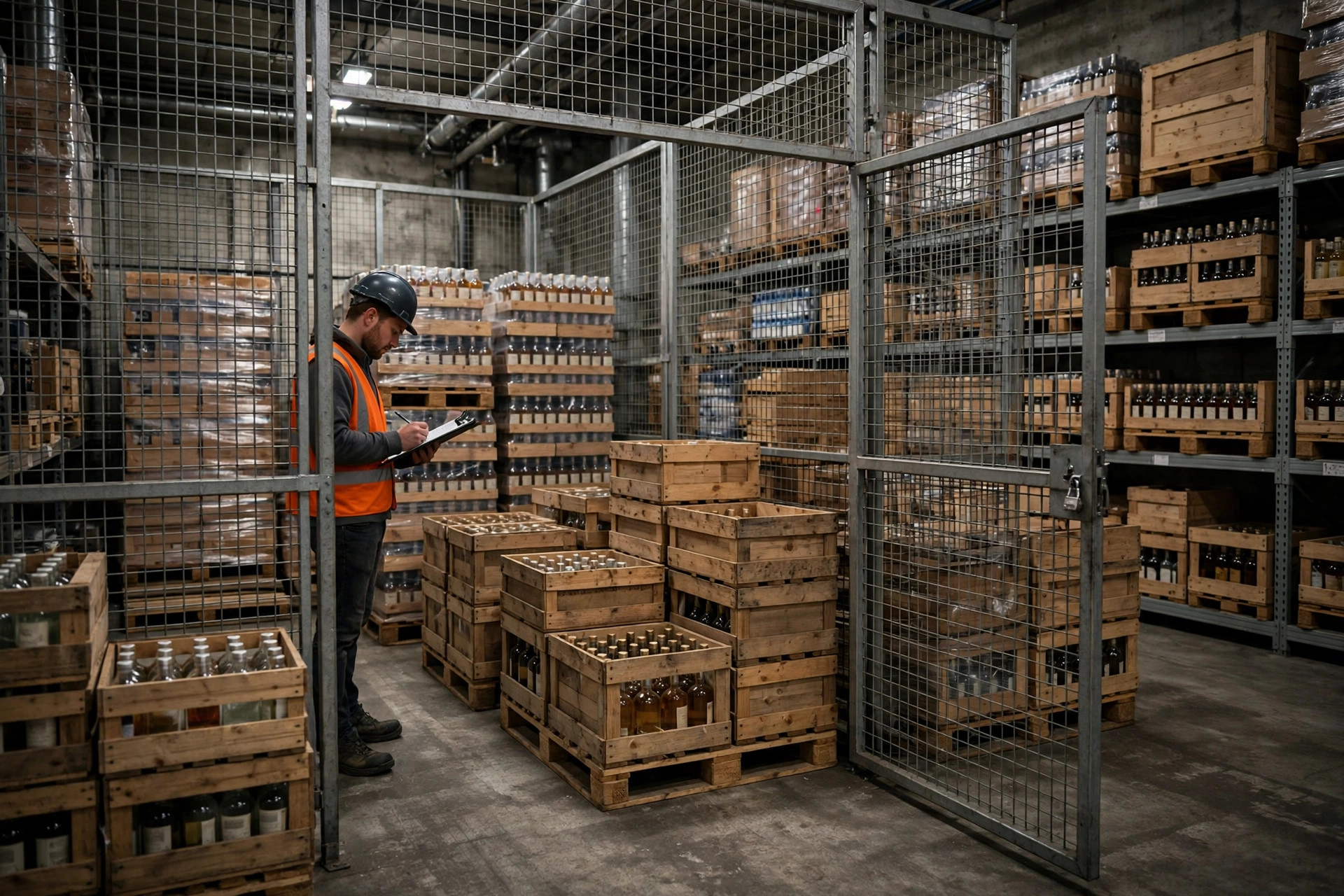
Prevention works in three layers. The physical layer: the bonded area gets its own lock and access control, with keys and codes split between people, never held by one person alone. The systems layer: two-person verification on inbound and outbound, separate counts for high-value lots, camera coverage over the bonded area and the dock, with recordings retained as regulations require. The people layer: an entry log for the bonded area, same-day removal of access for departing staff, and regular sample counts, rather than waiting for the annual wall-to-wall count to discover a shortage.
Next time you negotiate a contract, ask three questions. Is the bonded area physically separated? Is inbound and outbound verified by two people? How quickly would a count discrepancy surface? If the other side cannot answer, do not rent the space.
Spirits bonded warehouse insurance and bonds: discovering the gap after a loss is too late
There is one more item most clients barely read in the contract: insurance and bonds. A pallet of spirits is worth several pallets of general goods, so a policy bought to a general-goods limit will pay proportionally after a loss, and you absorb the gap. Bond arrangements work the same way: the bond amount and form directly affect how much product you can hold and move, and they need to be settled against regulatory requirements before signing.
The worst case I have seen was a client who bought a low limit to save premium, suffered a small water loss, and discovered at claim time that the policy covered only half of it. The premium saved was nothing against the loss absorbed. In a spirits warehouse contract, read the insurance clauses as carefully as the rent clauses, line by line, not just the total price.
Spirits bonded warehouse checklist before the first pallet
Pull all of this into one sheet, and check every item before signing and before the first shipment:
| Check | Ask | If it fails |
|---|---|---|
| TTB and state permits | Is the permit path clear, can the bonded area be used | Fix paperwork before product arrives |
| Bonded-area separation | Are bonded and non-bonded areas physically separated | Change sites or rebuild, do not improvise |
| Tax records | Can lot, quantity, and tax status reconcile three ways | Put the system in before accepting goods |
| Theft prevention layers | Access control, two-person verification, sample counts in place | Close the gaps before storing high-value lots |
| Insurance and bonds | Is the limit enough, are bond arrangements clear | Settle them before signing |
That sheet looks simple, but if our client had it in year one, his product would not have sat for two extra months. Tuition in the spirits warehouse business is expensive enough paid once.
The honest bottom line
Spirits warehousing looks profitable, and the barrier to entry is genuinely high. TTB permits, tax records, and theft prevention: if any one of the three is missing, both the product and the license can be at risk. Turn it around, and a warehouse that gets all three right can charge a premium, because what the customer is buying is not just space. It is compliance and peace of mind.
So do not start by asking what spirits warehouse rent costs. Start by asking whether the warehouse can compliantly hold your product. Rent negotiated cheap is worthless if the product cannot move.
By Susan, 3PL Sales Director