Spain ham export warehousing works on a logic unlike almost any other food export business: its inventory does not sit on a shelf waiting for orders. It hangs in a curing cellar, converting two to three years of time into money. The same leg, pulled six months early or released at full maturity, is effectively two different products at two different prices — and the temperature, humidity, rotation, and slicing rhythm in between decide whether that investment ends as a premium or a loss.
The data: volume barely moves, value jumps
According to Spanish Tax Agency data cited by the Spanish Serrano Ham Consortium, Spain exported 60,845.7 tons of cured ham and shoulder in 2024, up just 1.68% — yet value reached roughly 734.6 million euros, up 11.77%, with the average price rising to 12.07 euros per kilo. The European Union still took 69.73% of volume, but third-country markets, at 30.27%, grew 10.78% and supplied most of the growth. Exports to China exceeded 28 million euros in 2024, up about 60% on five years earlier, on a channel opened by a November 2018 agreement allowing bone-in ham into China.
Read together, these figures describe a market shifting from shipping more to shipping better: buyers are paying for longer curing, steadier quality, and a grading story they can trust. Warehousing here is not a cost centre; it is part of the pricing mechanism.
Spain ham export warehousing, first ledger: how time becomes money
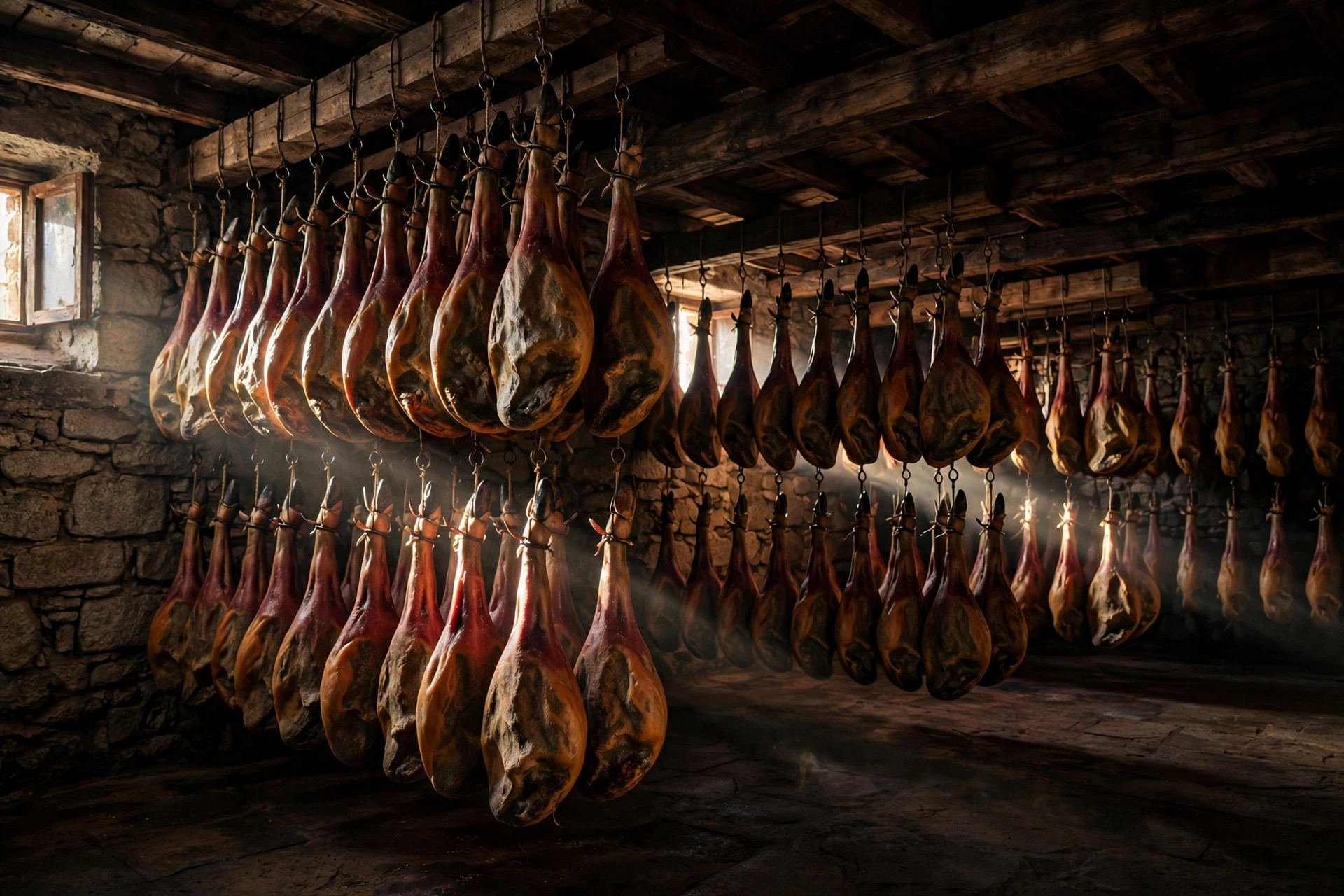
An Iberian leg's journey begins not in a slaughterhouse but in the dehesa, the open oak woodlands of southwestern Spain, where Iberian pigs roam freely and fatten on acorns and pasture. That diet shapes the fat, and the fat determines how far the leg can travel through curing. What follows is a four-stage process documented in producers' public technical material: salting at 1 to 5 degrees Celsius and 80 to 90% relative humidity; resting at 3 to 6 degrees and 80 to 90% humidity for 30 to 60 days; drying at 15 to 30 degrees for six to nine months; and finally cellaring at 10 to 20 degrees and 60 to 80% humidity for six to 30 months. Iberian ham generally cures for at least 24 months, and acorn-fed bellota legs commonly pass 36 months.
This is the first ledger in its simplest form: a leg occupies a hanging position for two or three years, tying up capital, space, and attention throughout. Releasing it early looks like faster turnover; in practice it ends work only time can finish, leaving flavour undeveloped and price capped. The counterintuitive point is plain: in ham export warehousing, a higher turnover rate is not necessarily better. What a cellar fears most is not slowness but an interrupted process, rushed for speed.
A cellar in Badajoz: one window, one month, one decision
In October 2024, visiting a mid-sized curing plant near Badajoz, I watched a plant manager explain why a batch of roughly 800 legs had its release pushed back a full month. The cause was unglamorous: through the summer, one ventilation window's opening rhythm had slipped out of step, leaving humidity locally high for several days. Routine sampling found surface mould on some legs still within the normal range — but the plant extended observation for the whole batch rather than take the chance.
The cost was real: 800 legs held an extra month, the next batch's entry delayed, cash collection pushed back. The manager's arithmetic ran the other way. This batch was bound for premium export orders, and a quality wobble could cost a third-country distributor's purchasing programme for years. Warehousing here is not about reading thermometers; it is about pricing risk — paying a month of certain cost to buy down the probability that a batch goes wrong.
The plant kept a position-level file for every batch — salting date, drying start, each inspection traceable to a hanging position. In quiet times that looks like bureaucracy; at customs and in origin-certification audits, it is the hardest evidence a producer owns.
A cellar is not a warehouse; it is a climate machine
Treating a curing cellar as an ordinary warehouse produces the second classic error. An ordinary warehouse optimises space utilisation and throughput; a cellar optimises the stability and evenness of climate. Temperature sets the pace at which fat melts and flavour compounds form, humidity sets the rate of moisture loss, and ventilation decides whether positions near a window and deep inside the room experience the same conditions. They never do, perfectly — which is why competent managers rotate positions, giving every leg as even a journey as possible.
The management vocabulary is therefore almost the opposite of cold-chain warehousing. Conventional cold storage demands constancy; curing demands a staged process — salting cold and damp, drying warm and dry, cellaring steady and slow. Running a cellar as a single-temperature cold room flattens a multi-stage craft into one number, and the layers of flavour are managed away with it.
A slicing room in Guijuelo: where export margin is won and lost
In the spring of 2025, in a slicing plant in Guijuelo, I saw the second ledger. This exporter's main orders are no longer whole legs but sliced retail packs: one third-country order ran to roughly 1,200 boxes, each specified by the distributor for slice thickness, vacuum level, and carton configuration. A whole leg travels with few steps and few risk points, but its price ceiling is low. Sliced product earns more per leg, yet every added step adds a failure mode: slicing-day room temperature, the integrity of each vacuum seal, the stacking pattern inside the container. A single failed seal claim can consume the whole order's margin.
Here sits another misunderstanding: that sliced product simply wants to be kept as cold as possible. Producer storage guidance tells a more differentiated story. Vacuum-packed sliced ham, unopened, keeps for 90 to 120 days under refrigeration and, once opened, should be eaten within 24 to 48 hours; a whole leg does not depend on refrigeration at all, and excessive chilling damages the fat's texture. Spain ham export warehousing therefore runs on two cold-chain logics at once — ambient cellaring for whole legs, refrigerated logic for sliced product — and mixing them up means protecting the right product with the wrong method.
A working cost model: cellaring and shipping
The table below is an illustrative model, not an industry price list, for seeing where the costs actually sit:
| Stage | Cost character | Key variable |
|---|---|---|
| Cellar position occupancy | Time cost, rising with curing months | Curing duration, position turnover |
| Climate control and inspection | Fixed cost plus labour | Cellar scale, sampling frequency |
| Grading and quality control | Quality cost, spent early to cut claims | Sampling rate, traceability completeness |
| Slicing and vacuum packing | Processing cost plus yield loss | Slice specification, seal pass rate |
| Refrigerated export shipping | Freight cost plus time risk | Destination distance, customs clearance time |
Visible freight and rent are only part of the bill; the larger items are time cost and quality risk, hidden inside the cellaring period. The trade-off is symmetrical: one extra month raises position cost by a known amount while lifting price and lowering claim probability; one month less saves a known amount while raising the probability of batch variation. A manager's job is to re-solve that equation for every batch, not carry forward last batch's answer.
The trend: Spain ham export warehousing is becoming the competitive edge itself
Pull the threads together and the direction of travel is clear. First, flat volume with sharply rising value indicates a buyer base upgrading toward premium product, with third-country demand expanding. Second, grading and origin certification are hardening into export preconditions: the black, red, green, and white label system, with protected designations of origin, is turning "can you document where this leg came from and how it was cured" into a threshold requirement. Third, slicing and small-format packs are the certain direction of travel, opening more retail shelves while pushing shipping complexity up a full level.
The attribution behind all three trends is the same: Spain ham export warehousing is moving from back-office function to competitive edge itself. Exporters once competed on dehesa pig supply; now they compete on running a two-to-three-year curing process that is stable, traceable, and repeatable, and on not dropping points at slicing and shipping. Supply decides the starting point; warehousing decides the finish, and the finish is where buyers pay.
Two questions remain genuinely open. First, as third-country share keeps rising, will cellaring and shipping parameters need customising by destination climate and customs rhythm, or will one European standard keep serving every market? Second, as slicing deepens, will cellaring and slicing plants stay separate specialists or integrate? The answers will shape the next round of investment — and, fittingly, will probably take another two-to-three-year curing cycle to verify.
By Dr. Chen, Supply Chain Researcher