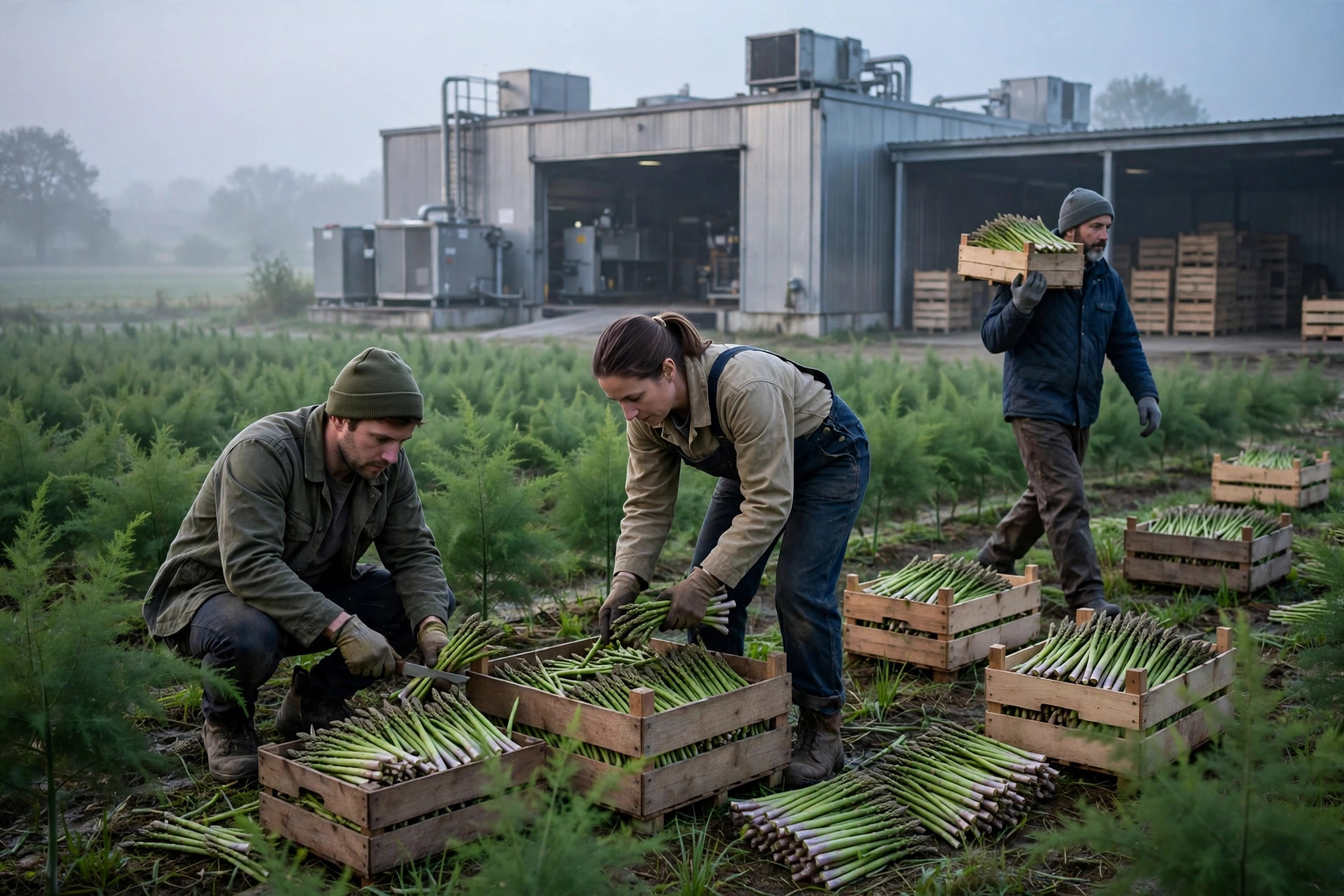
Let me start with the conclusion. In the Peru asparagus business, the winner is not the farm that grows the best spears. It is the packhouse that pre-cools fastest and holds the cold chain steadiest. An asparagus spear starts aging the moment it is cut. If field heat is not removed quickly, no airport cold store in the world will save it later. I have seen too many operators pour money into airport cold storage and packaging while cutting corners on field pre-cooling, and the result is always the same: the shipment lands in Miami with open tips and limp spears, and the whole container gets downgraded.
Put bluntly, the asparagus cold chain has one main line: cut it, remove field heat fast, never break the chain, and get it onto the plane or the ship on time. Any step that runs slow or breaks costs the packhouse directly.
A mistake I have seen: asparagus pre-cooling two hours late
A packhouse in Ica sits close to the fields and has decent equipment. One peak season, the harvest crew started at five in the morning, but the trucks waited until they were fully loaded before leaving. The first load of asparagus sat in the field sun until nine before it reached the plant. On arrival the spears still looked green. They went through pre-cooling, hydro-cooling, grading, cutting, and packing, and the shipment made its flight on time. When the buyer opened it in Miami, the tips had already flowered, and the whole lot had to be sold at a discount.
The problem was those four hours. Freshly cut asparagus respires hard, and field heat left in place means quality slides downhill every day. The plant later changed one simple rule: harvest trucks do not wait to fill up. They run small loads fast, with temporary shade and pre-cooling points in the field, and asparagus must enter pre-cooling within two hours of reaching the plant. In the first year after that change, peak-season complaints fell sharply. There is a rule in cold chain work worth remembering: two hours saved up front are worth more than two extra days in the cold store later.
Asparagus air versus sea: where to draw the line
Green asparagus and white asparagus travel differently. Green asparagus is delicate with a short shelf life, and it mostly flies: Ica field pre-cooling, packhouse grading and cutting, Lima airport cold storage, then customs clearance in Miami. The air freight bill is a time bill. Every step from harvest to loading must be timed, and the airport cold store is not a place to store goods. It is a transfer point where the chain must not break. Every extra day a shipment sits in airport cold storage is a day off its shelf life.
White asparagus keeps longer, so sea freight takes a bigger share. The sea freight bill is a temperature bill. With more than ten days at sea, any swing in container temperature, humidity, or atmosphere shows up as a quality discount on arrival. Sea freight is not a cheaper version of air freight. It is a different game: pre-cooling must be deeper, packaging must be steadier, and the distribution rhythm after arrival must be planned in advance. Pick the wrong mode and even perfect pre-cooling is wasted.
| Route | Suits | The core bill |
|---|---|---|
| Air (Lima airport cold storage to Miami) | Green asparagus, short shelf life, price sensitive | Time: every step from harvest to loading is timed |
| Sea | White asparagus, hardy, large volume | Temperature: days at sea, container conditions cannot swing |
There is one trade-off many people get backwards. Modified-atmosphere bags and similar packaging can extend shelf life, but they are not a cure-all. Packaging only buys you extra days if the cold chain never breaks. Break the chain and no bag will save the shipment. Get pre-cooling and an unbroken chain right first, then talk about packaging upgrades, not the other way around.
Three iron rules for the packhouse
First, harvest trucks do not wait, and pre-cooling does not wait for tomorrow. Field heat is asparagus's biggest enemy, and the sooner it is gone, the better. Second, the airport cold store is a transfer point, not a warehouse. When goods reach the Lima airport cold store, the goal is to get them onto a plane as soon as possible, not to "store them for now." Third, keep batches separate. Green and white asparagus, different grades, and different destination ports get pre-cooled, packed, and recorded separately. Mix one batch and you cannot trace any of them.
Where the asparagus chain breaks: airport cold storage, customs, and distribution
Put bluntly, the asparagus cold chain breaks most easily not in the field or the packhouse, but at handover points. The first handover point is from the packhouse to airport cold storage. When goods come off the packhouse refrigerated truck and enter airport cold storage, did they sit at ambient temperature in between? Half an hour at ambient temperature pushes carton temperature up and takes half a day off shelf life. The rule we set for packhouses is simple: dock the truck to the cold store door first, then open the doors. Door-to-door handover, no waiting on the ground in between.
The second handover point is customs clearance in Miami. Clearance is not the end of the cold chain. It is the start of another one. After clearance, did the distributor's refrigerated truck arrive on time, or did the goods sit in the sun on the tarmac waiting for a truck? Many packhouses think their job ends when the goods board the plane. In reality, the distribution rhythm after arrival in Miami is what decides repeat orders. One extra day in clearance is one day less shelf life for the distributor and a harder price negotiation on the next order.
The third break point sits at retail. Whether supermarket cold cases hold steady temperature, and how many days asparagus sits on the shelf, is outside the packhouse's control. What the packhouse can control is packaging: modified-atmosphere bags, absorbent pads, and box liners buy a little extra time when the chain wobbles slightly. Packaging is not insurance. It is a buffer, and a buffer only works if the chain never broke before it.
I have seen too many people understand cold chain as "keep everything refrigerated." In reality, cold chain means "manage every handover." Every handover point needs a temperature record, a responsible person, and a plan for overtime. Manage the handover points and the chain holds. Leave them unmanaged and the chain breaks no matter how good the cold stores are.
One last line: asparagus export is not won by the biggest farm. It is won by the fastest cold chain. Pre-cool one step faster and the shipment sells a grade higher. Break the chain once and the brand takes the hit. That is a bill every packhouse counts daily.
By Lao Mi, Supply Chain Veteran (20 yrs)