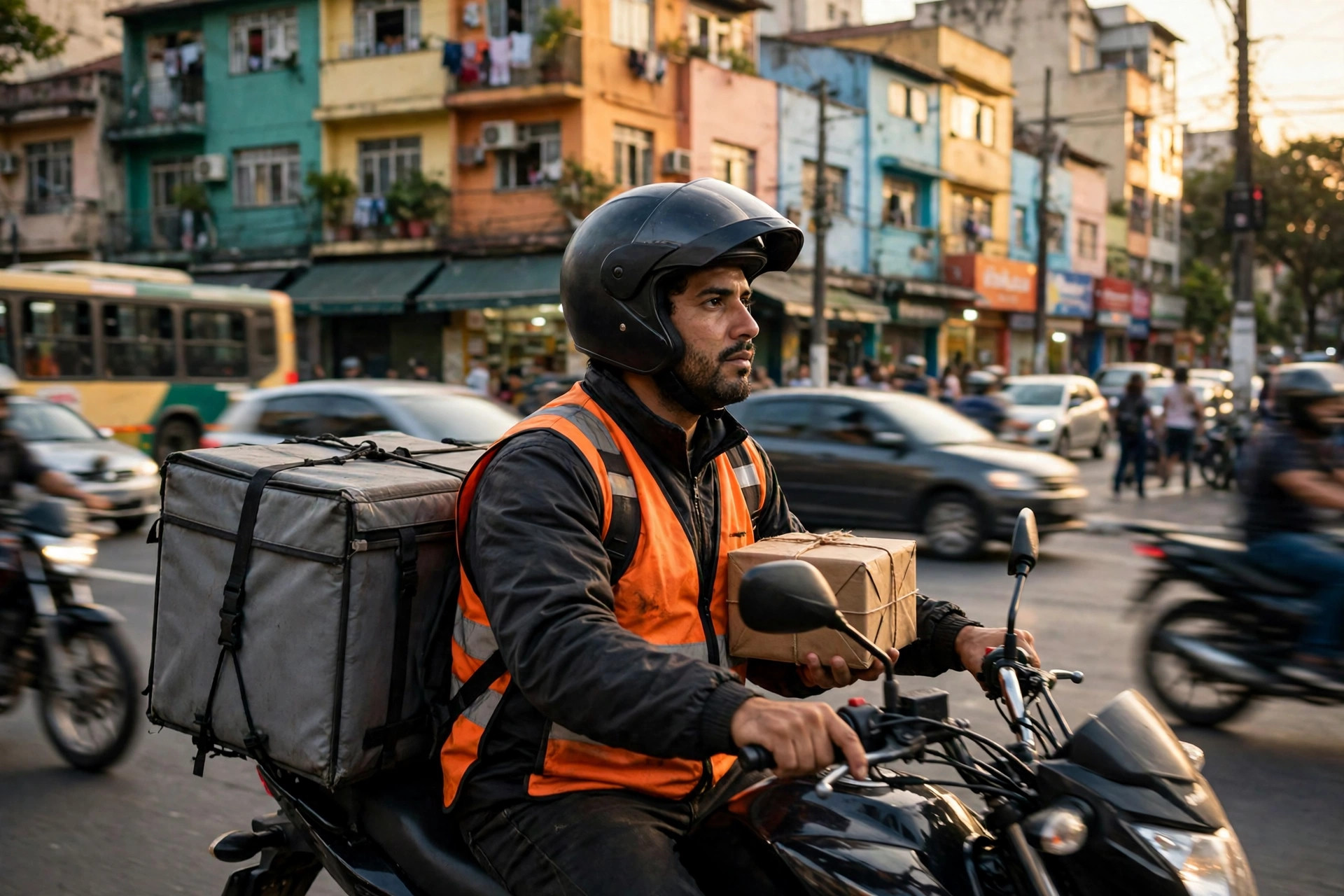
I run a 3,000-square-meter warehouse with about a dozen people and two forklifts, and here I am writing about south america last mile delivery motorcycle courier work in São Paulo. It sounds absurd, and honestly it is a bit absurd. But every small warehouse on earth is doing the same math on the last mile right now, and the answer South America came up with is exactly the one small operators like me should be stealing: the smaller the vehicle, the denser the drops, the better the money works.
Start with our own predicament. Last peak season I ran the numbers on city delivery: outsourcing to a third party kept the per-order price high and customers still complained it was slow, while running two vans of our own meant fuel, insurance, and driver wages that bled money the moment the slow season arrived. We small warehouses cannot afford to burn cash like that. Big companies talk about the last mile in terms of driverless vans, smart dispatch, and drones. The streets of South America tell a different story: motorcycle couriers everywhere, one bike, one top box, one phone, and the parcel gets there.
How South America Last-Mile Delivery Motorcycle Couriers Win the Street
South america last mile delivery motorcycle courier networks did not grow because anyone fell in love with bikes. They grew because of traffic. In São Paulo or Rio at rush hour, a van might manage two or three drops per run while a motorcycle threads through the jam and knocks out twenty or thirty drops a day. Freight here is not priced by the tonne. It is priced by the drop, and density is everything in the last mile.
The numbers back it up. Published rider pay rates show platforms such as iFood paying a minimum of about 7.50 reais for short trips within 4 kilometres, plus roughly 2–5 reais per kilometre beyond that, varying by city and time of day — check the latest official policy before quoting it. A 6-kilometre order works out to roughly 11.50–17.50 reais for the rider on that basis. That sounds small until you multiply it: 25 such orders in a day comes to roughly 290–440 reais. That is the motorcycle's business model in one line — low price per drop, high frequency, money made on turnover.
The platform story is worth a look too. Loggi was founded in São Paulo in 2013 as a platform connecting merchants with couriers, and it has grown into a major Brazilian logistics network covering more than 4,000 municipalities. Its trick was never owning tens of thousands of vehicles. It crowdsourced capacity, turning thousands of independent riders into the capillaries of the network. For a small warehouse, that idea beats any technology pitch: you do not need to own the fleet, you need to be able to call on it.
The Courier's Math: What a Kilometre Actually Pays
Revenue alone misleads. You have to split the courier's books open. The table below is an illustrative example: rates taken from the published figures above, running costs assumed at 0.70 reais per kilometre for fuel, maintenance, and tyres. Real figures will differ by city and by bike, so do not treat this as a standard rate card:
| Item | Per kilometre (reais/km) |
|---|---|
| Rider distance earnings | about 2–5 |
| Vehicle running cost (assumed) | about 0.70 |
| Gross margin per km (illustrative example) | about 1.30–4.30 |
On that illustrative basis, a rider covering 100 kilometres in a day earns roughly 200–500 reais in distance pay against about 70 reais of vehicle cost, and the rest is the day's pay for the work. The numbers are not glamorous, but look at the other side of the ledger: no fleet to maintain, no warehouse lease, no waiting for freight — one phone, one app, and the rider is working. Here is the counterintuitive part: the most expensive cost in the last mile is not fuel, it is a rider sitting idle or riding empty. What a platform really sells is not vehicles. It sells order density, so riders spend less time waiting and riding empty.
Getting into these networks has clear entry requirements too. Take Mercado Envios Extra in Brazil: riders need a top box of at least 80 litres and must register as an MEI, a micro-entrepreneur, under a delivery activity code. Eighty litres is a sensible number — big enough for most e-commerce parcels, small enough that the bike stays rideable. The paperwork is not optional, and platforms delist riders who skip it.
What Small Warehouses Can Copy from South America Last-Mile Delivery Motorcycle Couriers
Back to our own patch. South america last mile delivery motorcycle courier practice hands small warehouses three ideas worth copying directly. One, do not put heavy assets into the last mile. Owning a fleet feels solid until the slow season's fixed costs start dragging the warehouse under; crowdsourced capacity is paid per order, flexes up in peak season, and costs nothing when it is quiet. Two, density matters more than speed. Promising two-hour delivery across the whole city is less valuable than packing orders tightly into one neighbourhood so a rider makes several drops per trip and the cost per drop falls. Three, treat the warehouse as a rest stop for riders, not just the end of the line for freight. A small patch by the door for riders to wait, charge a phone, and grab water makes them pick your orders first, and your delivery times improve without spending a cent on vehicles.
This model has real limits, and there is no point hiding them: motorcycles cannot carry bulky goods, rainy days raise accident risk, and rider turnover is high. If you sell furniture or large appliances, forget it and use a van. But for small parcels, apparel, phone cases, and cosmetics, the motorcycle is the cheapest workable answer on the street.
As I write this, our own city delivery is still outsourced, and three rounds of price talks have gone nowhere. After looking at the South American playbook, my conclusion is simple: small warehouses should not copy big companies and build fleets. Copy the South Americans instead — pack the orders dense and crowdsource the wheels. The vehicle does not need to be big. It needs to keep moving.
Small warehouses have their own way to survive.
By Xiao Ma, Small Warehouse Owner