Amazon changed the rules again. I feel like I have said that sentence a hundred times this year. But the bill that hurt me this time did not come from Amazon. It came from the carrier — an oversize parcel surcharge I never saw coming.
In August 2026, I shipped a batch of floor lamps out of my warehouse in Ontario, California. When I reconciled the invoice at the end of the month, the surcharge column was $9,000 heavier than I expected. Three hundred lamps, thirty dollars of extra fees on each one. That is the oversize parcel surcharge doing its quiet work, one package at a time.
The lamp itself weighs only 18 pounds. The problem was the box: 50 inches long, one line past the 48-inch mark. I used to watch weight and ignore dimensions, figuring an 18-pound box could not possibly cost extra. The carrier disagrees. Once the longest side passes 48 inches, the additional handling charge applies, and it does not care how light the box is. The rule was always published. I just never read it.
Where the Oversize Parcel Surcharge Line Actually Sits
I went through both big carriers' rules line by line afterward, and here is roughly how the lines are drawn. The additional handling tier applies when any one of these is true: longest side over 48 inches, second-longest side over 30 inches, length plus girth over 105 inches, cubic volume over 10,368 cubic inches, or actual weight over 50 pounds. The oversize tier is stricter: longest side over 96 inches, length plus girth over 130 inches, cubic volume over 17,280 cubic inches, or actual weight over 110 pounds. Hit any one of those and the oversize charge applies, with a minimum billable weight of 90 pounds. Go further, over 150 pounds or over 108 inches on the longest side, and you are over the maximum: the fee gets painful, and some parcels are refused outright. Exact amounts vary by zone and change every year, so check the carrier's current published rates before you quote anything.
Girth means the longest side plus twice the width plus twice the height. Measure the right edges, or the math lies to you. In 2026 both carriers added a cubic volume test: over 10,368 cubic inches triggers additional handling, over 17,280 triggers the oversize charge. Boxes that used to pass on length alone can now trip on volume. A wide, short box is no longer safe just because it is short.
Two details catch warehouse teams off guard. First, the carrier measures the box at its bulging point after it is sealed, and fractions of an inch round up. One inch of bulge can push you over the line. Second, peak season adds a demand surcharge on top of the regular fee. For FedEx in 2026, the peak oversize demand surcharge ran $95.75 per package, rising to $117.25 in the busiest weeks. That is on top of the base oversize charge, not instead of it.
The minimum billable weight is another quiet trap. An oversize parcel bills at a minimum of 90 pounds, so a 55-pound shipment still pays freight as if it weighed 90. The fee is not the only extra cost: the freight itself goes up first. Dimension-based additional handling carries its own floor of 40 pounds. Ship light freight in a big box, and you get hit on freight and on fees at the same time.
Three Moves at the Packing Bench That Beat the Oversize Fees
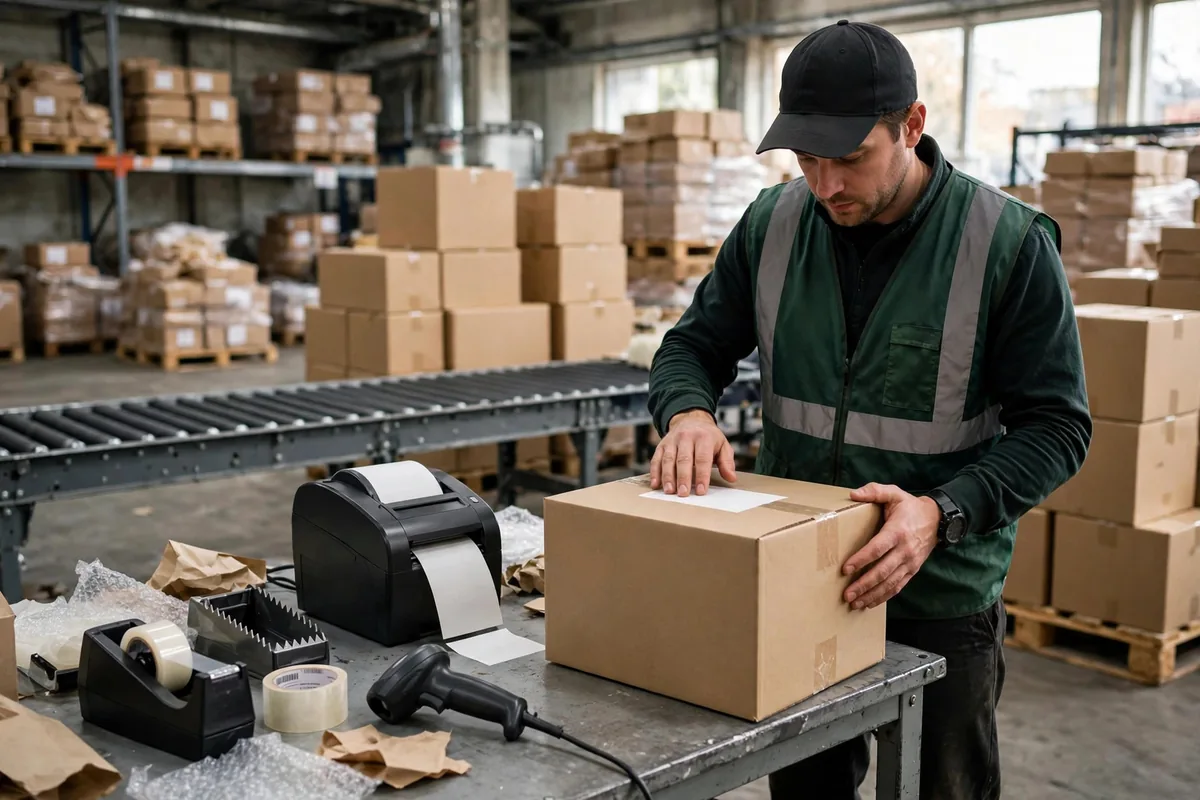
The first move is to measure. There is a tape measure nailed to every packing bench in my warehouse now. Every new product gets its three dimensions recorded in the product file before it ships. After sealing, we measure the box again at its widest point, and we check it once more before the label goes on. Any box over 48 inches gets flagged red: swap the box or move to the next move. Measuring is a crude method, and crude methods work. Nobody in my warehouse seals a box without measuring it now.
The second move is to change the box. In October 2026, a batch of fitness equipment shipped in a 24 x 24 x 31 inch box: 17,856 cubic inches, just over the 17,280 oversize line. Switching to a 24 x 24 x 29 inch box brought the volume to 16,704 cubic inches, just under the line. One inch of difference, and the oversize parcel surcharge disappeared from every single package. For reference, UPS published its 2026 commercial large package surcharge at $219.50 to $286.00 per package, varying by zone. Keep five or six box sizes in stock. One extra box size is cheaper than one extra surcharge.
The third move is to split. If a product can ship in two boxes, split it, and keep every piece under 48 inches. The surcharge drops to zero. Splitting adds a step and an extra label, but the math usually favors it, and the next section shows why.
One more trap people miss: the packaging itself can trigger additional handling. A box that is not fully enclosed in corrugated cardboard, shrink wrap or banding, or a cylindrical item shipped bare can get charged even when the dimensions are fine. Put odd-shaped freight in a proper carton first. Do not let the packaging pay the tuition for you.
Splitting the Box Can Cost Less Than Shipping It Whole
Here is the counterintuitive part: a light, bulky box costs more to ship than a heavy, compact one. The carrier charges oversize fees on size and volume, not on effort. My 18-pound lamp in a 50-inch box got hit with extra fees. A 50-pound dumbbell in a tidy box sailed through with nothing extra. Weight is not protection. Dimensions are the whole game.
Here is the math, as a hypothetical example based on 300 packages a month at $30 of additional handling per package:
| Option | Extra cost per package | Per month, 300 packages | Result | | Ship as-is | $30 surcharge | $9,000 | Money straight out the door | | Smaller box | $0.50 more per box | $150 | Surcharge gone | | Split into two | $12 for the extra shipment | $3,600 | Surcharge gone |
Spread across unit cost, it looks worse. That floor lamp sells for $89. A $30 surcharge eats more than a third of the selling price. No amount of conversion rate tuning or ad spend fixes a hole that big.
There is also a line where parcel shipping stops making sense. When a single piece approaches 110 pounds, or its longest side approaches 96 inches, stop fighting the parcel network and price out LTL. Multiple pieces going to the same address can ride one pallet under LTL, often for less than sending them one by one as parcels. Parcels are priced per piece. LTL is priced per pallet. The more concentrated the freight, the better LTL looks. Getting an LTL quote takes a few minutes: put it next to the parcel price with the surcharge included and take whichever is cheaper. When peak surcharges push parcel prices up, the LTL advantage only grows, so this math is worth redoing every month.
Three reminders before peak season: record the three dimensions of every new product, stock the box sizes you actually need, and mark the peak surcharge dates on the calendar. When you reconcile the monthly invoice, pull the surcharges into their own column. If the same product gets hit two weeks in a row, go back and change the box instead of waiting for peak season to fix it. The oversize parcel surcharge is not bad luck. It is a packing-bench problem, and it can be stopped at the packing bench. Measure before you seal the box. That one works. I have tested it myself.
By Ah K, E-commerce Seller (5 yrs)