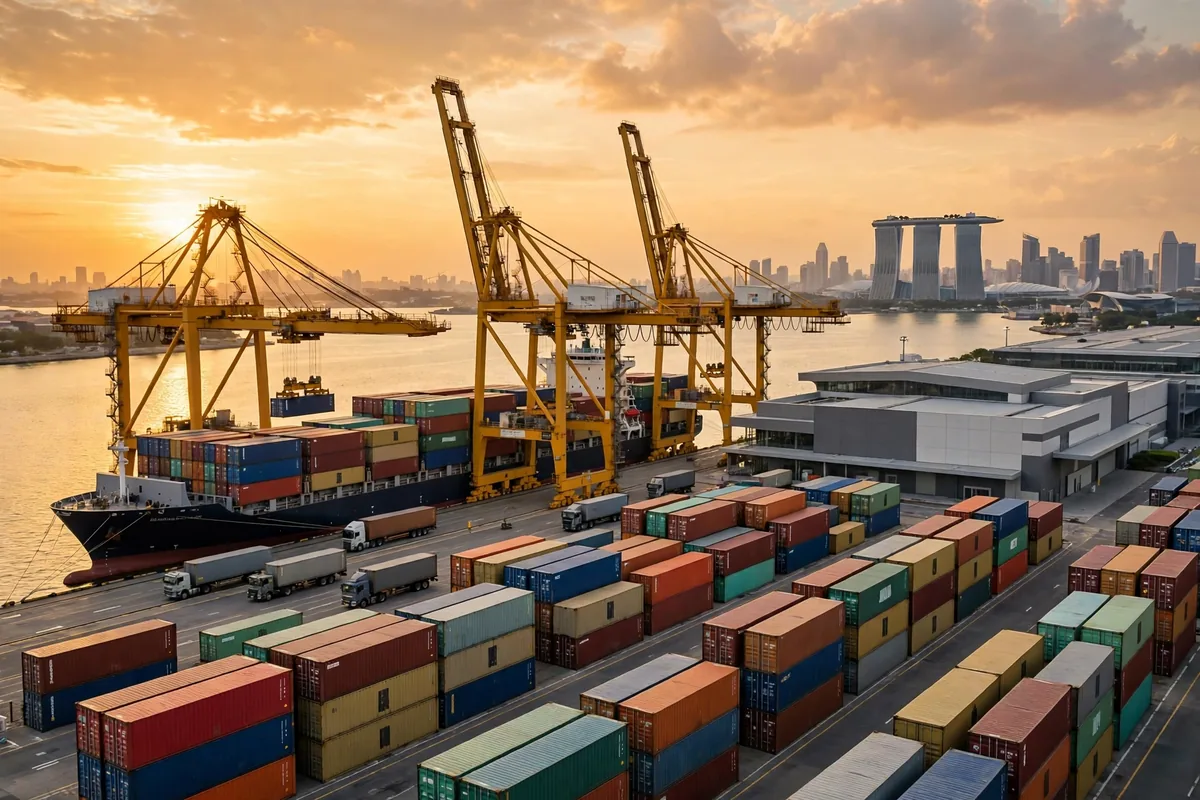
Let me open with the phone call that taught me how Singapore port warehouse distribution actually works. A friend who sells auto parts across Southeast Asia rang me late one night: his container had reached the Port of Singapore, and he had to choose — break it open for transshipment and split it, or send it onward sealed. Pick wrong and he would pay for an extra handling step; pick right and he would skip a round of storage. I run a 3,000-square-meter warehouse and have never rented a square meter in Singapore. But small owners survive on small sums, and the sum here was obvious: a giant hub plays a giant game, and the best we can do is pick up the pieces that fall off its board.
In 2024 the Port of Singapore handled 41.12 million TEU, up 5.4 percent on the 39 million TEU of 2023 — the first time it crossed 40 million. Somewhere between 85 and 90 percent of that volume is transshipment, according to the Maritime and Port Authority of Singapore and industry estimates. Read that again: the cargo never enters the Singapore market at all. It changes ships and leaves. So the heart of Singapore port warehouse distribution is not storage. It is handover. The shorter a box sits, the better the hub works; the moment cargo must stop, be opened, split, and re-packed, the bill gets complicated. Anything that moves cargo through faster is what the hub is built for; anything that asks it to slow down for you is on your bill.
The Singapore port transshipment math: cargo that never lands
In September 2022, when the first three berths at Tuas Port opened, my auto-parts friend had a shipment caught in that moment. One container, two destination countries. Splitting it in Singapore looked obvious — the shortest route on the map. But his small sum said otherwise. Splitting meant one more handling step, one more storage leg, and one more set of documents. Sending the box on sealed and splitting it near its destination meant a longer ocean leg, but zero waiting inside the hub. He sent it on sealed. The bill was lighter for it.
That is the first counterintuitive lesson of this hub: the stronger Singapore gets, the less a small seller should push cargo into its arms. A volume of 41.12 million TEU runs on standardisation, big batches, and fast turnarounds. A small shipment asking for customised distribution inside that machine is like driving a three-wheeled cart onto a motorway — the toll is priced for trucks, and it will eat you alive. Tuas Port, fully built out in the 2040s, will handle 65 million TEU a year across 66 berths as the world's largest fully automated container terminal; its first berths entered service in 2021. The more automated the port becomes, the more it loves cargo nobody has to touch. If we small players want a ride, our first rule is simple: minimise touches, minimise stops.
A second case makes the same point from the other side. A small seller I know ships consumer goods to three Southeast Asian markets and routed everything through Singapore for years, because the sailing frequency looked unbeatable. Then he counted the real cost: every split in the hub added a handling step and a storage window, and the window kept slipping because his volumes were too small to fill a sailing on their own. He now sends two of the three markets direct and keeps only the smallest, most awkward lane going through Singapore, where the hub's frequency is genuinely worth the extra touch. The frequency is real — just not free.
Bonded storage is a tax delay, not a tax holiday
Singapore's free trade zone and bonded warehouse system makes many small sellers' eyes light up — until you read the fine print. A bonded warehouse does not make tax disappear. It postpones it. Inside a free trade zone, goods can be imported, exported, and transshipped without paying duty and GST. In a licensed or zero-GST warehouse, imported goods can be held while duty and GST are deferred. The key is the second half of that sentence: as long as the goods stay inside the bonded area and never enter the local market, no tax arises. The moment they cross into the local market, every cent comes due.
The most expensive mistake I have seen is a small seller hearing "duty deferred" as "duty free" and letting cargo sit in a bonded warehouse for months while waiting for orders to pile up. The tax was postponed. The rent was not. Here is the small sum that matters: bonded storage only pays when the cargo turns fast. The faster it turns, the more the deferral is worth; the longer it lies there, the more you are just working to pay the warehouse. There is a second trap: bonded warehouses run on stricter paperwork, and one wrong character can leave a shipment stuck inside the zone. Small teams like mine cannot afford a shipment held up for three days because of a form.
So my rough rule: bonded storage is for two kinds of cargo only — cargo definitely transshipping on a fixed sailing, and cargo whose duty bill is large enough to justify the paperwork trip. Everything else stays out. The test is one sentence: if the money saved by paying the tax a month later does not cover the extra storage and labour, do not use the bonded warehouse. It is a crude test, and it has never cost me money.
Three plays a small warehouse can borrow from the Singapore port hub
Big-hub plays are out of our reach, but small plays are not. First, borrow the sailing schedule, not the warehouse: do not hold stock in Singapore long-term. Treat the port as an interchange station, cargo in and cargo out, and let the hub's frequency save you a leg of mainline transport. Second, use bonded storage as transit parking, never as a stockroom: goods arrive, get split, get reloaded, and leave inside one sailing window. If a shipment sits longer, stop and ask whether the plan was wrong. Third, borrow the facilities going up next to Tuas Port. The PSA Supply Chain Hub at Tuas sits inside the free trade zone beside the port, covers over 2 million square feet, and is scheduled to start operating in 2027, combining a container freight station, a regional distribution centre, cold storage, and dangerous-goods handling. Cold storage and dangerous-goods handling are capabilities a small owner could never build alone. Borrowing the hub's version is how a small warehouse survives.
And here are the two plays we cannot afford. The first is building our own distribution centre next to the hub: the capacity around Tuas is designed for regional volumes, automation, and compliance at a scale priced for big players — we small warehouses cannot burn that kind of money. The second is signing a long-term lease to lock in a price. Hub warehousing is priced for big customers' volumes; a small volume negotiating a long lock-in usually ends up worse off than paying as you go. Keep the comparison in front of you, because picking the wrong direction costs more than doing nothing:
| Route | Best for | Where the money goes | Biggest trap | | Direct to destination port | Single cargo, one clear destination | One ocean leg | Missing a shared-sailing chance | | Split in Singapore for transshipment | Several destinations, one container, many orders | One extra split and distribution step | Cargo sitting too long in the hub | | Bonded storage, then onward | Large duty bill, sailing already fixed | Transit storage and paperwork cost | Mistaking deferred tax for no tax |
Finally, a three-question test for the wall. Question one: where does this cargo finally go — into the Singapore local market, or onward? If it enters the local market, do not route it through bonded storage. Question two: does the money saved by splitting cover one more handling step and one more storage leg? If not, send the box on sealed. Question three: can the cargo clear the hub inside one sailing window? If not, sort it out at the port of origin first. Answer all three and go ahead. If any one stumps you, stay away for now.
That is the real lesson of Singapore port warehouse distribution for us. The hub teaches scale; we small owners need to learn selection. A transshipment hub moving 41.12 million TEU will never slow down for one small shipment, but its sailing frequency, bonded storage, and facilities are enough for us to pick from. Pick well and the savings are real; pick badly and the tuition fee is real too. A small warehouse has its own way of surviving: we do not match the big hub for scale, we borrow its rhythm.
By Xiao Ma, Small Warehouse Owner