A friend who trades African produce called me last month: "Xiao Ma, can you handle a Rwanda tea shipment? Decent volume." I told him to stop asking about freight rates and start asking about the warehouse. Tea is fussy. It drinks moisture and steals smells from everything around it, and two extra damp days in storage will show up at the auction — the buyers can smell a badly kept lot, and the price drops on the spot. My warehouse is only 3,000 square metres. We cannot afford that kind of lesson, so I ran the numbers before I said yes.
Here is the scale of rwanda tea export warehouse storage as a business. Rwanda's National Agricultural Export Development Board (NAEB) reports that in the 2023/24 financial year the country made 40,003 tonnes of tea and exported 38,467.7 tonnes for US$114.8 million. About 80% went through auction, 17.3% through direct deals, and 97.3% left the country as bulk tea. In 2024 tea exports reached US$114 million, up 27% on the year before, overtaking coffee as Rwanda's top agricultural export. Nineteen factories process the leaf, and more than 59,000 households grow it. The national target is 70,000 tonnes and US$300 million by 2029. The pie is getting bigger, and storage is the slice nobody talks about until it goes wrong.
How Rwanda Tea Travels From Garden to Port, Warehouse by Warehouse
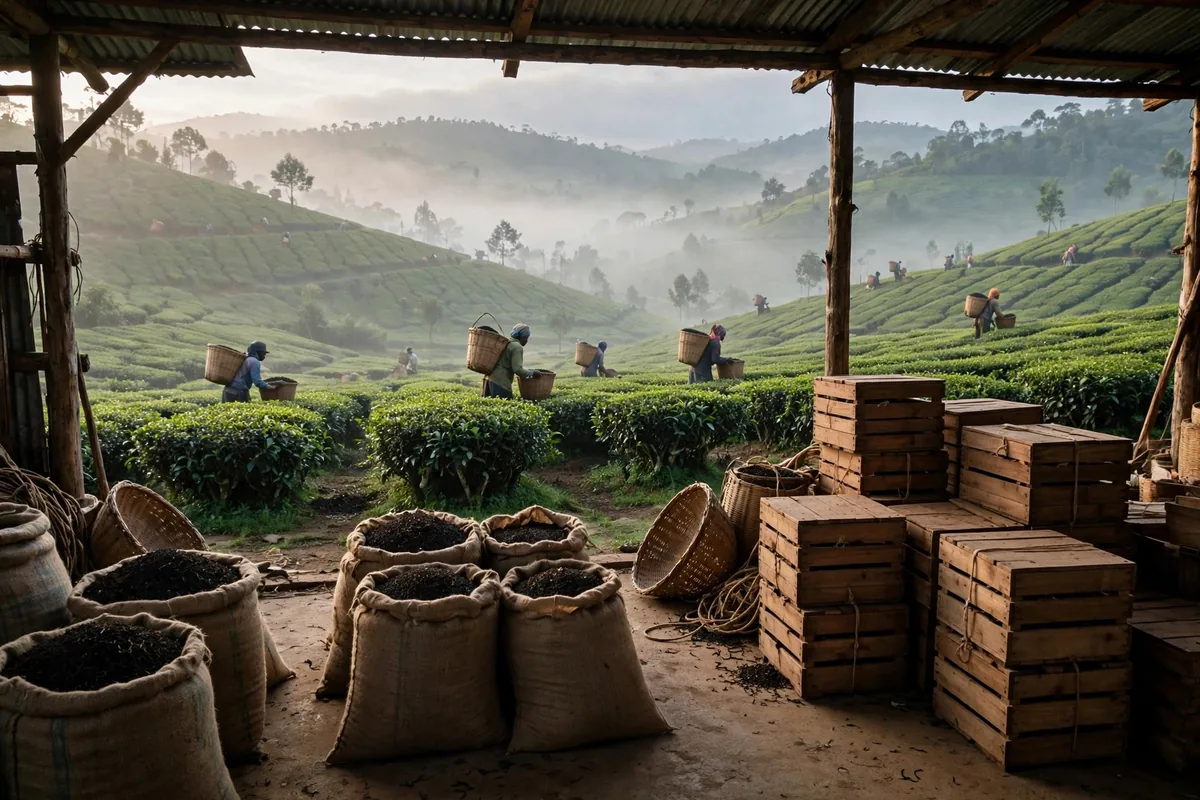
Rwanda is landlocked. Its tea reaches the sea through Mombasa in Kenya or Dar es Salaam in Tanzania, and most of it goes through Mombasa. The chain has three warehouses, and each one does a different job. Leaf comes off the highland gardens and goes straight into the factory warehouse for withering, rolling and drying. Made tea then moves to a consolidation warehouse around Kigali for grading, blending and packing. Finally the container goes on a truck: Mombasa to Kigali is 1,680 kilometres, six to seven days on the road, crossing at the Malaba and Gatuna border posts.
The three warehouses run on different logic. The factory warehouse is about speed — fresh leaf has to be processed the same day, and made tea only goes into storage once its moisture content is down. The consolidation warehouse is about separation — which factory, which grade, which auction lot, kept strictly apart, because one wrong blend can drag down the price of the whole container. The port warehouse is about waiting — waiting for the vessel, the documents, the inspection — and every extra day in the port area costs money. That waiting is the part of rwanda tea export warehouse storage most newcomers underestimate, because nobody puts waiting on a quotation. Kigali also has an inland dry port built by DP World: 13 hectares, 20 kilometres from the city centre, with bonded warehousing and a container yard, so tea can be consolidated there instead of queuing at Mombasa.
My own warehouse is 3,000 square metres. When I heard "13 hectares" my first thought was that one dry port equals forty-odd warehouses like mine. But the principle is the same at any size: a warehouse is not about square metres, it is about whether each job has its own clear place.
Tea Hates Damp and Smells: Three Warehouse Rules I Never Skip
Tea's talent for absorbing moisture and odour is famous in our trade. My low-tech fixes are three, and they sound crude because they are.
First, lock the humidity down. A made-tea warehouse should sit below 60% relative humidity, ideally 40% to 50%, at 10 to 20 degrees Celsius. One study kept black tea for twelve months at 70% relative humidity and watched its moisture content climb to around 10%; once moisture passes 13%, mould starts growing. Rwanda's highland rainy season is humid, so a warehouse without dehumidifiers is basically steeping the tea in damp air. I would rather rent 50 fewer square metres than skip the dehumidifiers.
Second, keep everything off the floor and off the walls. Tea chests sitting straight on concrete meet ground damp on day one. My rule: pallets lift stock at least 10 centimetres, leave a gap between the stack and the wall wide enough to walk through sideways, and keep an inspection aisle between stacks. On my daily walk-through, the first thing I do is touch the bottom chest of each stack. Damp or dry, your hand tells you in a second.
Third, isolate the smells. Once tea picks up a foreign odour there is no way back. Rwanda's tea ships 97.3% in bulk, mostly in cartons or woven bags with a moisture-proof liner, and that liner will not stop outside smells. So tea gets its own zone. Spices, chemicals, anything with a smell stays out of that zone, and forklifts and pallets are kept separate where possible. It sounds fussy until one tainted container costs you the auction price of the whole lot — and then it sounds cheap.
The Rwanda Tea Export Warehouse Storage Bill, Worked Out
The numbers below are a worked example, not a quotation — look at the structure, not the exact figures. Take one container of 20 tonnes of made tea shipping through Mombasa. At the 2023/24 export average of about US$2,984 per tonne, that container is worth roughly US$59,700. Say it sits ten days in a Kigali consolidation warehouse and five more days at Mombasa waiting for the vessel. Storage and port charges add up, but the biggest cost is on the road, not in the warehouse — trucking a container from Mombasa to Kigali costs more than the ocean leg. That is the fate of a landlocked country.
Here is the counterintuitive part: most people treat dehumidifiers and pallets as a cost. I treat them as insurance. Tea is priced by aroma at auction, so a lot that arrives damp or tainted can easily lose 10% of its value — nearly US$6,000 on our example container, enough to buy ten dehumidifiers. Every cent you save by cutting corners in the warehouse comes back to collect at the auction, with interest.
So my advice is specific. Before you take a Rwanda tea job, ask three questions. Does the factory have a moisture test certificate for the made tea? Can the consolidation warehouse show you daily humidity logs? Is consolidation done at the Kigali dry port, or improvised at Mombasa? If nobody can answer all three, I pass, however big the order. That is the whole of rwanda tea export warehouse storage as I see it: dry air, clean smells, clear paperwork, and the nerve to say no. A small warehouse survives by knowing which jobs it does not understand — and turning those down.
By Xiao Ma, Small Warehouse Owner