
Here's my verdict up front: most automation vendors treat CE certification as the finish line for exporting to Europe — certificate in hand, container on the water, done. The truth is, CE is the visible gate, and rohs compliance is the trap hidden behind it. CE never looks at your bill of materials; RoHS lives inside it, down at the level of every electrical component's material chemistry. Nobody warns you when your paperwork is thin. You find out when your container is sitting in Rotterdam going nowhere.
Two sides to this: CE answers "is it safe to use," RoHS answers "is it toxic." Europeans take the second question far more seriously than most exporters expect. Market surveillance across EU member states is real — spot checks, product withdrawals, fines, with penalties set by each member state's own law. One thing is common everywhere: the burden of proof is on you. No compliance evidence, no amount of explaining helps.
A RoHS Failure, Up Close: One Solder Joint Over 0.1%, and a Shipment Nearly Turned Back
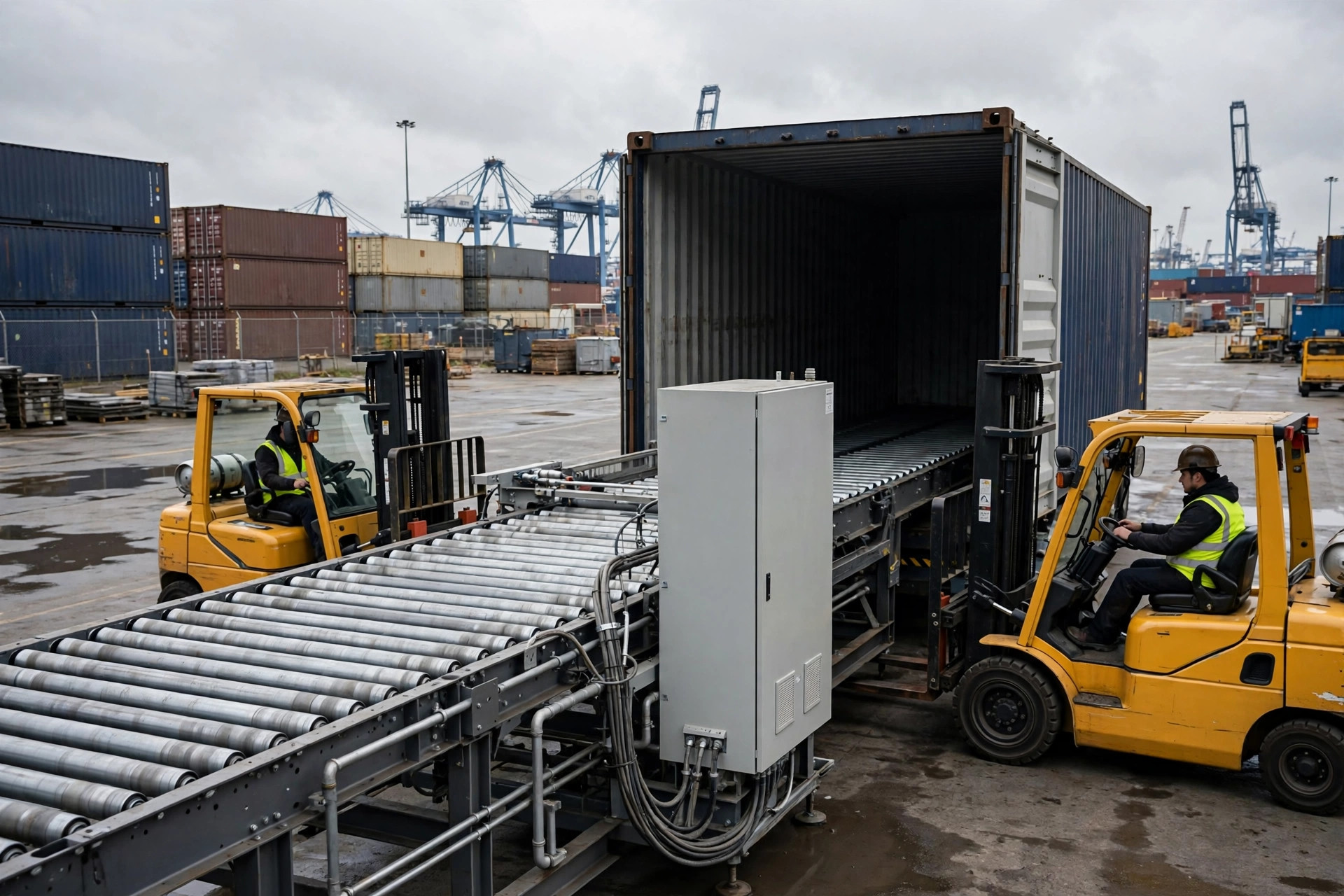
Fall 2021. A conveyor integrator out of eastern China — we were their solutions advisor at the time — shipped their first lot to Europe. Rotterdam customs pulled the container for inspection. The problem wasn't the machine. It wasn't electrical safety. It was the file: customs wanted RoHS conformity evidence for the machine and its key electrical parts. The company had a thick CE technical file and a blank page where RoHS should have been.
Then it got worse. Lab testing found that a domestically sourced relay module had solder joints where lead exceeded the 0.1% limit in the homogeneous material — one part, and the whole shipment was held for rework before release. The container sat in the port area for nearly three weeks. Demurrage and storage piled up daily (Rotterdam terminal rates apply — and they are not cheap), plus the cost of air-freighting replacement parts. That order's margin was basically gone.
I've seen too many exporters fall into the same hole: they spend serious money on CE and skip RoHS because "we're not an electronics company." But a conveyor's control cabinet, sensors, motor drives, and cable connectors are all electrical and electronic parts, and that is exactly what RoHS Directive 2011/65/EU covers. Ten restricted substances — lead, mercury, cadmium, hexavalent chromium, PBB, PBDE, and four phthalates (DEHP, BBP, DBP, DIBP) — capped at 0.1% in homogeneous material, 0.01% for cadmium. And "homogeneous material" is the part people miss: it is not an average across the machine. One solder joint over the line makes the whole machine non-compliant.
The second story is more common, and more aggravating. In 2022, a small sortation-equipment maker cleared customs without a hitch — then got the goods bounced by their EU distributor at incoming inspection. The distributor wanted the EU Declaration of Conformity to explicitly list the RoHS directive number; the factory's DoC only cited the CE directives. The distributor's line: "Without RoHS on the DoC, we can't put it on the shelf — we're the ones who get fined." Bluntly: the risk lands on the channel, and no matter how good your machine is, it never reaches the market.
One more, from 2023: a vendor exhibiting at a European trade show got a quiet warning from their local partner — even demo units on public display can attract market surveillance, and without a DoC they'd better not power the machine up. The CE and RoHS paperwork got assembled three nights before the show opened.
Three Things RoHS Compliance Actually Takes
No shortcuts, but no mystery either. Three things, in order:
First, supplier declarations of conformity. RoHS is a supply-chain problem, not a lab problem. Starting with your direct suppliers and working upstream: every electrical part, every batch of key material needs a RoHS conformity declaration or test report from the supplier. A usable declaration has four elements at minimum: the product or material scope, the directive number (2011/65/EU), the assessment standard, and a signature, stamp, and date. Watch three categories hardest: solder and solder joints, plastic housings and cables (phthalate country), and surface-treated parts (hexavalent chromium). Small factories trip here most — tier-three and tier-four suppliers have never heard of RoHS, and you either force them through it or switch suppliers. And write this into your purchase contracts: the supplier must notify you in advance of any material or process change and re-issue the declaration.
Second, lab testing for high-risk parts. Testing everything is not realistic — the cost breaks you. Go risk-based: new suppliers get tested, anything with a changed process or material gets tested, categories with a history of failures get sampled. XRF screening is fast and cheap, good for bulk triage; but XRF is screening only — borderline parts need quantitative chemical analysis before you can call them compliant. Turnaround is measured in weeks (depends on lab scheduling), fees are per part (get a lab quote). Remember: testing is a verification tool, not compliance itself. Without step one's supply-chain management, testing alone never closes the loop.
Third, the technical file plus the EU Declaration of Conformity. Archive the evidence from steps one and two: BOM, supplier declarations, test reports, notes on applicable exemptions if any — then the manufacturer or EU authorized representative signs the DoC explicitly citing 2011/65/EU. Two reminders. One: RoHS does have exemption clauses for specific applications, but the exemption list gets updated — check the current list on the official EU site rather than going by memory. Two: the directive requires you to keep the technical file for ten years after the last unit goes on the market. That is not a suggestion. That is what they audit.

Full Testing or Supplier Declarations? Run the Two RoHS Numbers Separately
Owners always ask me: why not just test every batch and be done with it? Two sides to it. Let me run the numbers with the assumptions stated: a mid-size conveyor line carries roughly 150–200 electrical parts, lab testing is priced per part (get a real lab quote), and a full round lands in the low thousands of dollars; building a supplier-declaration system takes roughly one quality engineer two to three months. On magnitude:
| Test-everything route | Declarations + risk-based sampling | |
|---|---|---|
| Direct cost per round | High: per-part lab fees stack up fast on a big BOM | Low: mostly supplier-management labor |
| Time cost | High: you wait on reports, delivery slips | Low: rides along with procurement |
| Risk coverage | Looks total, but only covers "this batch" | Covers "the whole supply chain," but depends on supplier honesty |
| Long-run cost | You pay again every batch | You pay to build the system once, then it gets cheaper |
Bluntly: full testing buys peace of mind — right for your first export order, when the supply chain isn't sorted yet. Declarations plus sampling buys you a system — right if you plan to stay in the European market. Here's the counterintuitive part: RoHS failures almost always come from a tier-three supplier you've never met, not from your own assembly line — so the money belongs in "managing suppliers," not in "testing every part."
One piece of advice to close: going to Europe, CE is the ticket in, RoHS is the ticket stub somebody checks after you're inside. Walk your BOM end to end before you ship. Doing it upfront isn't expensive. Fixing it after a failure costs you time.
By Lao Mi, Supply Chain Veteran (20 yrs)




