Conclusion first: if your warehouse handles more than 1,000 units a day, RFID warehouse inventory counting typically pays back in 12 to 24 months. If you handle a few hundred units a day, do not touch it yet — get your barcode counts solid first. RFID counting is genuinely fast, but it is not magic. Tag placement, reader settings, and system integration all have to be right, or accuracy falls straight back to barcode levels.
I have seen this pitfall three times. The first was in 2023, at an apparel distribution center that hired me for their RFID counting rollout. Their barcode counts were slow in a painful, specific way: a worker with a scanner manages about 12 to 20 items a minute, one at a time, and a full-wall count shut the building down for half a day. After RFID, a handheld reader reads 200 to 700 tags per second — no aiming, no one-by-one scanning, a whole pallet in one pass. Measured results: cycle counts ran about 25 times faster than barcode, and accuracy rose from roughly 65% to 75% with barcodes to about 98% to 99.5% with RFID. Beautiful numbers. They only happened because the team spent three months before go-live testing tag placement across four rounds.
RFID Warehouse Inventory Counting: Why It Is Fast — Batch Reads, Not One by One
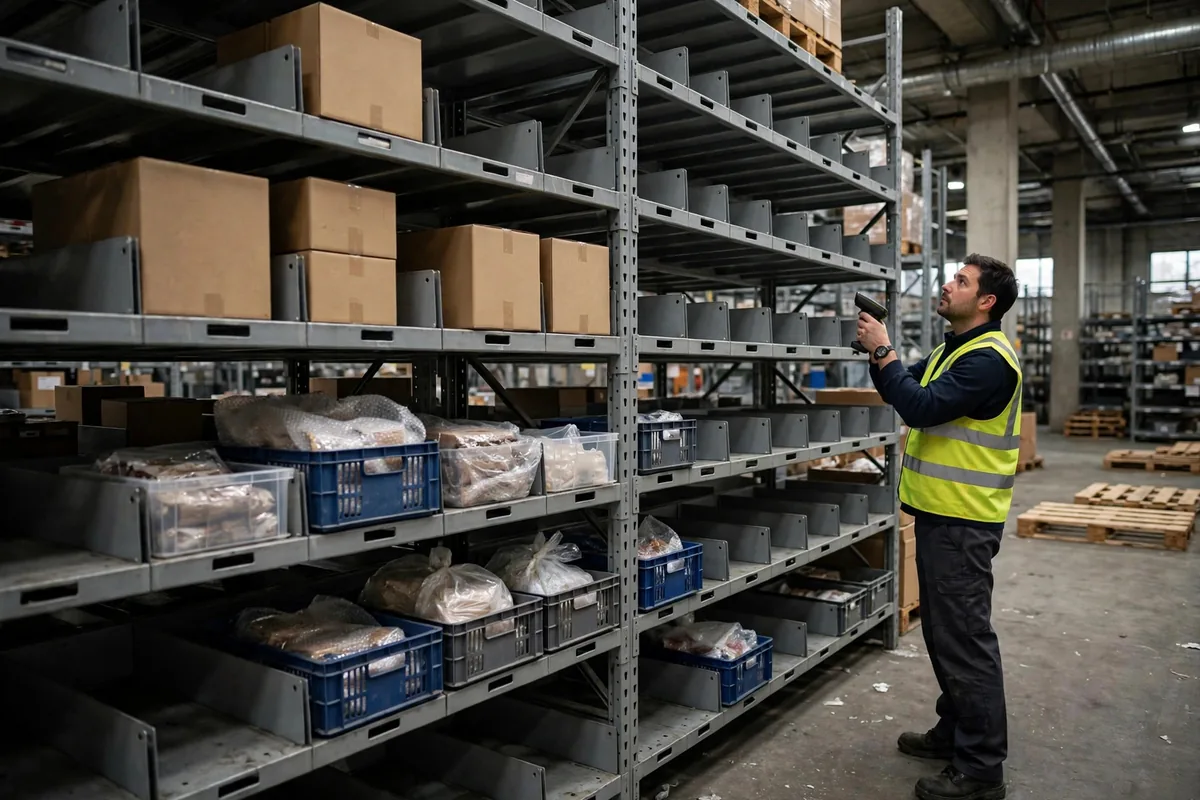
A barcode works one-to-one: aim the scanner at one code, read one item. RFID works one-to-many: the reader broadcasts a radio signal and every tag in range answers at once. The band used is UHF RFID, 860 to 960 MHz, which penetrates well and reads at distance — the right fit for a warehouse. Point a handheld reader at a rack and the whole row reports back in seconds. Full pallets, full racks, full aisles, all counted the same way.
Batch reading has a cost, though: you may read more than you want. Tags from the next rack over, or from a pallet behind you, can answer too. That is called a stray read. The fix is not to crank the power to maximum — more power means more stray reads. The fix is to count zone by zone, in batches, tuning antenna angle and power for each area. I have seen this pitfall three times, and every time it was the same story: someone maxed the power in week one to save time, the count came back higher than the books, and the team lost a full day before realizing the extra reads came from the next aisle.
Tag placement is the second make-or-break detail. Where the tag sits on the carton — front or side, how high, how far from metal — changes read rates dramatically. Metal racking and metal products reflect and absorb radio signals; a tag stuck flat on metal may not read at all, and needs a pricier on-metal tag. Liquid-heavy goods attenuate the signal too. My rule: test with real products before go-live, at least 20 units per category, and treat any category reading below 95% separately. GS1 sets 95% as the baseline for an RFID deployment worth operating. Below that, your count results are less trustworthy than a manual recount.
Four Steps to Roll Out RFID Warehouse Inventory Counting — Do Not Skip Step Two
Step one, pick the categories. Not every product belongs on RFID. Start with high-turnover, mid-priced, regularly packaged goods — apparel, footwear, standard auto parts are all good starting points. High-value small items, metal goods, and liquids: leave those for later.
Step two, test on site. Do not skip this. It is the step most often cut from the plan, and the one that can least afford to be cut. Take the reader and sample tags to the floor and measure three things: read rate with racks fully loaded, interference when forklifts pass, and read rates at different tag positions. Write the test report down — read rate, stray-read rate, causes of missed reads, item by item. Going live without a test report is driving blindfolded.
Step three, integrate with the system. The data RFID reads has to land in the WMS and in the inventory books. Tag encoding must align with your existing SKU coding, and filtering logic for duplicate reads and stray reads must be built into the system first — do not expect floor staff to catch them by eye. The discrepancy workflow also needs deciding in advance: when system counts and book counts disagree, who rechecks, how quickly, and how many times. Put it in the operating manual.
Step four, pilot small, then expand. Take one zone and one category and run cycle counts for two weeks. Expand to the full building only when the data is stable. During the pilot, reconcile daily and watch three metrics every day: read rate, discrepancy rate, and counting time. If the pilot numbers look bad, stop and tune. Do not push through.
Now the money. The example below uses stated assumptions: take a warehouse handling 2,000 units a day. A monthly full barcode count takes four people two days, costing about $8,000 a month in labor plus downtime. RFID counting takes one person half a day, about $1,000 a month. That saves $7,000 a month, or $84,000 a year. Assume tags, readers, software, and implementation total $120,000, and payback lands around 17 months — inside the typical 12 to 24 month range. But note the precondition: daily volume has to be large enough. A warehouse handling 300 units a day might save only one or two thousand dollars a month, and payback stretches to four or five years. The tags alone may never earn themselves back.
Here is the counterintuitive part: the biggest cost of RFID counting is not the tags. Tags cost far more than barcodes — barcodes cost nearly nothing — that is true. But the real money goes elsewhere: receiving gains an extra tagging and verification step, returns need tag deactivation, and count discrepancies need someone to investigate. If the process does not change, the tags are just a more expensive barcode. I watched one warehouse spend heavily on RFID while keeping the old receiving process. Tags went on crooked, read rates stuck around 90%, and counts still needed manual verification. They paid twice for the same job.
Go-live night checklist — tick every box: tag quantities reconciled against the SKU list; reader batteries, firmware versions, and power settings confirmed; pilot zone defined and stray-read isolation plan written; discrepancy workflow and owner assigned; rollback plan in place — if read rates miss the target, can you switch back to barcode counting immediately? If any box is unticked, do not go live.
RFID counting is not about showing off technology. It turns counting from a two-day shutdown into something done routinely, almost as a side task. Once cycle counts run steadily, inventory accuracy stays high, and both stockouts and overstock shrink. But only if the categories are right, the site is tested, and the process keeps up. Miss any one of those, and RFID counting is just an expensive toy.
By Lin Xiao, WMS Implementation Consultant