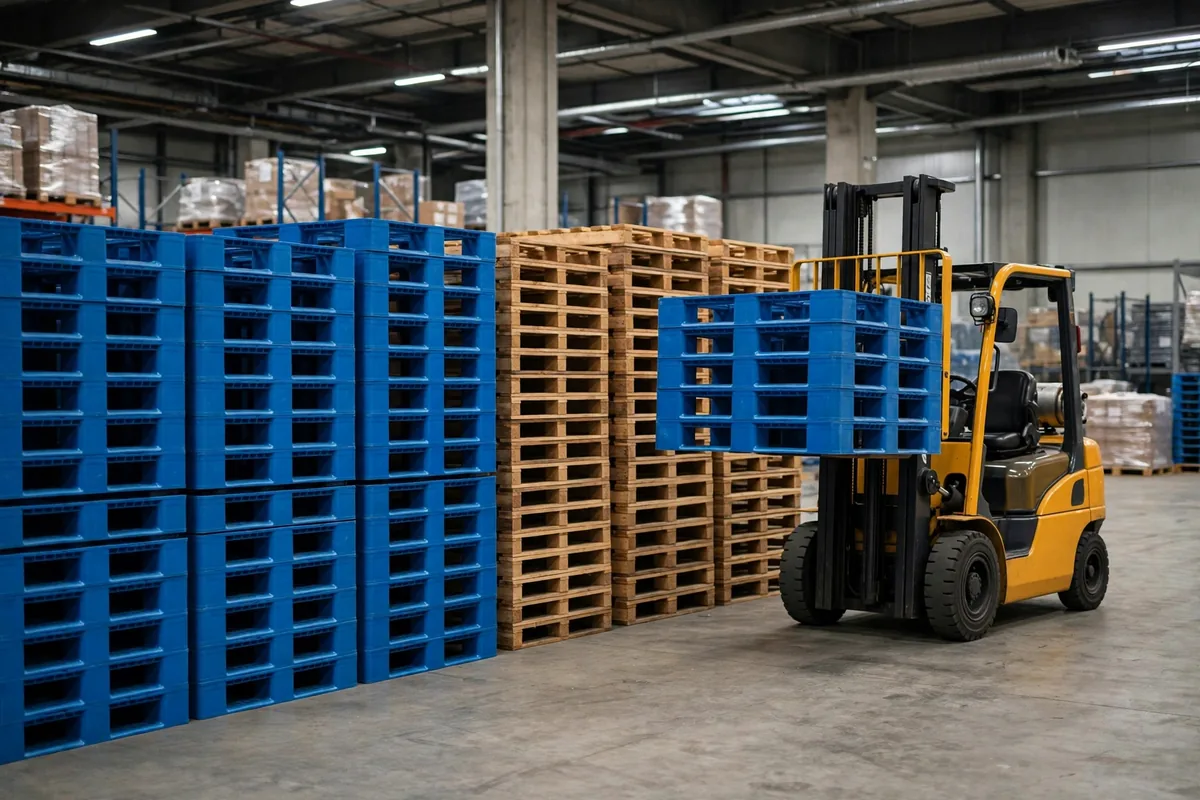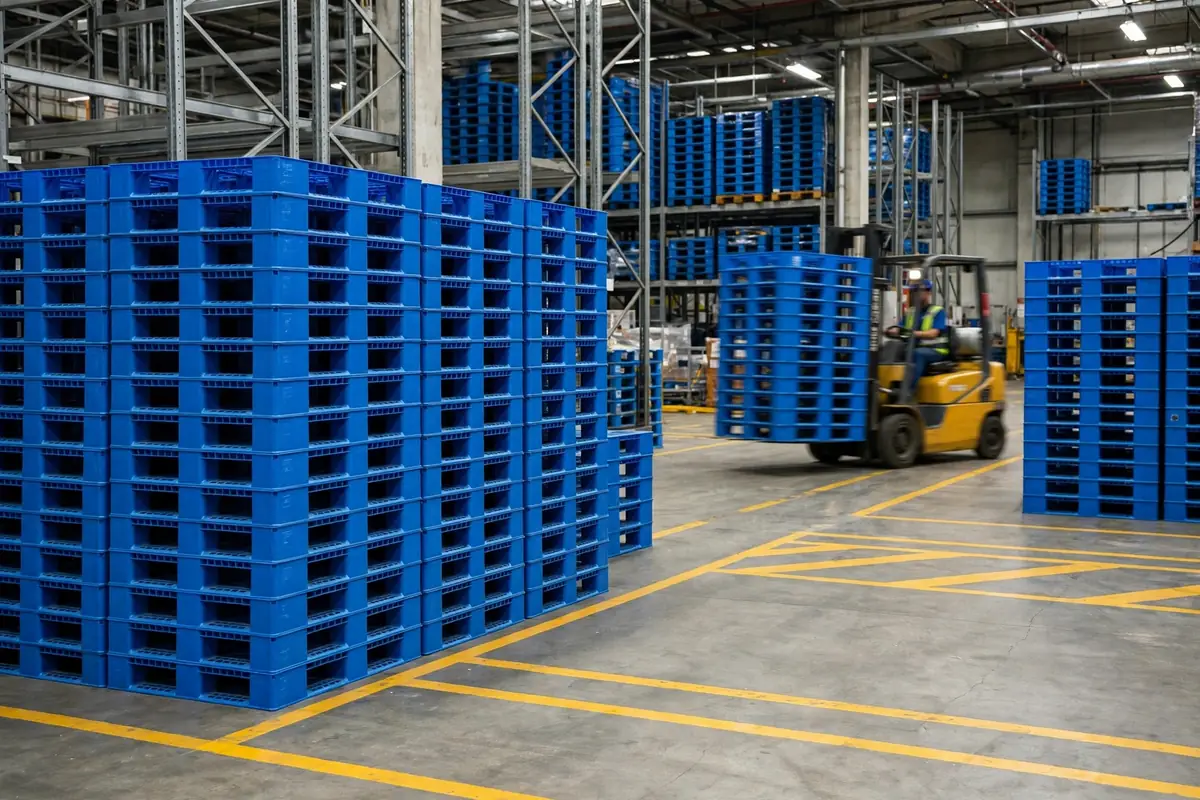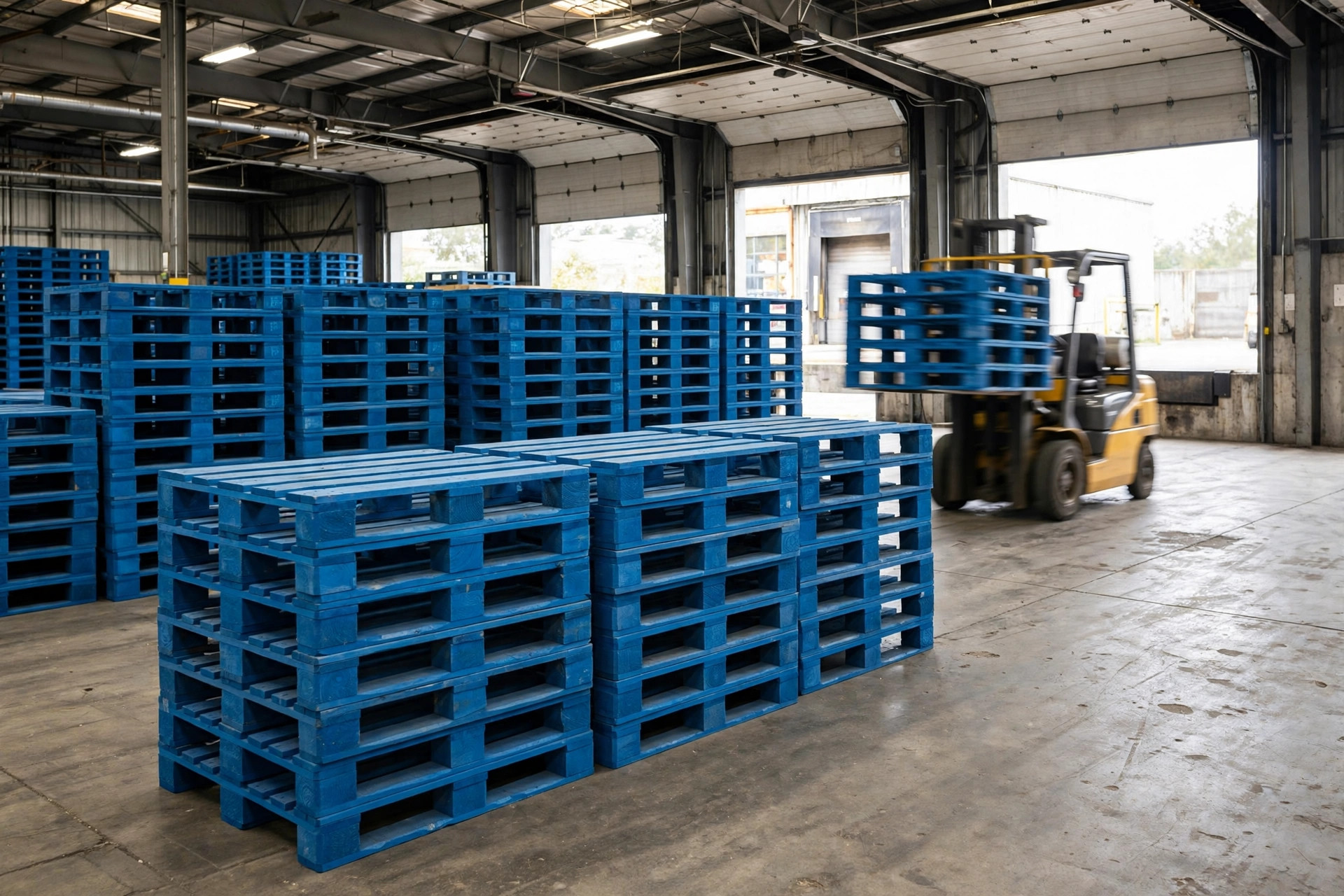
We can't afford to burn money like that. I say it at least three times a month. Our warehouse is 3,000 square meters, a dozen people, and pallets look like the cheapest thing in the building — until you add up a year of them and realize they ate real money. Pallet pooling versus buying isn't really a question of which price is lower. It's a question of where your freight goes, how fast it comes back, and how many pallets disappear along the way. Pallet pooling sounds beautiful — those blue and red pooled pallets stacked up like the big companies do it. But we run a small warehouse, and small warehouses survive by doing the math first and copying the big guys second.
Let me start with our mess. In spring 2024 we landed a supermarket-channel order, and the customer had one condition: ship on pooled pallets or don't ship at all. I figured, fine, rent them, how expensive can it be? Then the first monthly statement arrived. We'd shipped 800 pallets and couldn't account for more than 60 of them. Lost-pallet charges run about $50 to $55 each, so that alone was two or three thousand dollars. Worse, pallets sat in the customer's warehouse for almost a month, and the daily rental kept ticking the whole time — on our account. I called the customer to chase the returns and got told they were "in the queue." Our pallets were asleep in someone else's warehouse, and we were paying rent on the nap.
The second lesson was cheaper and dumber. Early in 2025 we bought a batch of used pallets because the unit price looked great — just a few dollars each. We hauled them back, inspected them, and found cracked boards and nails sticking out everywhere. A forklift picked one up, a corner gave way, the load went over, and we paid the customer over $400 plus an afternoon cleaning up. That day I learned the rule: buying the cheapest pallet isn't saving money, it's moving the money somewhere else.
What Pallet Pooling Really Charges You For
Pallet pooling is simple once you see it: a pooling company owns the pallets, you pay per use, you ship your goods on them, and the pooler collects them from the receiver, repairs them, and rents them out again. The standard in the U.S. is the 48-by-40-inch pallet — the blue ones and the red ones are that size. You don't buy, you don't repair, you don't chase returns. Sounds like a vacation.
But the rent isn't one number, it's four numbers stacked up. By published 2026 industry estimates: an issue fee of about $3 to $5 per pallet, daily hire of about $0.035 to $0.20 per pallet per day, a transfer fee of about $1 to $3.50 per pallet, and a lost-pallet fee of about $50 to $55 each. All in, one trip runs roughly $5 to $15 per pallet. The real rates are negotiated and the poolers don't publish a price list, so treat any number as a planning range and check the latest terms on the official source before you sign.
Two of those four charges do the real damage: time and loss. Every extra day a pallet sits in your account or your customer's warehouse, the rent keeps running. And loss is worse than rent — 60 missing pallets at $50 each is $3,000, more than the rental itself. That's exactly how our supermarket order bled: the freight went out, the pallets didn't come back, and the meter ran every day.
Buying looks like this. Published 2026 U.S. pricing puts a new 48-by-40-inch wood pallet at about $10 to $25, a used Grade A at about $6 to $14, and a Grade B at about $3 to $8, with heat treatment adding $1 to $3. Wood makes up more than 90% of pallets in service in the U.S., so this is our home turf. Once you buy a pallet it's yours: no rent, no daily meter, and losing one costs you its purchase price, not a $50 penalty. The catch is that you own the work — buying, repairing, finding floor space to stack them, and counting them at year end. Every one of those jobs is real labor.
Pallet Pooling or Buying? Follow the Freight, Not the Price List
Here's the counterintuitive part: pallet pooling doesn't save money for everyone. It saves money for freight that never comes back. If you ship to big retailers and the pallets are gone for good, renting beats buying, because you never have to chase a pallet home. If your pallets shuttle between your own warehouses and come back the same day, buying beats renting, because a daily rental on a pallet that lives in your own loop is pure loss.
This is the little decision table we actually use in our warehouse now. It's crude, and it works:
| How to compare | Renting from a pallet pool | Buying your own pallets |
|---|---|---|
| Cost per trip | Roughly $5–$15 per pallet per trip | New pallet about $10–$25, reusable many times |
| Long-run cost | Grows with volume and dwell time | Gets cheaper the faster pallets turn |
| Loss | about $50–$55 per lost pallet | Loss equals the purchase price |
| Management | Pooler handles recovery and repair | You handle buying, repair, and storage |
| Best for | Retail shipments, one-way freight | Closed loops, shuttles between your own sites |
Now a worked example — clearly labeled as a hypothetical example, not a quote. Say our warehouse ships 1,000 pallets a month, each sitting on our account for 20 days on average. Renting at a mid-range $8 per trip costs about $8,000 a month. Buying 1,000 new pallets at $15 each is a one-time $15,000, and if each pallet survives 10 trips, that's $1.50 per trip, plus about $1 per trip for repair and handling — roughly $2,500 a month. Buying looks far cheaper. But add loss: lose 5% in a month and that's 50 pallets — about $2,500 in lost-pallet charges if rented, versus $750 of purchase value if owned. Flip it around: if all 1,000 pallets go to a supermarket and never come back, buying them is $15,000 thrown away, and renting at $8,000 is the bargain. The break-even point isn't on the price list. It's in whether your freight comes home.
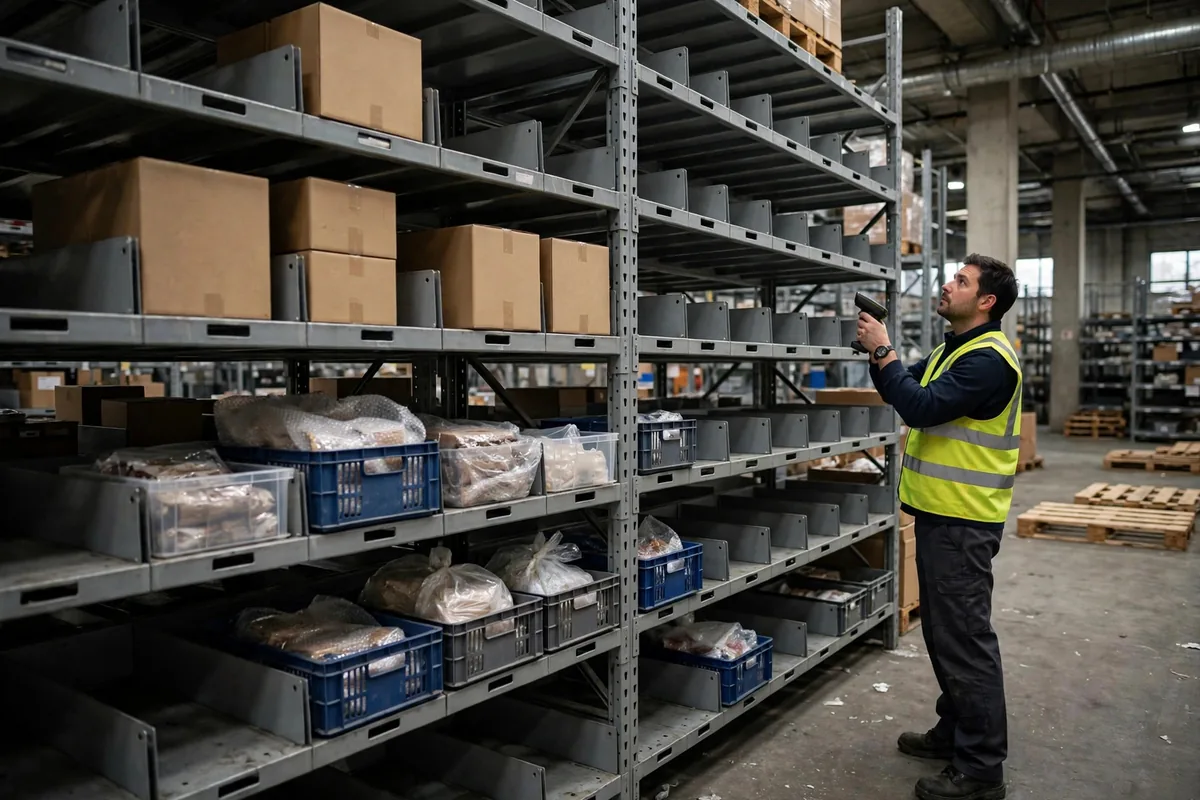
So this is how we run it now: supermarket freight goes on rented pooled pallets; shuttles between our own sites and local deliveries go on our own used Grade A pallets. Neither extreme, both where they belong. And three small habits that actually work: count incoming pallets the same day they arrive and book them in the same day — never wait until month end to argue about the gap; keep blue and red pooled pallets in their own zone, never mixed with our own stock, because once they're mixed you can't tell whose is whose; and watch the loss rate every month — over 3% and we go to the customer for answers, instead of waiting for the quarterly bill to hurt.
The big companies' standard answer — rent everything or buy everything — doesn't fit us. Our answer is: look at where the freight goes, how fast it turns, and how much disappears. Get those three right, and the pallet pooling versus buying question answers itself.
Small warehouses have their own way of surviving. Get this math right, and the money you save buys the whole crew dinner more than a few times over.
By Xiao Ma, Small Warehouse Owner