Here's my verdict on rcs wms wcs task dispatch ownership: in any warehouse, task dispatch answers to exactly one system. When RCS, WMS, and WCS all think they're in charge, you get robots staring each other down in the middle of the aisle.
I've been saying this for the better part of a decade, and I've watched it go wrong too many times to count. The division of labor was never complicated: the WMS decides what needs doing (which orders, which batches, what priority); the WCS decides which equipment does it (splitting tasks across conveyors, lifts, and AMRs, arbitrating who goes first); the RCS just figures out how to drive there (routing, collision avoidance, charging). On the question of rcs wms wcs task dispatch ownership, the answer is the WCS layer. Every project I've seen that wired the RCS straight to the WMS — skipping the WCS — ended badly.
Vendors love the closed-loop RCS pitch: cheap, fast, great demo. But cheap things always send the bill later.
The WMS is headquarters issuing orders. The WCS is the field commander, deciding which unit goes where. The RCS is the motor pool — it just drives to the given coordinates. No army has headquarters radioing drivers directly; without the commander in the middle, orders arrive as noise. Same in a warehouse.
The night nobody owned task dispatch
November 2023, two weeks before peak season, I walked into a 3PL site for a post-mortem. They'd just commissioned a fleet of AMRs. The robot vendor's RCS came with its own scheduling, so the integrator — cutting corners — fed WMS tasks directly into the RCS and left the WCS as a hollow pass-through. On paper, there were three layers. In reality, there were two brains.
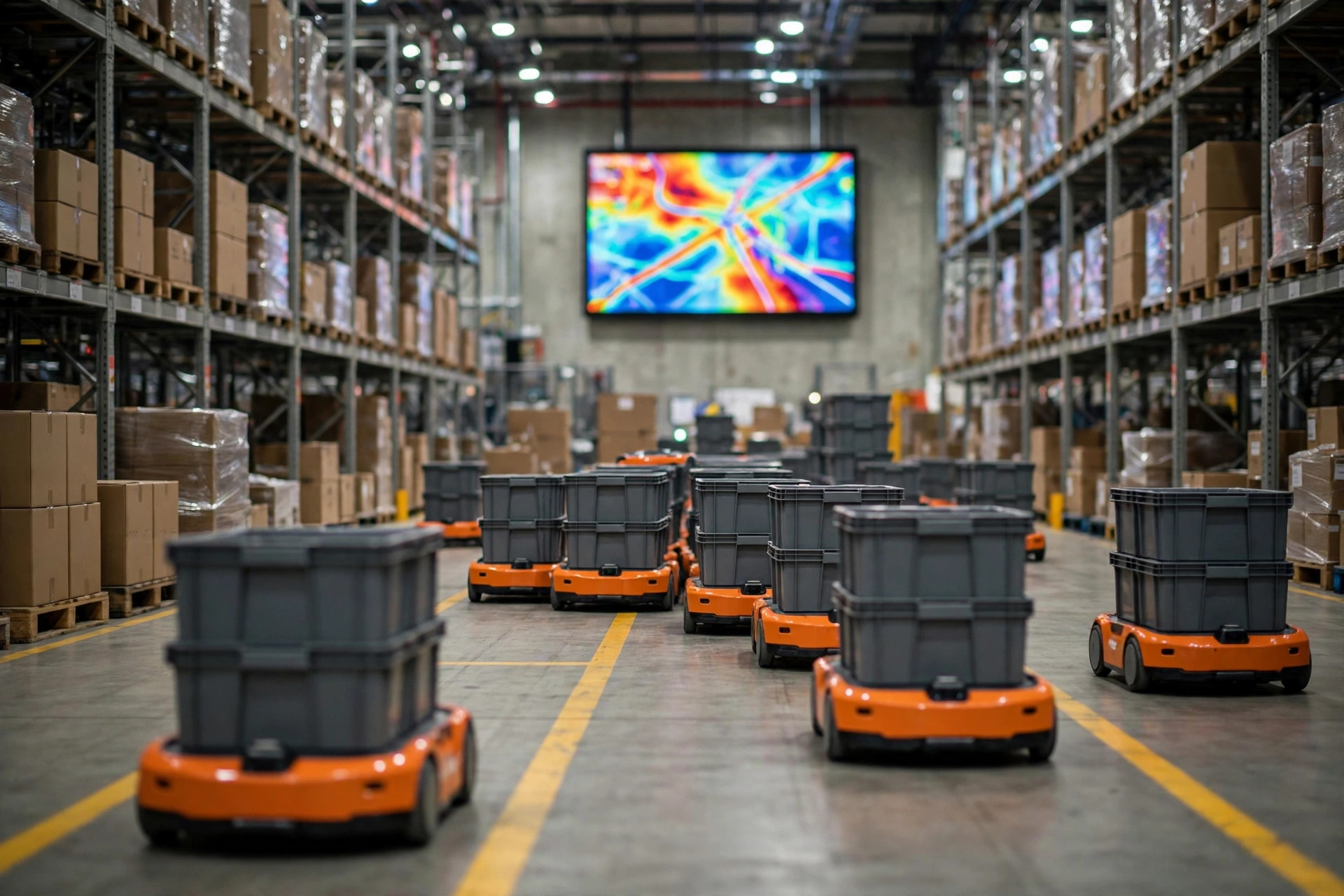
It blew up within the first week. One evening the WMS released a batch of rush orders by priority; the RCS re-sequenced them because a different order "looked smoother" on its pathing algorithm. Two dispatchers, two plans, one aisle. A dozen robots met head-on in the main travel lane and refused to yield. Deadlock.
When I arrived, the shift supervisor stood at the aisle mouth with a two-way radio, talking robots backward one by one like a traffic cop. Forty-plus minutes. The entire pick zone sat idle. More than 2,000 orders missed their ship time that night, and the SLA penalty conversation with the customer dragged on for weeks.
The root cause fit in one sentence: task dispatch had two owners. The WMS said "this one is urgent." The RCS said "that one is smoother." The robots in the middle couldn't satisfy both, so they satisfied neither.
The fix: the WCS took dispatch back, the RCS was demoted to driving, the WMS to issuing business orders. Two weeks of re-integration, stable before peak. What changed wasn't hardware — it was the org chart.
Two ways I've seen this wired wrong. First: WMS straight to RCS, WCS left as decoration. Integrators adore it — one less interface, two weeks shaved off, a prettier quote. The price is the forty-minute night above. The WMS understands business but not machines; the RCS understands vehicles but not business. With nobody translating in between, it's a matter of time.
Second: dual dispatch. Layers exist on paper, but both WCS and RCS run their own sequencing. The WCS says "A first"; the RCS prefers B's smoother path and quietly reorders. Dashboards look "normal," but dispatch authority ping-pongs between layers. Hardest to diagnose — no single disaster, just efficiency that never arrives until peak volume folds it. I've watched operations blame "bad robots," replace the fleet, and keep the problem. The disease is in dispatch ownership, not the wheels.
One acute, one chronic — same root cause: task dispatch ownership split across two systems.
RCS, WMS, WCS: who does what
Vendors love blurring these boundaries in their slide decks — whatever they sell gets drawn bigger. So here's my one-sentence version of each:
WMS thinks about the work. Orders, inventory, locations, waves, priorities. It doesn't care about machines; it cares whether the business logic is right.
WCS thinks about the equipment. It translates WMS tasks into instructions machines understand. Conveyor speeds, merge-point arbitration, how AMRs hand off to lifts — that's its call.
RCS thinks about the road. It manages the fleet and nothing else. How each unit drives, how it avoids collisions, where it charges. Outside the fleet, it has no business deciding anything.
Pin this ownership table to the wall. Use it in vendor negotiations, in integration design reviews, and in every blame-storming session afterward:
| Decision | Owns it | Executes | Stays out |
|---|---|---|---|
| Order priority, wave building | WMS | — | WCS, RCS |
| Which equipment / zone gets the task | WCS | — | RCS |
| Robot routing, right-of-way | RCS | — | WMS, WCS |
| Conveyor pacing, merge arbitration | WCS | — | WMS, RCS |
| Inventory, locations, batch logic | WMS | — | WCS, RCS |
| Task rerouting after equipment failure | WCS | RCS (drives the new route) | WMS |
Iron rule: where the boundary is fuzzy, power moves up, never down. WCS-vs-RCS disputes go to the WCS; WMS-vs-WCS to the WMS. Pushing authority downward breeds a second brain, and two brains always fight.

Counterintuitive: the smarter the RCS, the bigger the trap
I know how that sounds. The smarter the vendor makes the RCS, the better the demo — path planning, task sequencing, charge management, all in one box. But look at both sides.
I worked with an e-commerce warehouse that started with 30 AMRs from a single brand, running the vendor's closed-loop RCS. It ran fine. Integration was cheap, go-live took two months, the boss thought he'd found a bargain.
Then the business grew: 80 units, two conveyor lines, a lift. That's when it broke — the RCS only understood its own robots. No conveyors, no lifts, no cross-device handoffs, no merge arbitration. The integrator came back; the WCS was built from scratch, interfaces rewritten, re-tested end to end. Three months, seven figures — more than doing the WCS right on day one.
Here's the thing: a vendor's RCS is optimized for selling robots, not running warehouses. Small fleet, one brand, no other equipment — genuinely cheap and good. Cross that boundary, though — mixed fleets, robots plus conveyors plus lifts — and dispatch ownership must move up to the WCS, or every expansion is a rebuild.
That's the trade-off in one line: a closed-loop RCS buys you today's cheap and bills you tomorrow's rewrite. A WCS up front costs you today's expensive and saves you every expansion after.
Do the math before you sign
Forget the vendor stories. Match your own situation:
One robot brand, no new equipment planned for two years — take the vendor's closed-loop RCS. Cheap, fast, and own the consequence: you'll rewrite it when you expand. That's a legitimate choice, as long as you know you're making it.
Mixed fleet, or robots mixed with conveyors and lifts — dispatch ownership goes to the WCS from day one. Pay for the integration once, demote the RCS to driving. Skip it now and you'll pay double later.
Complex task logic (multi-site, dynamic priorities, wave rules that change daily) — make the WMS strong, the WCS thin, and let the RCS just drive. The more complex the business, the more you need "thinking about work" separated from "managing machines."
The money tells the same story:
| Approach | Upfront integration cost | Expansion / rework cost | Right for |
|---|---|---|---|
| Closed-loop RCS | Low (comes with the robots) | High (rebuild from scratch) | Single-brand small fleet, no expansion for 2 years |
| WCS owns dispatch | High (one more layer) | Low (new equipment plugs in) | Mixed equipment, expansion planned |
Practical advice: print the ownership table and stick it on the meeting-room wall. Make every integrator walk it — which layer holds which logic. Can't explain it? Don't talk price yet.
I always close vendor negotiations with three questions, and you can steal them:
One — which layer holds the task-sequencing logic? Can't answer: pass. Two — add one new machine, how many layers need code changes? "All of them" means dispatch was never consolidated. Three — WMS and RCS both go down: which comes back up first? Hemming and hawing means walk away. A team that can't explain task dispatch ownership will never build you a system where it's clear.
By Lao Mi, Supply Chain Veteran (20 yrs)