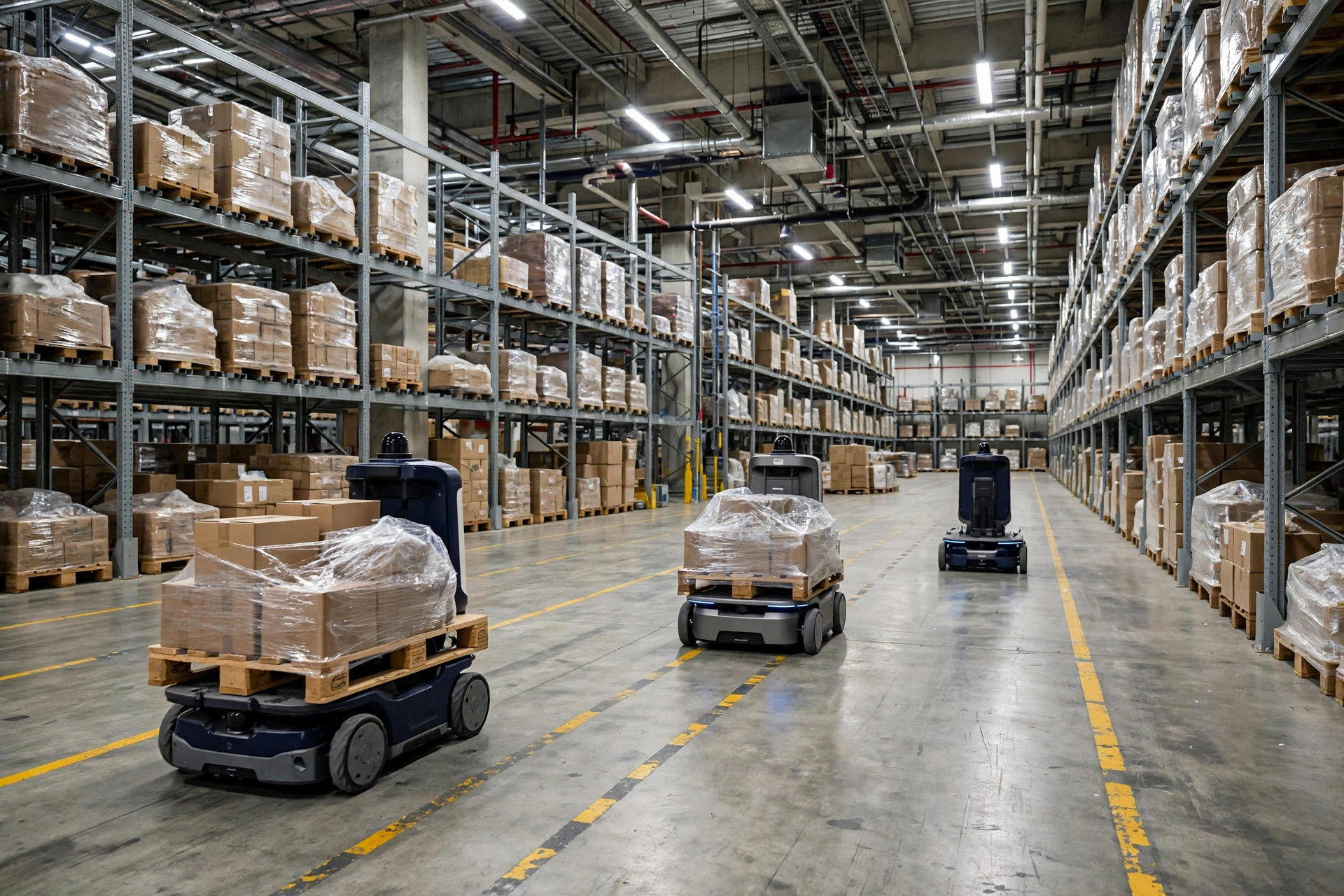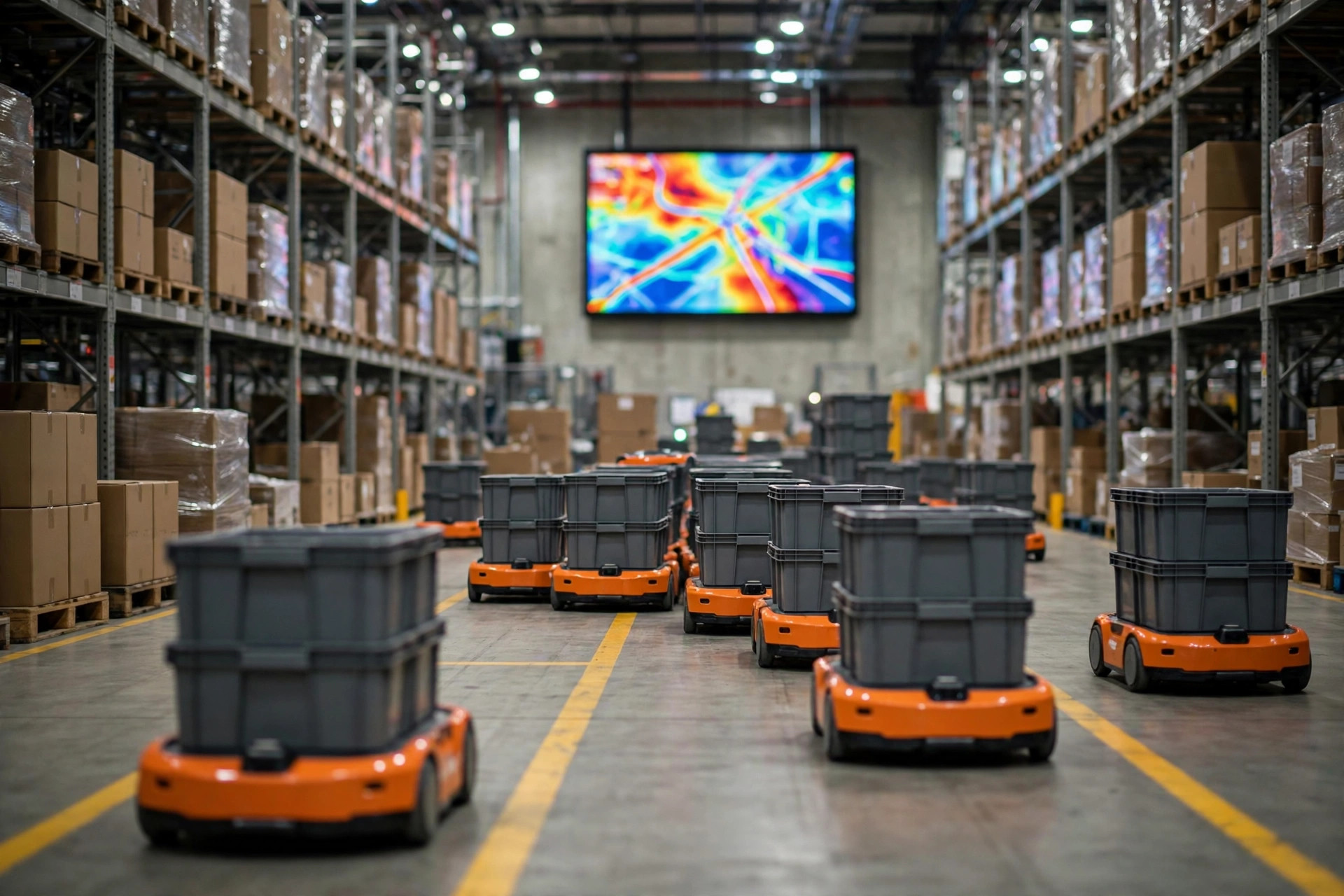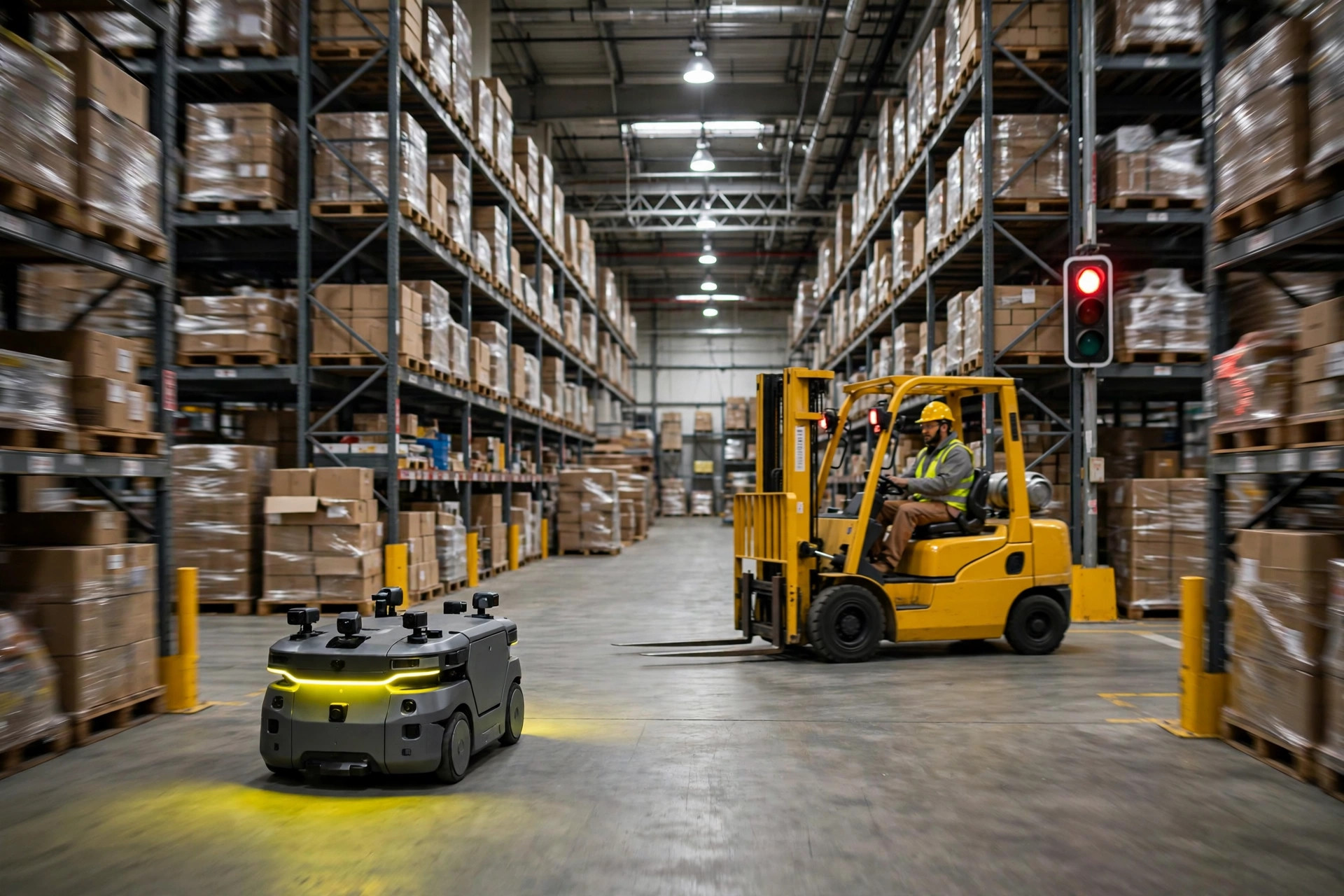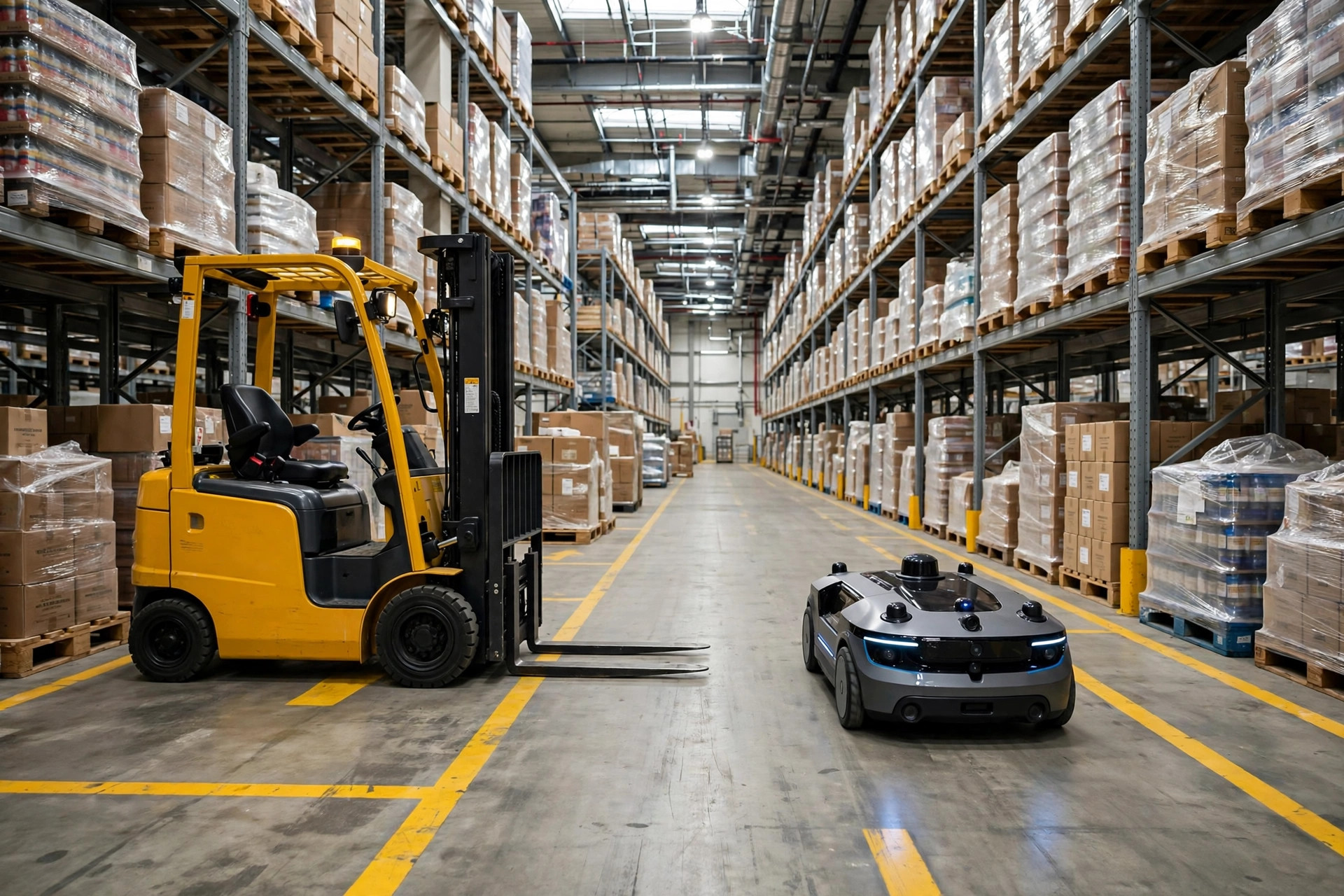
The near-miss happened on a Tuesday, at the mouth of aisle 7. An AMR carrying a replenishment pallet stopped dead, its bumper a foot from a forklift's forks. The driver slammed the brakes, the load shifted, and for three seconds nobody breathed. Then everyone went back to work like nothing happened. That is the problem with mixed-traffic warehouses: nothing happens, right up until it does.
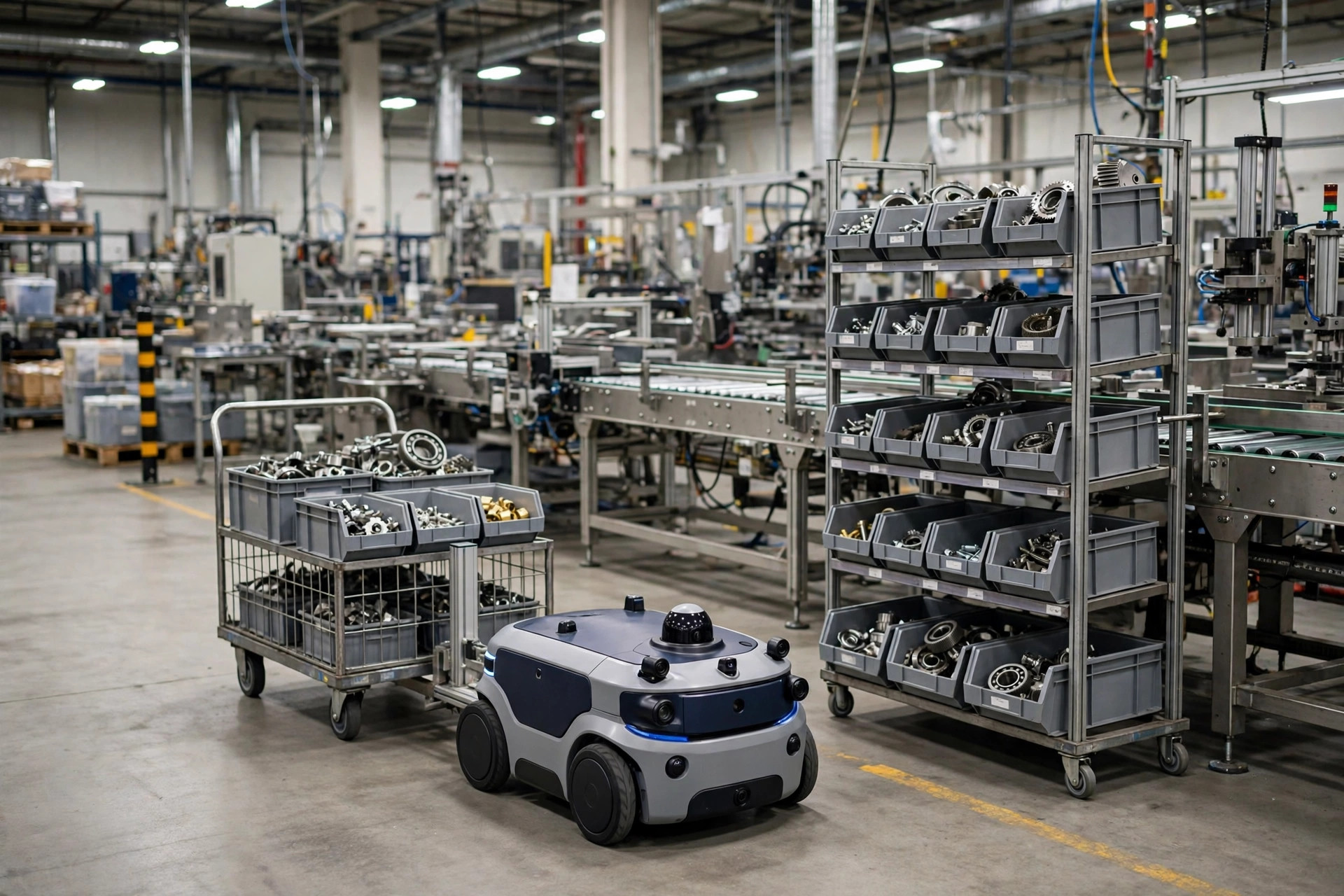
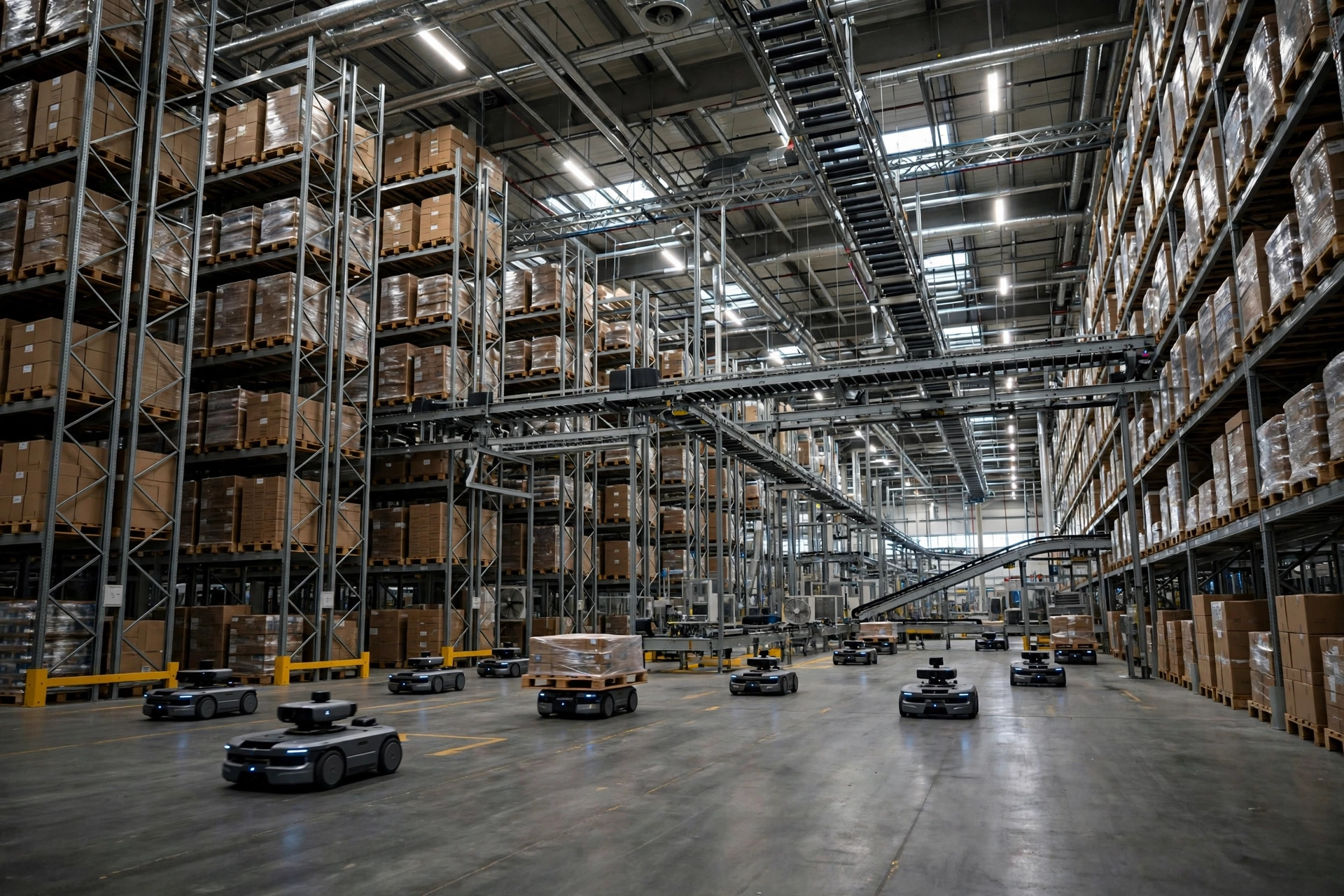
I spend a lot of time in warehouses that run both manual forklifts and AMRs, and the pattern is always the same. The AMRs obey the robot control system. The forklifts obey the driver. Two rulebooks, one floor. The RCS plans routes, manages charging, and keeps robots from hitting each other — but a manual forklift is invisible to it. To the RCS, your best driver is just a moving obstacle with unpredictable intentions.
The fix comes in three tiers, and I will be honest about what each one costs you.
Tier one is the cheapest: put a positioning tag on every forklift — UWB or Bluetooth beacons — and feed the positions into the RCS. The AMRs slow down within about five meters of a forklift and stop within two. Hardware runs a few hundred dollars per truck. The catch is software: your RCS vendor has to expose an interface for third-party position data. Ask that question before you buy the AMRs, not after. I have watched warehouses discover this gap six months into a deployment, and it is an expensive surprise.
Tier two is intersection signalization, and it is the best bang for the buck I have seen in mixed-traffic safety. Wherever forklift routes cross AMR lanes, you install a traffic light tied to the RCS, plus floor sensors. When an AMR needs the intersection, the manual direction gets a red. A few thousand dollars per intersection. One 3PL I worked with in Fontana, California — 120,000 square feet, eight AMRs, six forklifts — started with the two most dangerous crossings. Near-misses went to zero in the first month. The warehouse manager told me it was the first safety project in his career that paid for itself in avoided paperwork alone.
Tier three is full traffic zoning: AMR-only areas, manual-only areas, and mixed zones with speed limits, one-way rules, and floor markings. This is the most thorough option and the most expensive. It makes sense for greenfield builds. Retrofitting an operating warehouse means moving racking and shutting down aisles, and the downtime cost usually kills the business case.
Now the three mistakes I keep seeing, because knowing the tiers is not enough.
First, writing safety rules for the AMRs and ignoring the forklifts. ANSI/RIA R15.08 sets safety requirements for industrial mobile robots, and it is a solid standard — but it governs the robot, not your driver. A mixed-traffic safety assessment has to include the manual equipment, or your beautiful RCS simulation describes a warehouse that does not exist.
Second, making the slow zones too big. I have seen operations teams, trying to be safe, designate half the building as an AMR slow zone. Throughput tanked, and the ops team started quietly disabling the zones to hit their numbers — which is worse than having no zones at all. Keep slow zones surgical: intersections, aisle ends, the charging area entrance. Let the AMRs run full speed everywhere else. Safety that kills productivity gets bypassed; safety that respects productivity gets followed.
Third, skipping the traffic rehearsal. Everyone wants to go live the day the equipment arrives. Do not. Take two days before launch, get every driver and every supervisor on the floor, and simulate peak-hour crossing scenarios — emergency stops, manual overrides, the night-shift temp routes. Two days of rehearsal is cheap. One real incident with a stopped line is not.
Ask these three questions before you buy the RCS
A lot of mixed-traffic pain is baked in at purchase time. If you are evaluating an RCS, put these three questions in the RFP.
First, does it accept third-party position input? Can the RCS ingest UWB, Bluetooth beacons, or even forklift telematics? If it cannot, every integration downstream is theater. Make the vendor demo it live. Do not accept a slide.
Second, how good is the mixed-traffic simulation? A serious RCS ships with a digital twin that models human randomness — the sudden reverse, the unscheduled stop — and stress-tests it. A design that never collides in simulation will probably survive the floor. A design that cannot pass simulation is a gamble with your safety record.
Third, what is the e-stop and manual takeover logic? When an AMR e-stops, who moves it? Can the RCS push the dead robot's location to the nearest forklift driver? If that loop is not closed, one stalled AMR blocks half an aisle until someone notices.
One more thing, about people. Mixed-traffic forklift drivers need their own training: AMR braking distances, blind spots, what a robot does after an e-stop. A driver with twenty clean years behind the wheel does not automatically know how to share a floor with a robot. Half a day of training costs almost nothing and matters enormously.
And do not forget nights and ad-hoc routes. The RCS knows the daytime fixed routes. It does not know about the shortcut the night shift opens to hit a deadline, or the half-aisle closed for weekend cycle counts. Those unplanned changes are the most dangerous moments in a mixed warehouse. My practice: preload two or three alternate route plans in the RCS, give the night supervisor one-click authority to switch, and have the AMRs drop into building-wide slow mode for fifteen minutes after any switch. Most RCS vendors do not ship this by default. Ask for it.
Before you go live, run this checklist: forklift tags installed and reporting; intersection signals wired into the RCS; mixed-zone speed limits configured; every driver has physically touched the e-stop; and the RCS has a plan for the ad-hoc routes that appear on nights and weekends.
Mixed traffic is not a technology problem. It is a management problem. The smartest RCS in the world cannot manage a forklift that is not in the system. Make the manual fleet visible first. Everything else follows.