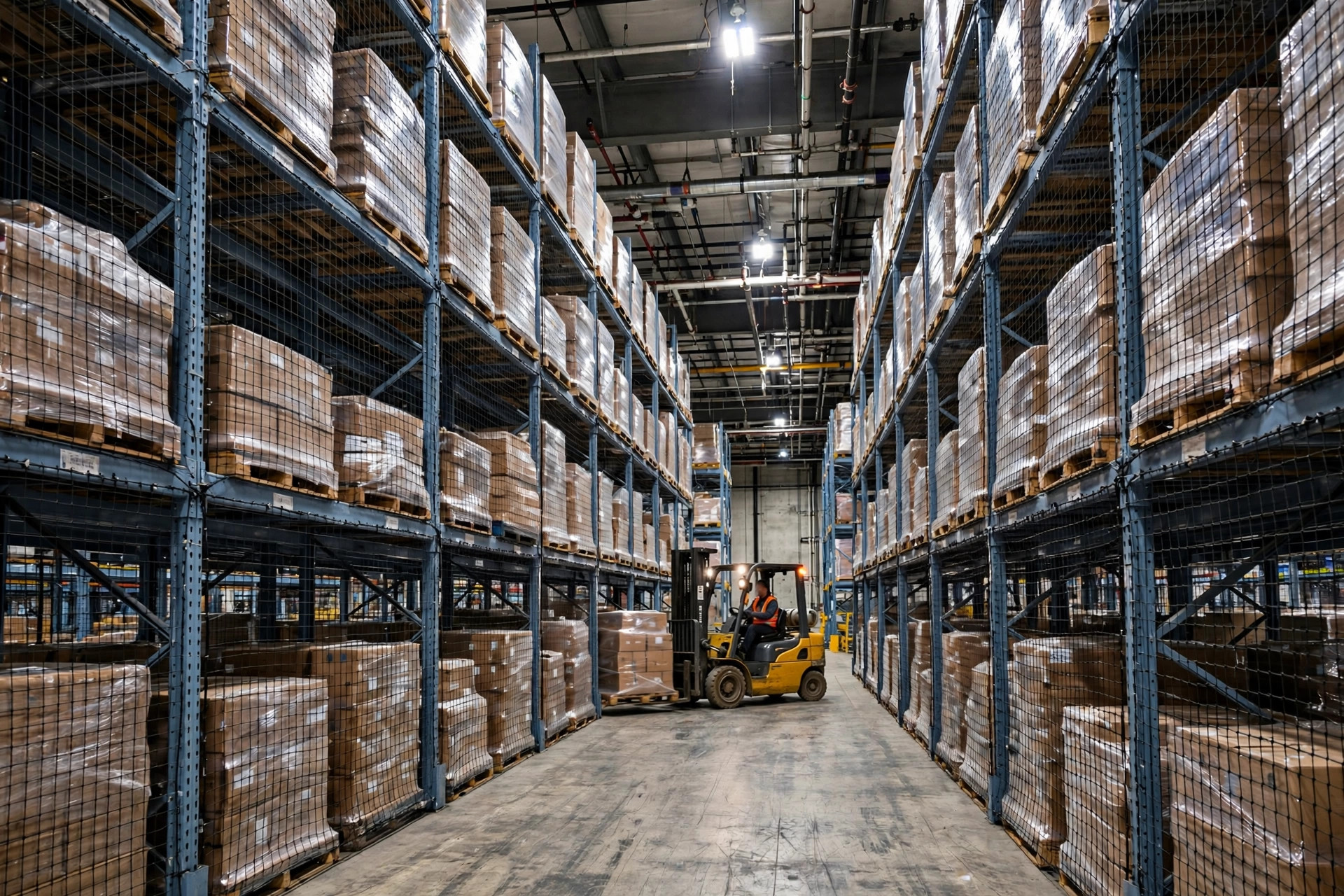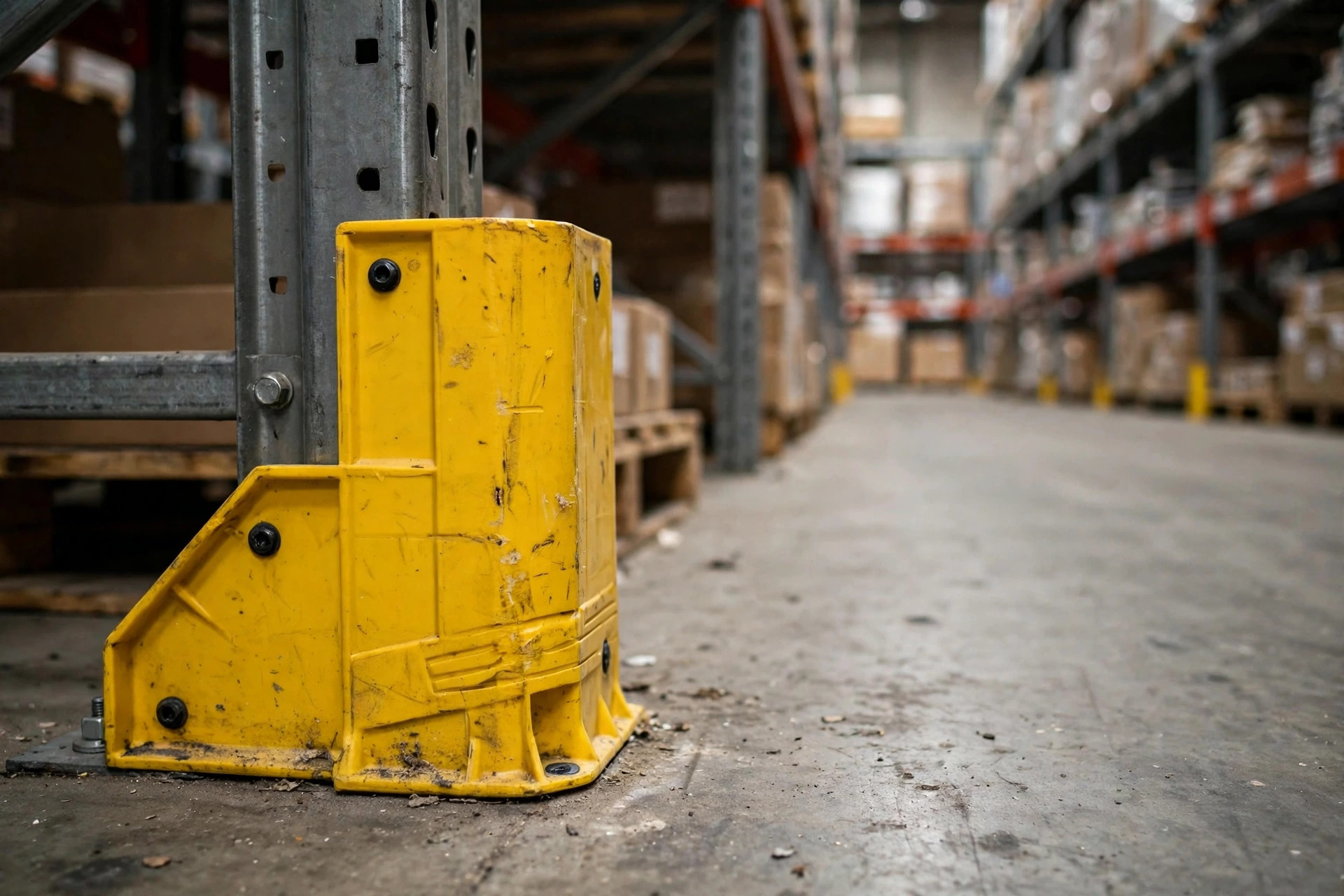
An OSHA inspector walked my warehouse three times without saying a word. At the end of aisle 7, he crouched down and knocked on an upright with his knuckle — dented, paint scraped off. He looked up at me: "How long has this one been hit?"
I told him a forklift had clipped it last month and we'd already filed a work order. He nodded and wrote something in his notebook.
That note turned into a citation.
This was early 2024, at a warehouse in Southern California. That citation forced me to think the whole rack-protection question through from scratch. Here's what I landed on: how OSHA actually views rack impact protection, how to choose between upright protectors, guardrails, and end-of-aisle guards — and the standard drill for after a hit.
OSHA Never Wrote a Dimensional Standard — Which Doesn't Mean You're Off the Hook
First, a misconception to clear up: OSHA has never published a rule saying "upright protectors must be this tall" or "guardrails must be this thick." You can search the standards all day; those numbers don't exist. What OSHA 1910.176(a) says is one sentence: storage of material shall not create a hazard. Everything else is the inspector's judgment on site.
The real teeth are in the General Duty Clause — Section 5(a)(1) of the OSH Act: employers must furnish a workplace free of recognized hazards. The inspector's logic runs like this: that dented upright, you saw it; you didn't fix it; so it's a recognized hazard left unabated. Citation. No dimensional standard needed anywhere in that chain.
So who sets the numbers? Two sources. First, ANSI/RMI MH16.1 — the standard for the design, testing, and utilization of industrial steel storage racks — which covers how to evaluate and replace racks after impact. Inspectors and judges both recognize it. Second, the rack manufacturer's own specs: every upright's load capacity and damage tolerance is engineered by the maker, and the maker decides at what point a damaged upright must go.
And there's a party even pickier than OSHA: your insurer. In loss-control surveys, missing impact protection is a routine demerit. Whether your premium goes up sometimes comes down to details like these. So don't read "OSHA never wrote a number" as "there's no requirement." Requirements without numbers are often the hardest ones to deal with.
Protectors, Guardrails, End-of-Aisle Guards: Don't Put Them in the Wrong Place
Three kinds of protection, three completely different jobs. Put one where another belongs and you've effectively installed nothing.
An upright protector wraps the base of a single upright. It handles low-speed scrapes and pallet-corner knocks — a forklift brushing past, a pallet corner catching the steel on the way in. It protects one upright, stands a couple of feet tall at most, and covers the zone where forks and counterweights can reach. Remember: a protector handles rubbing, not ramming.
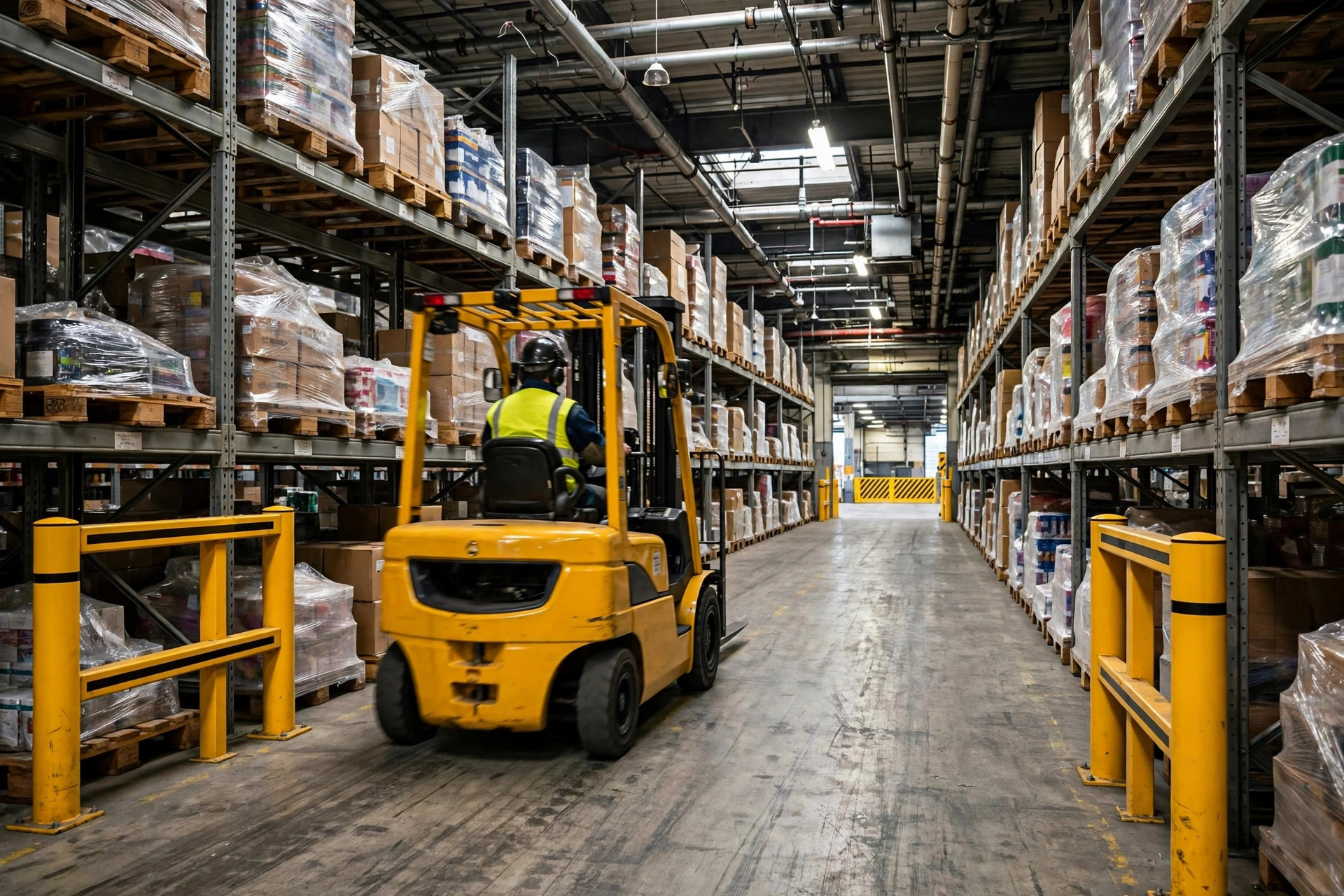
A guardrail runs in sections, typically at aisle ends or the ends of rack rows, and it's built for head-on forklift impact. It spreads the hit across the floor and multiple anchor points — energy levels that would destroy a protector, a guardrail absorbs.
End-of-aisle guards sit in the turning zones at both ends of an aisle — exactly where a forklift's tail swings widest. This is where hits happen most. More than half the upright damage I've seen in ten years was at aisle ends.
The dividing line is one thing: impact energy. Low-speed rubbing — protector. Possible head-on strike — guardrail. Aisle ends and turning zones — protect them, period, don't economize there.
For configuration, here's my rule-of-thumb thinking by aisle type and forklift size. Main aisles with heavy forklift traffic: guardrails at the ends, plus protectors on the first upright facing traffic — that first upright takes the most head-on exposure. Very narrow aisles: lean on protectors, because guardrails eat into clear aisle width and create new scrape points. Receiving and shipping staging areas: forklifts turn constantly there, so go heavy on end protection — don't stop at one upright.
Forklift weight is the other axis. A one-to-two-ton electric truck and a four-to-five-ton IC truck carry impact energy levels several times apart. At the same speed, the heavier truck can shatter a protector. So the bigger the truck, the higher the protection level: at aisle ends served by heavy trucks, go straight to guardrails and don't rely on protectors alone. There's no universal formula for this — it's a judgment call on impact energy, and erring conservative never hurts.
After installation, walk my short acceptance checklist: anchor bolts must go into the floor — a protector just sitting there doesn't count; the protector must hug the upright with no wobble; safety yellow, with reflective tape in dim areas; height must cover the impact zone, not just look the part; and re-measure clear aisle width afterward — protection hardware must not intrude into the aisle.
After a hit, follow this drill in order. One: take that bay out of service immediately, tape it off — no "it looks fine, keep loading" gambles. Two: inspect the upright for dents and plumb, check beam connectors for disengagement and safety pins for presence. Three: photograph everything and report it. Four: replace deformed uprights per the manufacturer's spec — hammering one back into shape to save money is the dumbest savings there is; fatigued steel doesn't carry what it used to. Five: only reload after a re-inspection passes.
The cost of doing nothing, in three ledgers. One: the OSHA citation — a serious violation runs into five figures per item, and OSHA adjusts penalties for inflation every year. Up only. Two: insurance — a premium hike is the mild outcome; the severe one is being flagged high-risk and struggling to renew. Three: a collapse that hurts someone — work stoppage, investigation, liability. That's a scale no citation can compare to, and the owner ends up at an OSHA hearing in person.
So here's my question for you: the hit uprights in your warehouse — have they been replaced, or are they still in service because they "look fine"? If it's the latter, forward this to your safety lead.