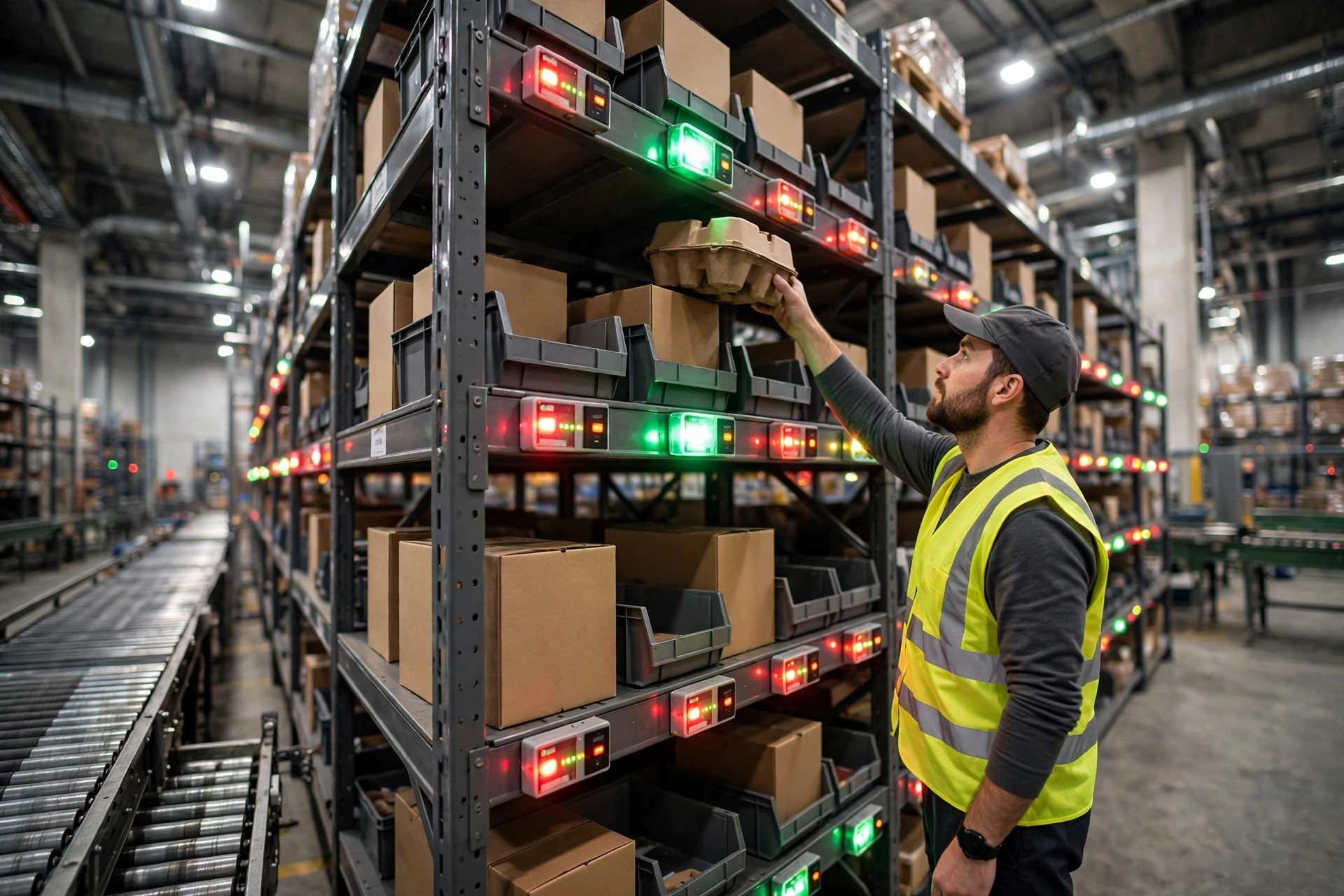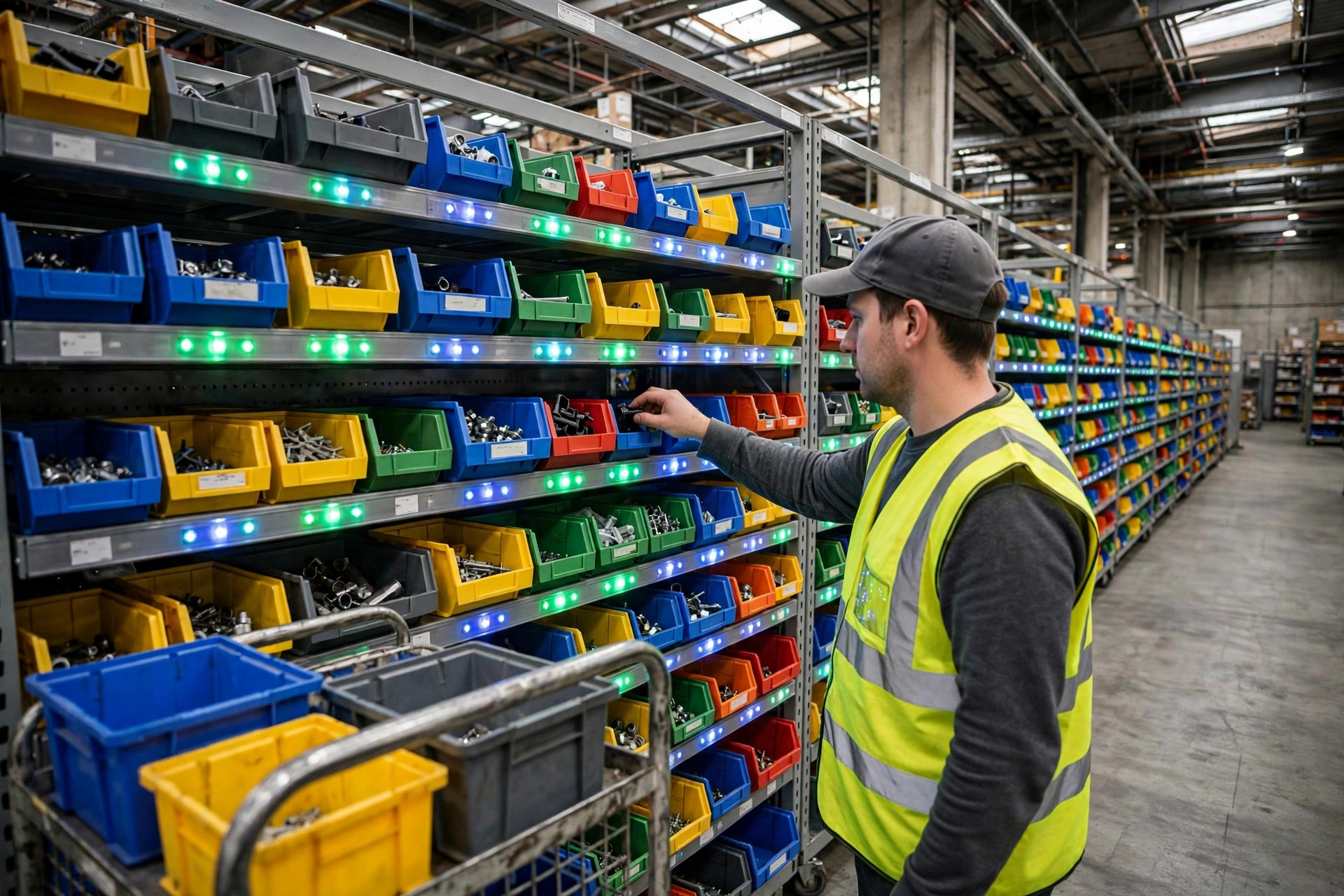
Every year I walk dozens of pick modules and hear the same question: "Pick-to-light or voice picking — which one is actually better?" What makes the question interesting is not the technology itself but the market's answer so far. Over the past two years, both camps have thickened their case-study libraries: pick-to-light (PTL) keeps expanding in small-parts, high-density operations like cosmetics, pharmaceuticals, and auto parts, while voice-directed picking keeps deepening its hold in cold storage, bulky goods, and food distribution. Neither has driven the other out. That outcome, more than any vendor whitepaper, tells us what this debate really is: not a contest of performance, but a problem of fit.
The Numbers, Side by Side
Let us start with what can be verified in public sources. The figures below come from published case studies and product literature of the mainstream PTL and voice vendors; real-world results swing with SKU similarity and order density, so I flag where a number is vendor-quoted rather than independently measured.
| Dimension | Pick-to-Light (PTL) | Voice Picking |
|---|---|---|
| Pick accuracy | Above 99.9% (vendor-reported) | Above 99.5% (vendor-reported) |
| Typical UPH (eaches) | 300–450 lines per hour | 200–350 lines per hour |
| New-hire training | Half a day | 1–2 days |
| Investment scale | Per pick face, a few hundred dollars per light module; grows linearly with locations | Per operator, several thousand dollars per voice terminal |
| Sweet spot | High-density small parts, thousands to tens of thousands of SKUs, multi-line orders | Bulky goods, freezers, irregular items, dispersed locations, hands-busy work |
Against the paper baseline, both are overwhelming wins — paper-based eaches picking typically runs 150–250 lines per hour with a mis-pick rate an order of magnitude worse. So the real question was never "should we adopt technology," but "which one fits."
Two field cases make the table three-dimensional. In 2023, a Pennsylvania third-party warehouse serving beauty and personal-care brands ran roughly 30,000 SKUs and 8,000 orders a day in its eaches zone. Before PTL, it relied on paper plus manual second checks; mis-ship rates stayed stubbornly high, and the cost of returns and customer-service tickets kept climbing. After the PTL retrofit, the project's published review reported accuracy above 99.9%, returns fell by roughly 40%, and seasonal-temp training collapsed from three days to half a day. The project lead put it plainly: the lights eliminated "finding the slot," the single most time-consuming decision in the process, and left people with pure execution.
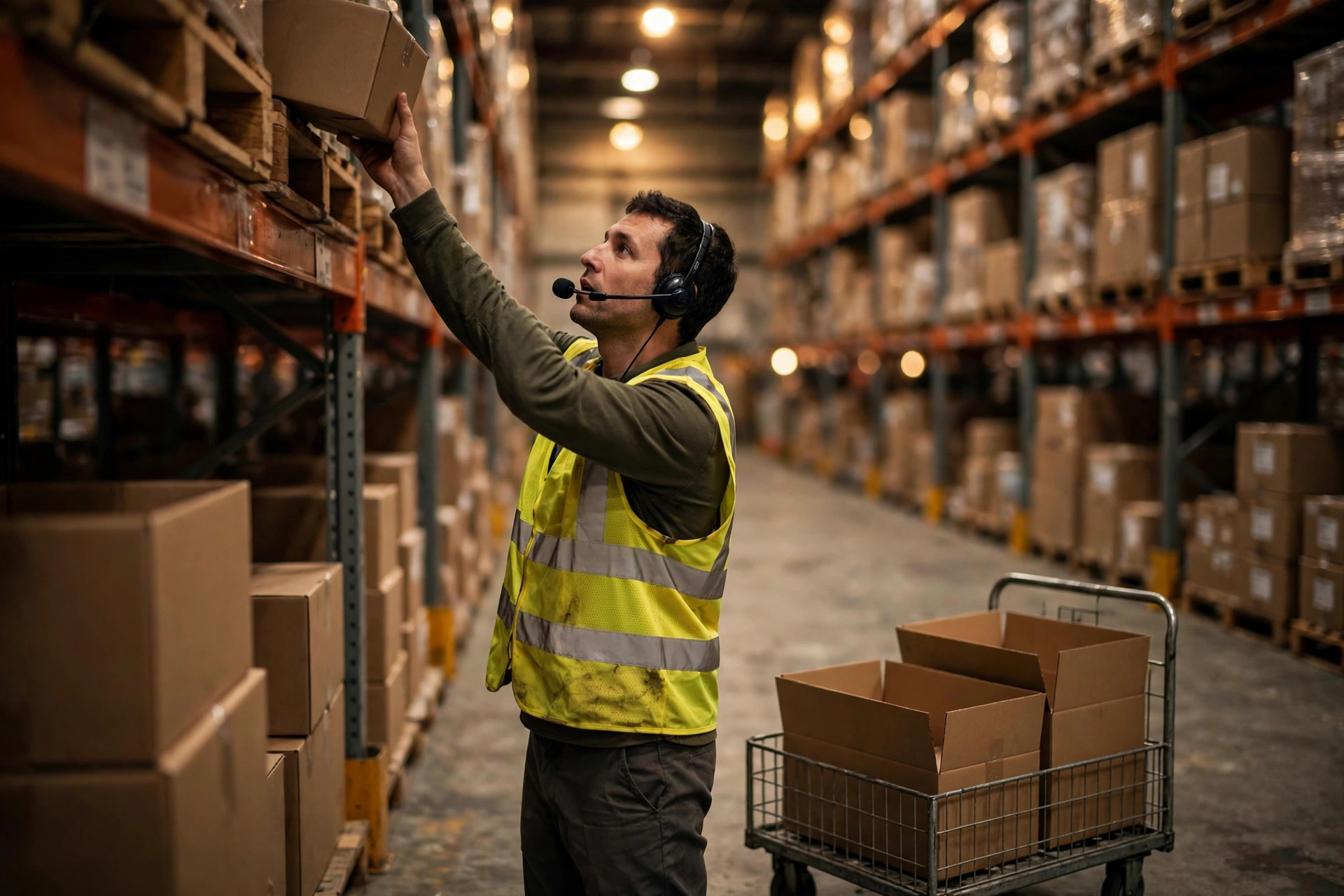
The second case is in California. In 2024, a fresh-food distribution center equipped its freezer zone — running well below zero — with voice picking. Workers in heavy gloves cannot realistically operate scanners or paper, so voice became the only workable option. With both hands free, lines picked per labor hour rose about 15% versus the paper era, and new hires worked independently by their second day. The manager's comment was refreshingly honest: they chose voice not because it was fastest, but because in that environment, nothing else could work at all.
Why Neither Approach Can Kill the Other
PTL is fast because it replaces thinking with seeing. Light on, glance at the quantity, grab, press to confirm — the whole decision chain compresses to two or three seconds, with almost no literacy or training required. That is why its accuracy touches the ceiling. But the boundary is equally sharp: it pins the operator in front of the lights. Stretch past tens of thousands of SKUs into sparse, spread-out locations, and the cost of wiring and retrofitting lights climbs steeply while the economics deteriorate fast.
Voice is free because it replaces seeing with hearing. Operators can walk and listen with both hands on the work, and dispersed locations or awkward product shapes simply do not matter. The price is verification by spoken check-digit: one extra conversational round trip per line, which makes the per-line cycle inherently a beat slower than PTL. Noisy environments also cap speech-recognition accuracy — a physical ceiling that better algorithms can approach but never remove.
Push the analysis one layer deeper and the selection logic becomes clear: it was never about choosing the "best" technology, but the one whose economics and ergonomics match the order profile. SKU count determines whether a technology can pay for itself; order-line count and product shape determine whether human motion can be compressed at all. Forcing PTL into a bulky-goods warehouse, or voice into a dense small-parts zone, means using a technology's strength to compensate for a scenario's weakness — a fight that ends badly for both.
There is also a cost layer most analyses skip: the cost of an error. A mis-ship costs far more than the re-ship labor and freight — there are service tickets, marketplace penalties for e-commerce sellers, and the invisible cost of lost customers. Public sharing from several 3PL operators puts the all-in cost of one mis-pick at three to five times that order's fulfillment cost. That is why every additional 0.1 point of accuracy translates into real money at scale — a technology decision is only complete when "errors" appear as a line item in the math.
Which leads to the counterintuitive point worth stating on its own: the most accurate solution is usually neither the fastest nor the most expensive — at least not the most expensive in total cost of ownership. In high-wage markets, PTL, which looks pricey up front, often delivers the lowest cost per order once amortized over three years of volume. In low-wage, high-volatility markets, voice — priced per head and scalable on demand — wins on flexibility. The first principle of selection is three-year TCO divided by total orders, not whose demo video looked slicker. Many warehouses get this arithmetic wrong and end up buying anxiety instead of technology.
A Selection Framework in Three Questions
The data and the attribution above compress into a practical framework of three questions.
First: are SKUs under roughly ten thousand, average lines per order above five, and locations dense? Three yeses means PTL deserves the first look — its economics in that band are close to unbeatable.
Second: is there a freezer, bulky or irregular items, dispersed locations, or work that genuinely requires two hands? A single yes points to voice; do not argue with physics.
Third: tens of thousands of SKUs with a heavily skewed velocity curve? Do not rush into an either-or. Apply ABC stratification — PTL for the high-velocity A movers, RF guns plus voice for the long-tail C movers — and the hybrid route often produces the lowest TCO. In practice, the best-performing warehouses are rarely "pure-blood" implementations of one technology.
What Vision AI Changes
According to what vendors have shown at industry expos and in published roadmaps over the past two years, a third route is forming: cameras above the pick face running AI vision to verify, in real time, whether the operator grabbed the right SKU in the right quantity, flagging mistakes on the spot. The logic splits "guidance" from "verification" — guidance (light or voice) can use the cheapest available means, while verification moves to machines and no longer depends on human attention. Some vendors are already piloting voice guidance paired with vision-based verification, eliminating the spoken check-digit entirely.
My read is that over the next three to five years, neither pure PTL nor pure voice disappears, but we will see more "lamp-less PTL" (projection or screens replacing physical light modules) and hybrid "vision-verified voice guidance." The endgame of technology routes is never replacement of one by another; it is that once machines drive verification cost toward zero, guidance reverts to whatever is cheapest. History's pattern is consistent: any link that depends on "people not making mistakes" eventually gets handed to machines.
If vision verification truly pushes mis-pick rates into irrelevance, most rows in today's comparison table may stop mattering within five years. The variable worth tracking is not whose lights are brighter, but when "verification" disappears from human motion altogether — and what a warehouse looks like on the other side of that change.
By Dr. Chen, Supply Chain Researcher