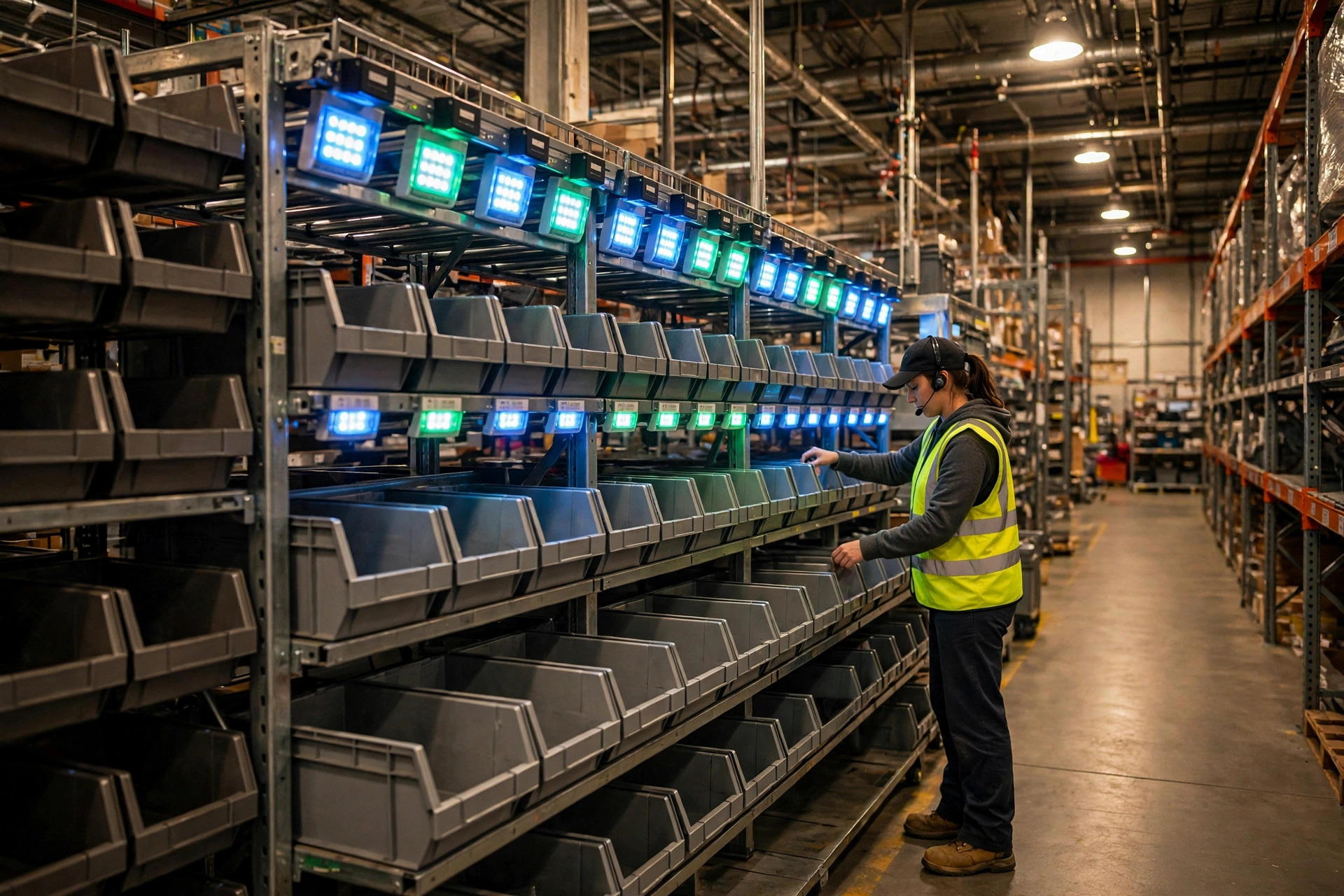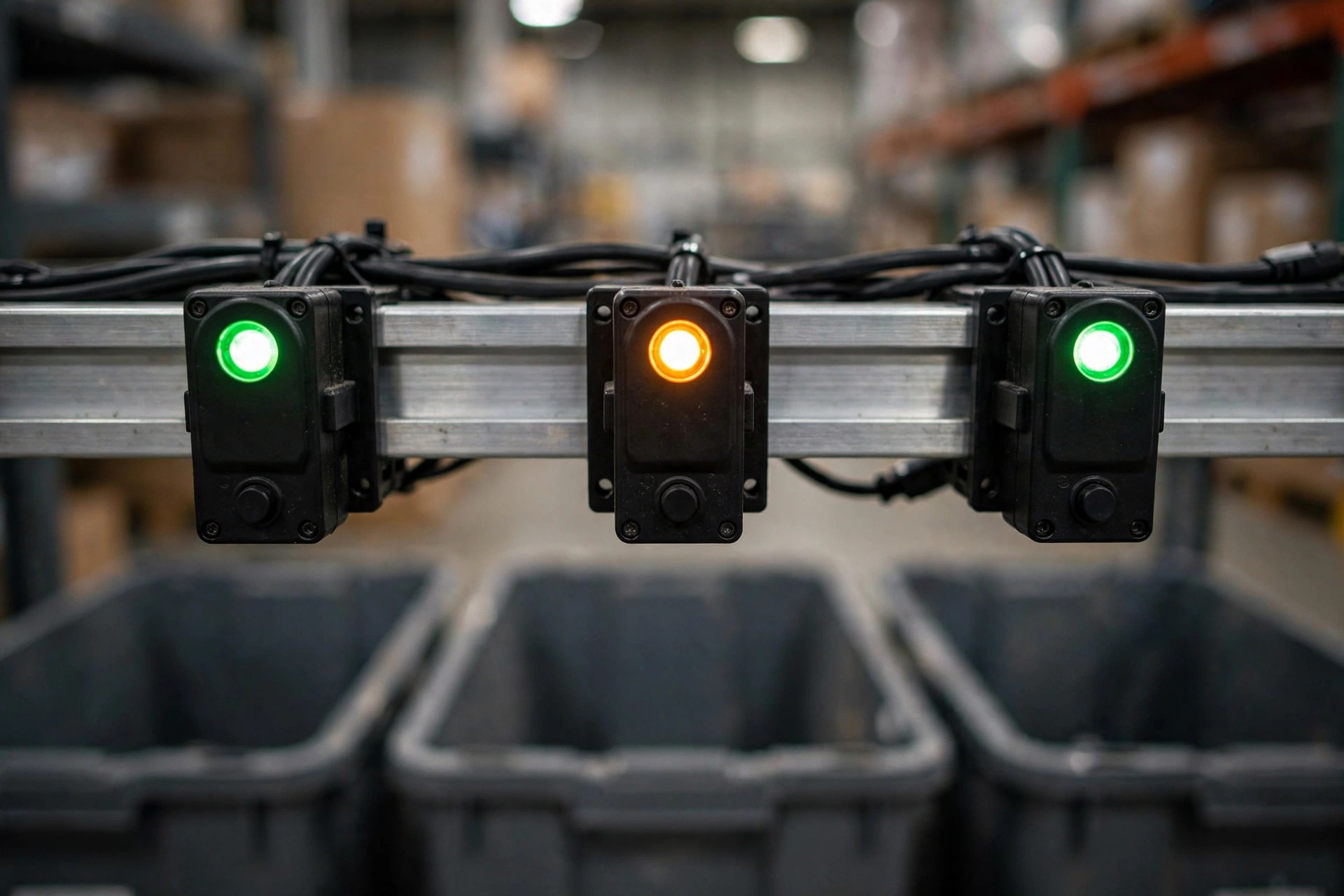
Monday, 7 a.m. Pickers walk up to their zones and start scanning totes. Nothing lights up. Not one or two modules—the entire face of the flow rack, dark. Orders are already in the queue, dozens of them, and the pickers stand there with paper slips, matching SKU by SKU. Fifteen minutes later the supervisor calls me: "It was fine last night. What happened?"
I told him: the batteries died. That batch of light modules went in almost four years ago.
That morning was the first time it really hit me: the most expensive part of a pick-to-light system isn't buying it, isn't installing it. It's the batteries.
Here's my verdict up front: wireless light modules save you the wiring, but they turn power into a recurring maintenance liability amortized over years. When you buy, the vendor tells you the batteries last three to five years, and you nod and sign. A few years later, a few thousand modules die in the same year, and you learn what systemic risk means.
And that three-to-five-year number is real—it's the industry's public claim. In interviews with trade press, vendors say battery lifecycles on wireless light modules now run three to five years. One European manufacturer's datasheet is more honest: a replaceable 3.6V lithium cell, "up to" three years of battery life. Note the words: up to.
Batteries: don't trust the rated lifespan
Why does the rating lie? Because a module's power draw tracks its workload directly.
Rated life is computed in a lab: so many light flashes, so many display refreshes, so many radio packets. A real warehouse module is nothing like that. The modules in your outbound zone flash hundreds of times a day. The ones in the spare-parts area flash ten times a week. Modules installed on the same day can differ in real lifespan by a factor of two.
So I've seen this movie: the outbound modules start dying at two and a half years, one by one, while a maintenance guy climbs racks swapping cells; the spare-parts modules are still going strong at year four. And your plan is wrecked—you thought "this batch has another year left," but the high-use zone was already past the line.
There's a sneakier trap: temperature. Modules in coolers or near dock doors drain far faster than ones at room temperature. A cold-chain warehouse I know bought into the vendor's room-temperature numbers and built its maintenance plan around them. First winter, the plan blew up. They learned something expensive: a battery's datasheet lifespan is only valid at room temperature.
My rule of thumb is simple: take the vendor's rated life and multiply by 0.7 for your plan. They say three years, you plan for two. Don't argue about precision with me—the morning the batteries die, 70 percent beats 100 percent every time.
Inspections: don't wait for the lights to go out
Here's the thing: most warehouses do zero maintenance on their PTL modules. Once installed, nobody touches a module until it goes dark.
That's the biggest trap of all. Because modules don't fail all at once. First they dim, then they get sluggish, then they occasionally ignore a confirmation press—then they're dead. Pickers actually notice early: "I have to press this one three times." But they don't file a work order; they just press harder. Until one Monday morning, the whole row goes dark and you lose fifteen minutes of startup.
When I later consulted for a warehouse on this, we put the PTL modules on the weekly inspection sheet. Three things:
First, check brightness. Once a month, the inspector walks the pick zones and notes any module that's visibly dimmer. Dimming is the first signal of voltage drop—weeks before total failure.
Second, check confirmation lag. Press confirm and the light takes a beat to go out? Note it. That module probably won't survive the quarter.
Third, check the radio logs. The backend usually keeps them. Any wireless module reporting anomalies, excess retransmissions, drop-offs? An offline module is eight times out of ten a dying battery, not a network problem.
It sounds fiddly, but one experienced inspector can sweep several thousand modules in a morning. The cost is half a labor-day, in exchange for never again having a "Monday morning whole row dark" incident. Run the math—it's worth it.

Replacement: do it before peak season, not during it
So: thousands of modules need new batteries. How do you do it?
Whatever you do, don't go one-by-one-as-they-fail. That model turns your maintenance tech into a full-time battery swapper, and there's always a module hovering between "dead" and "about to die."
The right approach is batch replacement—by zone, in stages, timed away from peak season.
Here's how I usually schedule it for clients: group modules by installation date, stagger each batch by six months. Zone A installed in 2022, Zone B in 2024. Zone A's batteries get fully replaced at the start of 2026, Zone B waits until 2028. When you replace, you replace every module in the batch—lit or not.
Why so aggressive? Because same-batch modules die in a concentrated window. Replacing one at a time just buys you a year of monthly outages. One batch replacement, then two quiet years.
Timing matters too: finish a month before peak, with buffer. Never do it during peak. During peak, pickers measure bathroom breaks with a stopwatch—tell them "this rack's lights are offline for half a day" and they'll chase you out of the building.
Spare parts have their own logic. For a consumable like module batteries, keeping 5 percent of your total module count in stock is plenty—if you're on a batch schedule. If you're in replace-as-they-fail mode, you'll never have enough, because failures come in clusters.
And one thing I'd write into the contract: when you buy wireless PTL, list batteries as a separate spare-parts line item in the purchase agreement. Don't come back four years later asking the vendor what a cell costs now. The day you sign, you're the buyer; four years later, whatever price they quote, you pay. Lock in spare pricing and lead times. That's been a standard clause in every PTL contract I touch since I got burned.
The verdict: battery power or wired power?
Which brings us to the obvious question: if it's this much trouble, why not just wire them?
It's a genuine trade-off. There's no right answer.
Wired is the peace-of-mind option. Modules draw power straight from the bus, and once installed you forget about power for a decade. Industry veterans say it straight: for high-intensity multi-shift customers, they still recommend wired systems first—dead simple to install, an hour of training and maintenance can support it, and a failed module is a swap, not a project. The downside is equally real: wiring costs, and every slotting change means re-running cable. Flexibility suffers.
Wireless is the mirror image: fast to deploy, no heartbreak when you re-slot, and it's the only option for mobile pick carts and mobile put walls. But the price is everything above—inspections, spares, batch replacement schedules, battery clauses in the contract. The money you saved on wiring gets spent, year by year, on batteries and labor.
My decision rule has exactly one input: how often you re-slot.
If your slotting stays put for three years, go wired—one upfront investment buys a decade of not thinking about power. If you run e-commerce, re-slot quarterly, and spin up temporary put walls for peak—go wireless, but manage batteries as a standalone maintenance project: a plan, a budget, an owner.
The dumbest combination is picking wireless and managing it like wired—install and forget. Because then, one Monday morning, you'll stand in front of a dark row of modules with orders piling up and the supervisor on the phone asking what happened.
And you'll remember what I told you today: PTL batteries aren't consumables. They're a maintenance project. Run them like a project and they're a money-saving machine. Treat them like consumables and they're a time bomb.