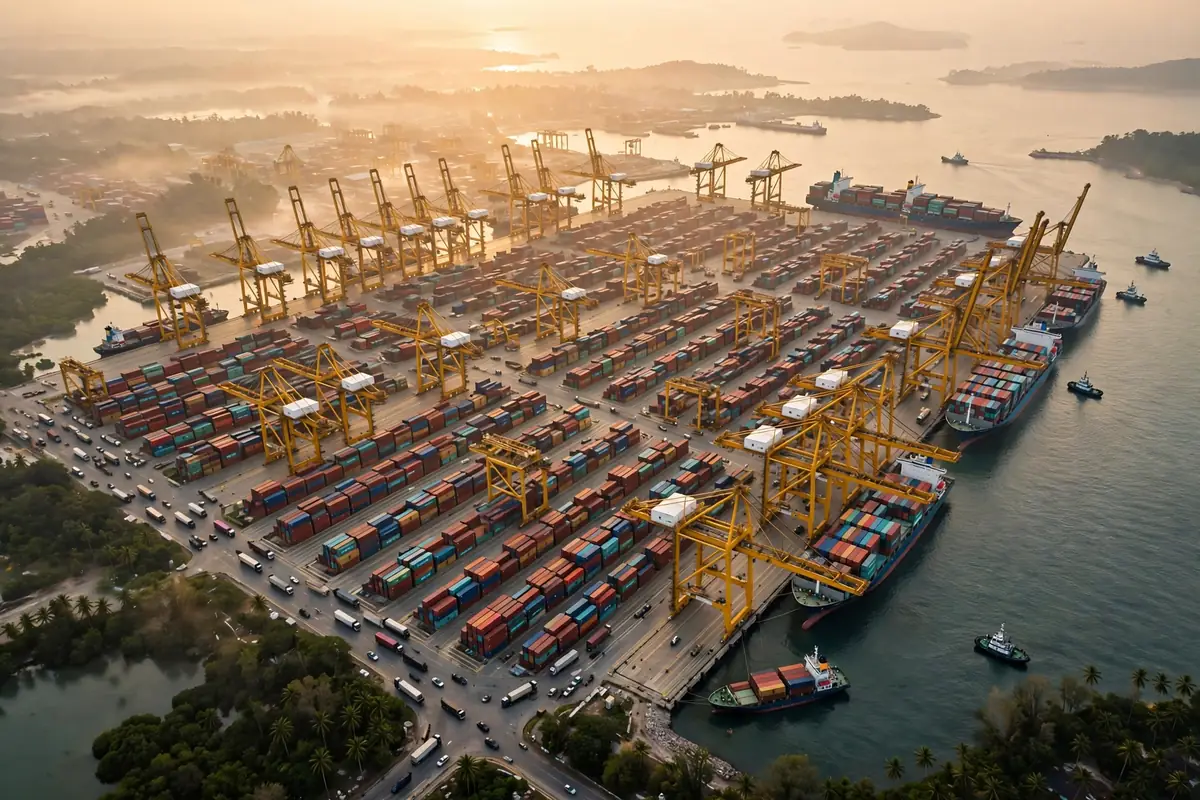
Let me be honest up front: Port Klang is not a place where a 3,000-square-meter warehouse like mine opens its own facility. That is a daydream. But the cargo still has to go through Port Klang. Three or four of my clients selling into Southeast Asia send everything through it — into Malaysia, then on to Kuala Lumpur, Singapore, even Indonesia. I have never rented a single square meter there, but I have run the Port Klang numbers for my clients over and over, and the mistakes I have seen would fill a small book.
Here is one that nearly went wrong. In the summer of 2025, a Shenzhen seller of small home appliances sent a 40-foot container to Port Klang, bound for a Kuala Lumpur warehouse to fill online orders. The box berthed on a Monday. It was not picked up until Thursday afternoon — right on the edge of the 96 hours of free storage Westport gives non-ASEAN import containers. One more delay and demurrage would have kicked in. Why did it take three days? The pickup slot was never booked, the trucks were queued, and one customs document — a certificate of origin — was missing. The seller told me afterward that those 96 free hours saved him. That is when it clicked for me: the Port Klang math is not just freight plus rent. It is time. Every extra day your box sits in the port, the freight you saved evaporates.
Port Klang Is Not One Port — It Is Two Terminals Plus a Free Zone
People talk about Port Klang as if it were a single port. It is not. It is Westport and Northport, plus a free zone next door. In 2025 the port handled 15.14 million TEU, a record, ranking tenth in the world. Westport took 11.33 million of that; Northport handled roughly 3.8 million. About 57.6% of Westport's boxes were transshipment — unloaded from one ship and loaded onto another, never entering Malaysia at all. Northport leans the other way, serving Malaysia's own imports and exports.
That split decides where your cargo should go. If your goods are entering the Malaysian market, Northport usually runs smoother: the path from berth to customs to inland trucking is shorter. If your cargo is only passing through Southeast Asia on its way to Indonesia or the Middle East, Westport's transshipment network is denser. But if your goods are meant for Kuala Lumpur and you force them through Westport just because it has more sailings, every step — pickup, customs, trucking — takes a longer route.
The free zone, PKFZ, sits right beside the port. Its advantage is that cargo enters without paying duty first, which suits transshipment, distribution, labeling, and light processing. In the second half of 2025 I ran the numbers for an auto-parts client: part of his stock was for Malaysia, part was bound for Indonesia. He used to send everything to a Kuala Lumpur warehouse, clear customs, pay duty, then split it. After switching to a free-zone warehouse as a buffer, the Indonesia-bound portion never cleared customs at all — it was relabeled, repacked, and shipped on, skipping a round of duty and paperwork. But a free-zone warehouse is not a cure-all. If you park stock there for months waiting for orders, the rent and handling cost about the same as anywhere else. It cannot save a hoarding problem.
Port Klang to Kuala Lumpur: The Distribution Math — Slow Is Expensive
Port Klang sits about 38 kilometers from Kuala Lumpur — under an hour by road. Sounds close, right? Those 38 kilometers are exactly where small sellers miscalculate most.
I have seen two approaches. One is a port-side warehouse plus a small front warehouse in Kuala Lumpur: bulk stock stays at the port, and KL keeps about two weeks of fast-moving items, shipping orders the moment they land. The other is the "keep it simple" route — everything piled into one big KL warehouse, the port used only for clearance and pickup. The first looks like an extra warehouse and an extra handling step, but when peak season hits and orders spike, the KL warehouse has stock ready to ship. The second looks cheaper until peak season clogs the port, pickups drag, the road jams, and customers cancel orders while waiting. The losses dwarf whatever rent was saved.
Here is how the three main routes compare for a small seller:
| Route | Best for | Upside | Catch |
|---|---|---|---|
| Clear at Port Klang, distribute from Kuala Lumpur | Goods entering the Malaysian market | Close to consumers, fast last mile | One slow day at the port and storage and delay charges show up |
| Transship via Westport, never clear customs | Cargo moving on to a third country | Skips a customs and duty round, dense sailings | Transshipment boxes queue; many sailings does not mean your box moves fast |
| Transship via Singapore or Tanjung Pelepas | Cargo where speed is everything | Mature hubs, fast connections | Expensive — small volumes carry a heavy per-unit cost |
Singapore and Tanjung Pelepas are genuinely mature — dense sailings, fast connections. But for a small seller, hub prices are honestly expensive. Port Klang is cheap in a way that demands you know how to count: low fees, plenty of ships, but you have to nail the timing of pickup, customs, and trucking yourself. Get the timing wrong and the money you saved pays for the lesson.
That auto-parts client I mentioned? The buffer-pool switch worked better than I expected. The Indonesia-bound stock was relabeled and repacked in the free-zone warehouse and moved on within about a week, without clearing customs or sitting in the KL warehouse waiting on paperwork. The Malaysia-bound stock cleared customs separately into KL. One shipment, two routes, each minding its own business — and peak season stayed orderly. The free-zone warehouse earned its keep not through cheap rent but by letting "clear customs" cargo and "don't clear customs" cargo stop tripping over each other.
Here is the contrarian take: many sailings do not mean your cargo moves fast. More than half of Westport's boxes are transshipment, so the terminal's business is moving boxes between ships. Your import container is just one more box in the queue. That 2025 record of 15.14 million TEU was built mostly on transshipment. Picking a port by its ranking is like picking a restaurant by the length of the line outside — a long line means business is good, not that you will be seated quickly.
One more number worth watching: the Westports 2 expansion, new terminals CT10 through CT17, aims to roughly double capacity to around 27 million TEU, with the first new terminal targeted for 2028. More berths will mean looser schedules and more capacity — but that is years away. Do not put 2028 capacity into this year's plan.
So for a small seller, Port Klang comes down to three rules. First, cargo entering Malaysia goes the Northport way; cargo passing through goes the Westport way — do not pick the wrong door just because it has more ships. Second, use the free-zone warehouse as a buffer pool, not as a hoarding depot. Third, those 96 hours of free storage are for people who count time: documents, appointments, and trucks ready three days early, not scrambling after the ship has berthed.
We small warehouses cannot afford to burn money like that. The big players can rent tens of thousands of square meters at Port Klang and keep a local team to grind through the process. We cannot. What we can do is nail the timing of every step and spend every dollar where it counts. Small warehouses have their own way of surviving — and that way is: do not compete with a big port on appearances. Beat it on arithmetic.
By Xiao Ma, Small Warehouse Owner