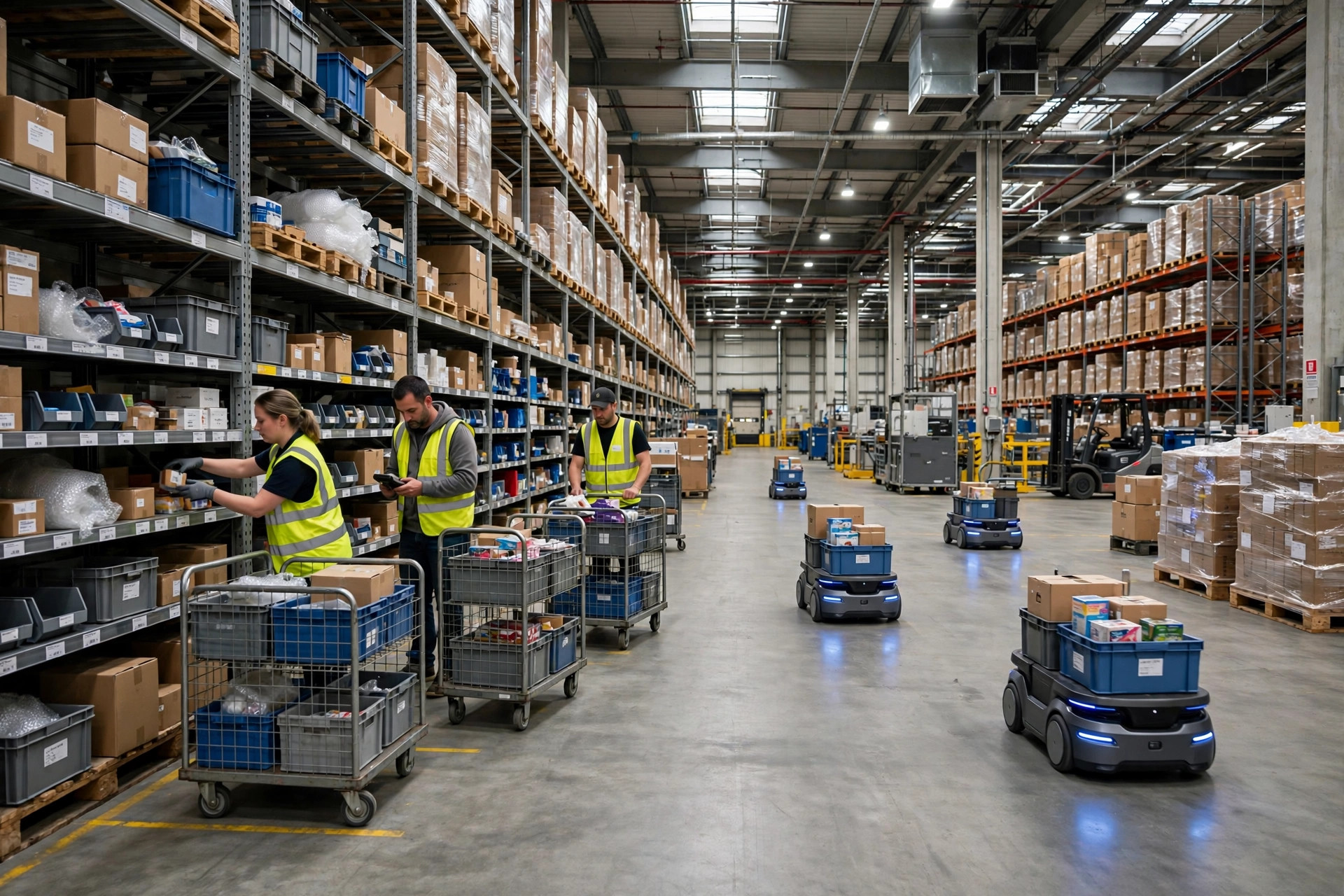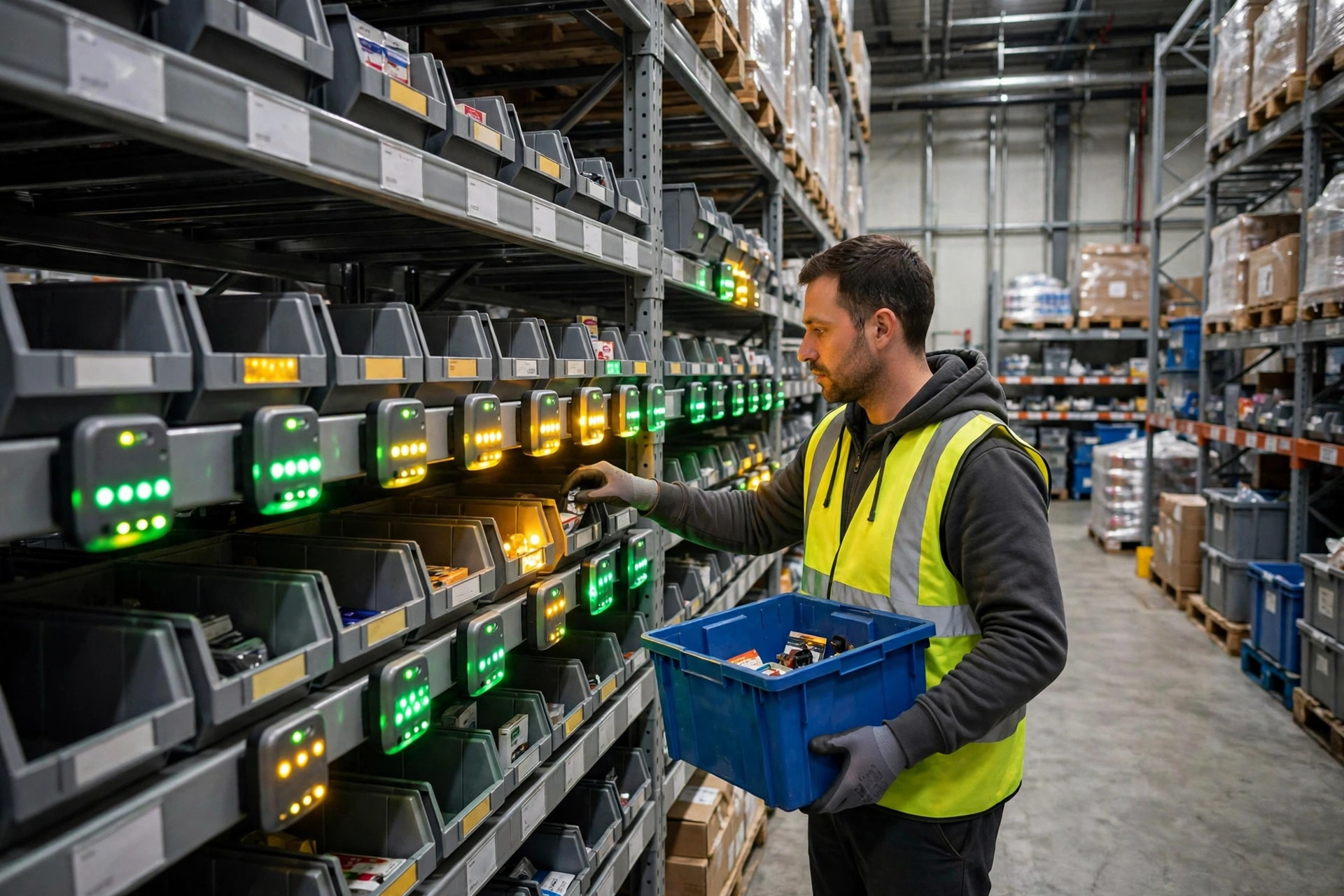
Let's start with a number, not a concept. A paper-list picker does roughly 60 order lines an hour, and about five of those minutes per hour go to hunting: finding the order number, confirming the slot, double-checking the item. On your books that's "labor cost." In reality, it's search cost. The only question that matters about pick-to-light system cost is this: are you willing to pay a known, fixed equipment bill to kill a search bill you'll never fully account for?
Here's my framework up front, and I'll unpack it below. Whether the system is worth it comes down to three numbers: total light count, all-in cost per light, and monthly net savings. Payback months = total investment ÷ monthly net savings. Anything over 24 months — walk away.
Where pick-to-light system cost actually goes
Most people hear "light-directed picking" and picture buying a pile of lights. That's half right. The per-light price is easy; the system price is not. I break the cost into five buckets, using 1,000 lights — a common project size — and publicly reported ranges (always confirm against current vendor quotes):
| Cost item | What it covers | Magnitude at ~1,000 lights (USD) |
|---|---|---|
| Display modules | Light + button + small display, priced per pick face | ~$60–$120 per light, $60k–$120k total |
| Controls & wiring | Controllers, cabling, installation labor | ~$15k–$30k |
| Software integration | Task flow integration with your WMS/OMS | ~$10k–$30k — older the interface, pricier the job |
| Project & commissioning | Design, on-site tuning, training | ~$10k–$20k |
| Annual maintenance | Lamp replacement, controller spares | ~8%–12% of total per year |
Notice the split: the lights themselves are only about 60%. The other 40% is the cost of "making the lights light up." Vendor quote sheets love advertising "under $100 per light," and then your final invoice lands at roughly 1.7× the unit price. Signing without the all-in number? That's money spent wrong.
Case one. Early 2025, a beauty-and-supplement 3PL in Ohio showed me their books: three high-velocity pick zones, roughly 1,200 lights. Hardware quoted at $110k; with wiring and software integration, the final landed cost was $196k — 70% over budget. The overrun was entirely integration: their WMS was over a decade old and the interface had to be rewritten. Lesson one: the lights aren't expensive. Your legacy system is.
Pick-to-light cost vs. paper picking: where the savings hide
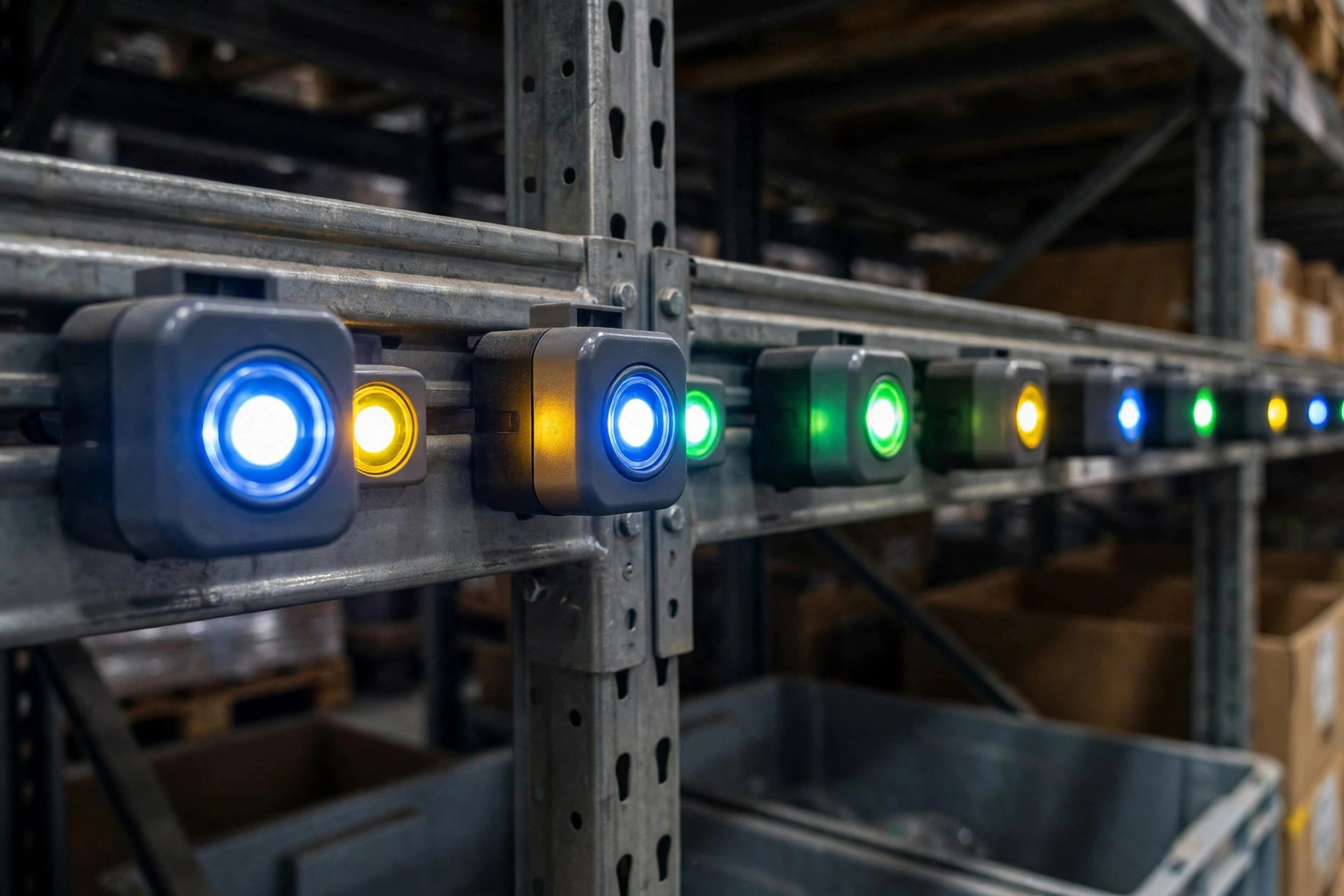
Light picking saves you money in three places:
One, speed. A light goes on, the hand moves, the eyes stop searching. Publicly reported data puts pick-to-light at 30%–50% faster than paper in high-velocity SKU zones. A picker doing 60 lines an hour on paper can hit 85–95 in a lit zone. Read that qualifier again: high-velocity zones, not the whole building.
Two, accuracy. Paper picking typically runs an error rate in the low tenths of a percent; pick-to-light is publicly reported at 99.9%+ accuracy. A mispick doesn't cost you "one return." Add customer service time, return freight, reshipping, and the customer who never comes back, and the industry rule of thumb runs 2–4× the order value. Take a warehouse doing 2,000 orders a day at $40 average order value. Cutting the error rate from 0.5% to 0.1% saves roughly 2,000 × $40 × 0.4% × 365 ≈ $117,000 a year. Most people never put this line in the spreadsheet.
Three, training. A new hire on paper needs 2–3 weeks to learn slots and item codes; on lights, they follow the glow and are productive in days. In tight labor markets, this line item is real money.
What I deliberately did not say: pick-to-light saves zero travel time. The picker walks exactly as far as before. It kills search and confirm time, not walk time. That brings us to the counterintuitive part.
The contrarian call: fewer SKUs, less reason for lights
Gut instinct says "we have too many SKUs, we need lights." The math says the opposite: lights are amortized per SKU, and a slow-moving SKU is a light burning money.
An installed, all-in light runs roughly $150–$200 (backed out from the table above). If that SKU gets picked twice a day, the light saves you under $20 a year in search time — a 8–10-year payback. The same light on a SKU picked 200 times a day pays for itself in months.
Case two. Late 2024, a pet-supplies e-commerce warehouse in California asked me to run the numbers: 12,000 SKUs, vendor quote around $900k for full-facility lighting. I asked for one table first — SKU pick-line distribution. The top 800 SKUs drove 72% of all pick lines; the bottom 10,000-plus SKUs combined contributed under 15%. Lighting everything meant 72% of the lights would serve 15% of the picks. Payback came out at 40 months. I killed the proposal and told them to do "lights for the high-velocity zone, voice guidance for the slow zone" instead. The biggest trap in pick-to-light: it's not that lights are expensive — it's that lights in the wrong places are expensive.
The decision rule is one sentence: light only the ~20% of SKUs that drive ~80% of your pick lines. The rest don't deserve a light.
A payback framework — plus who should buy and who shouldn't
Here's the formula. No fluff.
Payback months = total investment ÷ (monthly labor savings + monthly error savings − monthly maintenance allocation)
Plug in the Ohio 3PL's real numbers:
| Line | Value |
|---|---|
| Total investment | $196,000 |
| Pick lines covered by lit zones | ~65% |
| Picking speed gain (lit zones) | ~40% |
| Monthly labor savings (~2.5 fewer pickers at local fully-loaded cost) | ~$11,000 |
| Monthly error savings (0.4% → 0.08%) | ~$5,000 |
| Monthly maintenance allocation | ~$2,000 |
| Monthly net savings | ~$14,000 |
| Payback | ~14 months |
Fourteen months. Worth it. That's why my red line is 24 months: hardware generations turn over roughly every three years, and technology churn plus business change will eat any payback you push further out. Twenty-four months is where the finance stays respectable.
A back-of-envelope version for meetings: lights N × $180 all-in per light = total investment; each 1,000 lights saves roughly $10k–$15k a month net — only if the lit zone covers high-velocity SKUs. N × 180 ÷ 12,000 = your payback months. Ten seconds of mental math.
Here's the buy/no-buy verdict in three buckets each.
Buy, if: your SKUs number in the hundreds to low thousands with concentrated velocity; your mispick cost is high (beauty, supplements, baby products); labor is expensive or scarce and training a picker takes three weeks.
Don't buy, if: your SKU count is tiny (dozens) — a picker can find those blindfolded, and lights are pure burn; your orders are all "one item each, scattered across the building" — the lit zone can't cover enough pick lines for the speed gain to matter; your WMS is so old the integration needs a rewrite — price that first, then talk about lights.
One calculable conclusion to close with: pull the last 90 days of SKU pick-line data from your WMS. If the top 20% of SKUs drive over 70% of pick lines, and those SKUs can sit in contiguous slots, then estimate total investment as "lights × $180" and monthly benefit as "$12k per 1,000 lights." Payback under 24 months — light it up. Over — stick with paper and batch picking. Pick-to-light was never a technology question. It's an arithmetic question.
By Lao Zhou, Logistics Cost Analyst