Let me be honest with you: our warehouse is 3,000 square meters of rented space that mostly handles local e-commerce goods — cardboard boxes, clothes, small appliances. So when a friend who makes craft chocolate asked me last year if we could handle a Peru cocoa export warehouse storage job — a shipment of Peruvian cocoa beans for export, from a collection warehouse in the Andes all the way to the port of Callao, my first thought was: cocoa? Isn't that a chocolate factory's problem? We are a small warehouse. We cannot afford to burn that kind of money. That question turned into a crash course in Peru cocoa export warehouse storage.
Fair enough — working out numbers is what I do. And once I ran them, I realized Peru cocoa export warehouse storage is not a big-company-only game. A small warehouse can handle it with scrappy methods, as long as you understand what the beans are actually afraid of.
Peru Cocoa Export Warehouse Storage Starts With Moisture
Cocoa beans are fussy about one thing above all: water. According to the International Cocoa Organization, properly dried beans sit at about 7 to 7.5 percent moisture, and the Codex standard requires below 8 percent for stable storage over 12 months. Go above 8 percent and mold risk shoots up fast. The Global Cold Chain Alliance's 2024 commodity guidance is even more direct: keep warehouse relative humidity at or below 65 percent, store at 18 to 21 degrees Celsius for up to 12 months, and drop to 0 to 4.4 degrees for longer holds.
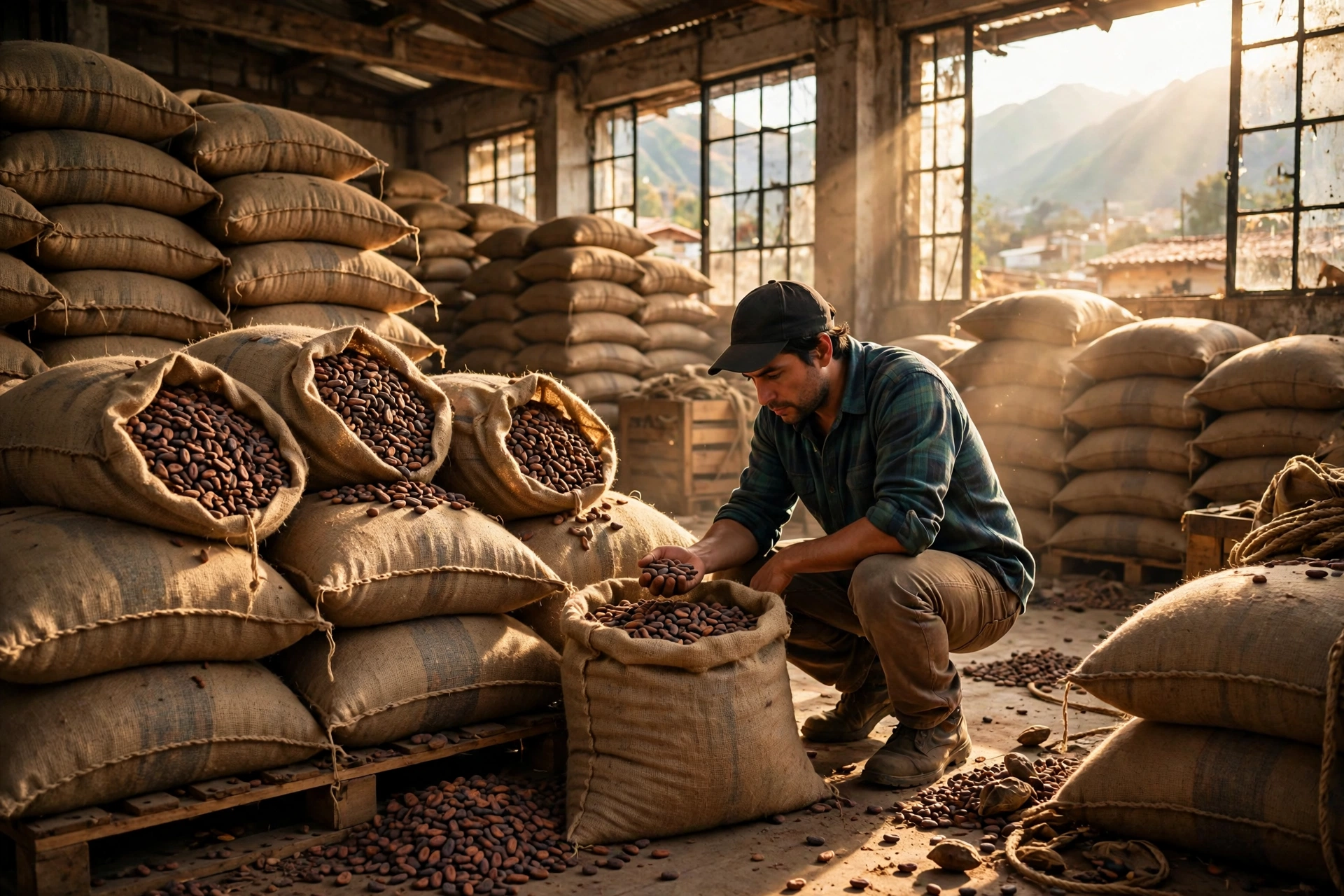
In plain language: the beans hate damp. Peru's growing regions — San Martín, Junín, Ucayali — are tropical rainforest country, where the air stays humid most of the year. The beans get sun-dried up in the hills, packed into jute sacks, and trucked down the mountain. One rainstorm on the road and the moisture bounces right back up. By the time the container reaches Callao, the buyer's inspection finds excess moisture, the whole container gets rejected, and guess who pays? The warehouse, per the contract.
My friend's first shipment taught us this the hard way. Here is an illustrative scenario: in September 2025, a lot of beans collected in San Martín tested at 7.2 percent moisture at the origin warehouse — a beautiful number. Then the truck spent two days on mountain roads, hit a rainstorm, and water seeped in at the edges of the tarp. At the consolidation warehouse near Lima, a retest showed the sacks at the edges had jumped to 8.6 percent. We caught it early, spread the beans out, and ran fans over them for two days; most of the lot was saved. Three sacks at the edge had already gone moldy and had to be downgraded, costing a few thousand dollars. The lesson that stuck with me: the first line of defense in cocoa storage is not inside the warehouse. It is on the road.
So rule number one: test moisture on every inbound lot, and sample more than you think you need. A handheld moisture meter costs a few hundred dollars; one rejected container costs ten thousand times that. We test at least five sacks per lot. Anything above 7.5 percent goes into a separate zone with a red tag — condition it first, store it later. Mold spreads: one moldy sack infects its neighbors, and then you lose a pallet.
Three Warehouses, Three Different Jobs
The Peru cocoa chain has three stages — origin warehouse, consolidation warehouse near Lima, and port warehouse at Callao — each doing a completely different job.
Peru has close to 100,000 small family farmers growing cocoa, and five regions — San Martín, Junín, Ucayali, Huánuco, and Cusco — account for about 86 percent of national production. Each smallholder dries their own beans, so quality varies from farm to farm. The origin warehouse has one job: take the beans in, grade them, and pick out the bad ones. Our scrappy method is simple: the origin warehouse does not need to be big; it needs to breathe. Pallets are non-negotiable. Sacks never sit directly on the floor and never lean against the walls — leave an air gap. In the rainy season, a few industrial fans beat an air conditioner on cost. As long as relative humidity stays below 65 percent, the beans hold.
The consolidation warehouse is where the real work happens. Near Lima, the warehouse grades, consolidates, and prepares export documents — and faces the buyer's inspection. Some 70 to 80 percent of Peru's cocoa exports are classified as fine or flavor cocoa, an unusually high share that means buyers are picky. Grading cannot be skipped: sort by bean size, mold rate, and impurity rate into three tiers, with the fine-flavor grade shipped separately. Mix the grades to save a few dollars and one failed inspection downgrades the whole container.
The port warehouse is the easiest part. Callao is Peru's main seaport, and DP World's container terminal alone handles roughly 60 percent of the country's containerized cargo; in 2025 it passed 2 million TEU for the first time. The port warehouse has one rule: fast in, fast out — target 72 hours from arrival to loading. The last trap sits inside the container: sun by day, cooling at night, condensation dripping from the roof onto the top layer of sacks. Our fix is to line the roof with absorbent cardboard and load in the cool morning hours.
Running the Numbers: What Peru Cocoa Export Warehouse Storage Actually Costs
Here is a worked example — an illustrative scenario, not official rates — for a 20-tonne shipment of fine-flavor cocoa, from origin warehouse to loading at Callao:
| Stage | Illustrative cost per tonne | Notes |
|---|---|---|
| Origin collection and grading | About USD 25 | Includes hand sorting and moisture testing |
| Origin to Lima transport | About USD 60 | Mountain roads; rainy-season risk extra |
| Consolidation storage, 2 weeks | About USD 18 | Ventilation, retesting, consolidation |
| Port warehouse and loading | About USD 30 | Moisture protection, loading labor |
| Total | About USD 133 | Excludes ocean freight and insurance |
Now put that next to the value of the cargo. In 2024, Peru exported 102,771 tonnes of cocoa beans worth USD 795.69 million — roughly USD 7,700 per tonne. Warehousing runs under 2 percent of the cargo's value, yet it decides whether the whole container sells at the fine-flavor price. A 20-tonne container downgraded from fine to bulk because of mold can lose hundreds to over a thousand dollars per tonne in price.
Here is the counterintuitive part: most people think cocoa storage money should go to air conditioning and dehumidifiers. Wrong. The money should go to testing — moisture meters, sampling labor, grading labor. Small money that prevents big losses. Big companies rely on systems; we rely on being diligent with our hands.
There is one more trade-off worth naming: hermetic bags. Three-layer sealed bags hold moisture far better than jute, and a 12-month study confirmed it. But they cost several times more, and origin farmers do not trust them — they only know jute. Our compromise: jute at origin, then after retesting at the consolidation warehouse, the fine-flavor grade gets repacked into sealed bags and the ordinary grade keeps the jute.
Don't Play Big Company When You're a Small Warehouse
At the end of the day, the biggest trap for a small warehouse taking on Peruvian cocoa is not technical. It is attitude. Do not start by building a climate-controlled facility and buying a full lab — that is the big-company playbook, and we cannot afford it. Our advantage is flexibility: rent a well-ventilated old shed for the origin warehouse, share someone else's spare capacity for consolidation, and keep the port warehouse to fast in, fast out.
The floor is non-negotiable: a hygrometer, a moisture meter, pallets, and fans. Four things, none optional. Without them you do not even know what state your beans are in, and that is not warehousing — that is gambling. Peru's raw cocoa bean exports topped USD 876 million in the first eleven months of 2025, up 25 percent year on year, with full-year export volume projected at around 112,000 tonnes. The market is still growing, but it belongs to the people who can hold the moisture line.
One last piece of honest advice: before you take a cocoa job, borrow a moisture meter and test the dampest corner of your warehouse. If you cannot control your own humidity, do not take the order yet. Get ventilation, pallets, and a testing routine in place first. Then come back. Cocoa is a business a small warehouse can do — and do with dignity.
By Xiao Ma, Small Warehouse Owner