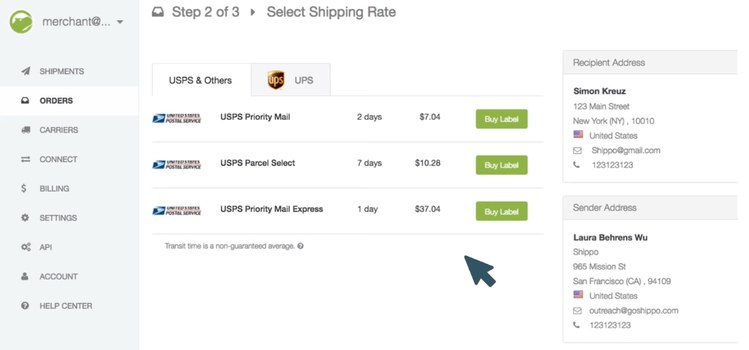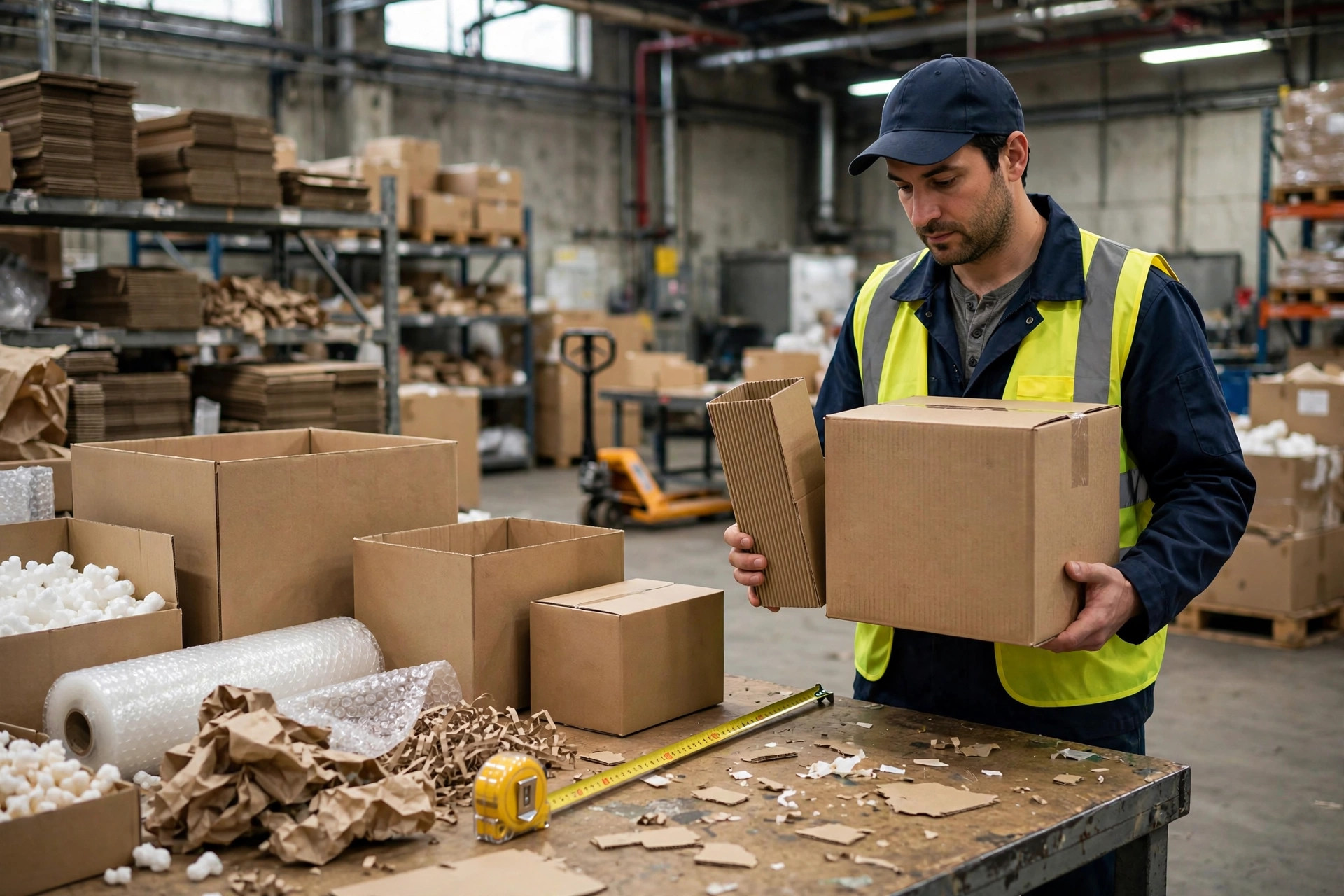
A home-goods independent e-commerce site shipping 40,000 orders a month used 12×10×8-inch boxes as its workhorse. Last year it moved 70% of its orders to 10×8×6-inch boxes. Average shipping cost per parcel dropped by $0.60 (illustrative estimate — actual rates follow each carrier's current published policy). That's $24,000 a month, $288,000 a year. The smaller box itself costs $0.12 less apiece — another $58,000 a year. One-time cost of the switch: die-cut tooling, first production run, system rule updates — $18,000 total. Payback period: under a month.
Most people's first reaction to that math: why didn't we do this sooner? Second reaction: does my warehouse have the same room to save? This article works the whole calculation through.
How dimensional weight quietly taxes you
Carriers bill on two weights: actual weight and dimensional (DIM) weight. DIM weight = length × width × height ÷ divisor, and you pay on whichever is greater. Divisors vary by carrier and service — check each carrier's current published policy (139 is the commonly used divisor for US domestic parcel).
Here's the trap: your product weighs 2 lbs, but in a 12×10×8 box the DIM weight is 960÷139 ≈ 6.9, billed at 7 lbs. You pay for 7 lbs and ship 2 lbs. The 5-lb gap is freight on thin air.
Drop to a 10×8×6 box: 480÷139 ≈ 3.5, billed at 4 lbs. Three billable pounds gone per parcel. The entire secret of packaging downsizing in one sentence: you're not saving money on cardboard, you're deleting the freight charge on air.
Three box types, one table
Using that client's actual order mix as an illustrative model (rate figures are examples — always verify against carriers' current published rates):
| Box | Dimensions (in) | DIM weight | Per-parcel cost (example) | Annual cost at 40k/mo |
|---|---|---|---|---|
| A — large box | 12×10×8 | 7 lbs | $11.80 | $5,664,000 |
| B — small box | 10×8×6 | 4 lbs | $11.20 | $5,376,000 |
| C — poly mailer | — | actual 2 lbs | $10.60 | $5,088,000 |
A → B: $0.60 saved per parcel, $288,000 a year. A → C: $1.20 per parcel, $576,000 a year.
But C isn't for everyone. Poly mailers suit apparel, soft goods, and books — anything that survives compression. Rigid, fragile, or sharp-edged products in a mailer will generate damage claims that eat the freight savings and then some. That's the trade-off: the mailer is the lightest and cheapest option with zero crush resistance. Before choosing, split your catalog into "crushable" and "not crushable" — the second group shouldn't even look at mailers.
The packaging matrix: don't guess your box sizes
More box sizes aren't better, and neither is blindly going smaller. The method is data: pull three months of order line dimensions, cluster the combinations, and define 3–5 box sizes targeting 90%+ order coverage. Cover the remaining 10% long tail with one or two large boxes.
Why cap the count? Every added box size means one more pick slot at the pack station, one more packaging SKU to stock, one more packing rule in the WMS, and one more decision for the packer. My rule of thumb: under 50,000 orders a month, 3–4 box sizes is the sweet spot. Past that, management complexity eats half your freight savings.
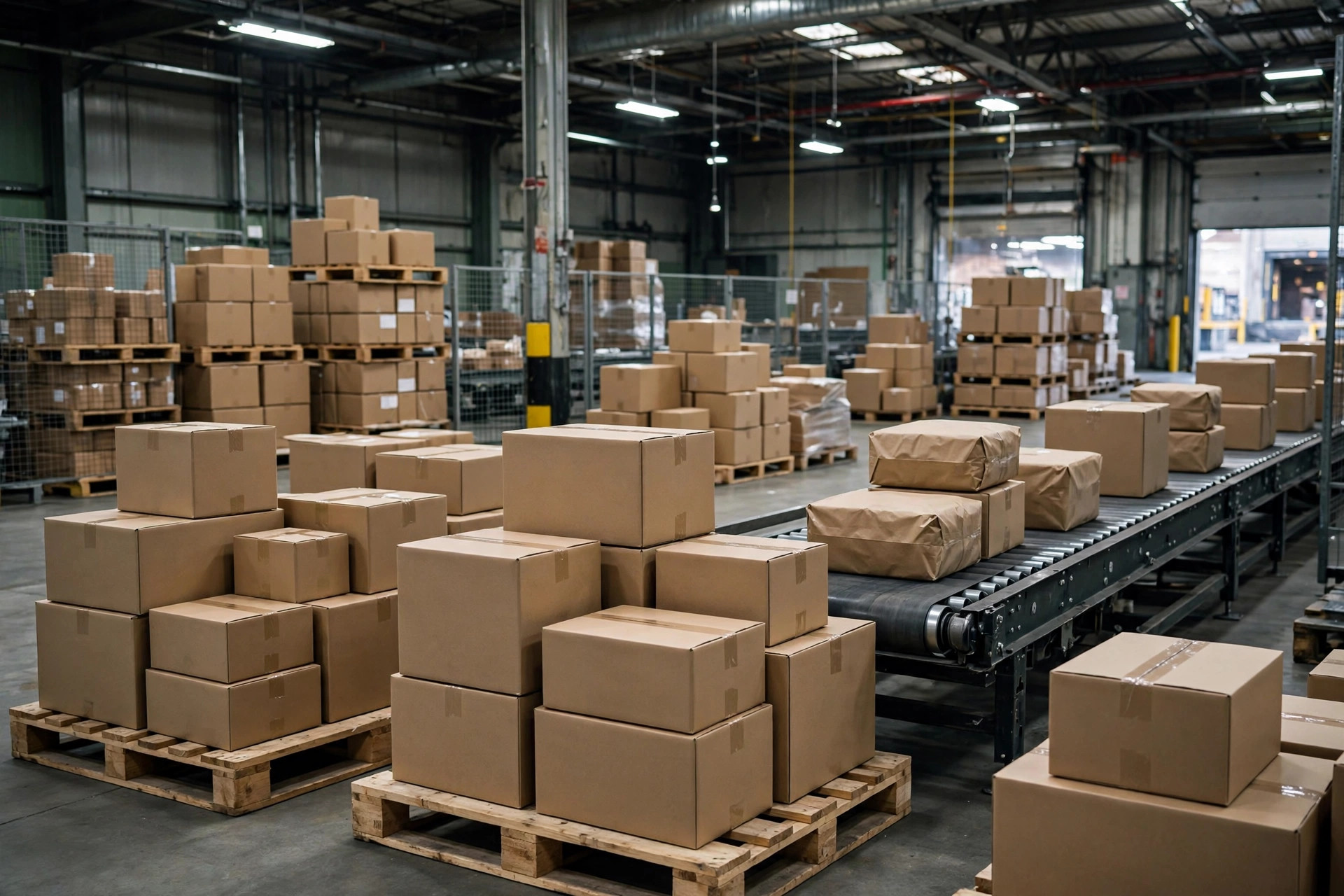
Switching costs come in three parts: die-cut tooling for custom sizes, the first production run as safety stock, and burning down old-box inventory — never hard-cut; run old and new in parallel for a month and let the old stock deplete naturally. Payback = total investment ÷ monthly savings. For projects above 20,000 orders a month saving $0.50+ per parcel, payback lands under three months almost every time. Below that volume, don't bother — the savings won't cover the switching cost.
One more lever most operators miss: once your box sizes are set, take the annual volume to the box manufacturer and negotiate tiered pricing. A warehouse at 40,000 orders a month burns through 300,000+ B-boxes a year — at that volume, moving from distributor to factory-direct typically shaves another 8–10% off unit cost. Downsizing saves freight; consolidated purchasing saves packaging cost. Track them as two separate lines, but capture both.
And a final caution on the math: divisors and rounding rules differ by carrier. One client modeled everything on a 139 divisor, then discovered their primary carrier used a different divisor with different sub-pound rounding — real savings came in 20% below the model. Always run real orders through each carrier's online rate calculator before committing. Never trust back-of-napkin numbers.
Smaller boxes, fewer damage claims
Here's the counterintuitive part. Most operators fear downsizing will crush products. The data usually says the opposite.
A Los Angeles 3C-accessories seller at 30,000 orders a month moved from 10×8×8 to 9×7×6. Less void space meant dunnage went from a fistful of foam peanuts to two sheets of bubble wrap. Transit damage claims fell from 0.9% to 0.6%. The logic is simple: in an oversized box the product rattles, rattling means impact, impact means damage. In a fitted box the product can't move, so it's safer.
What is 0.3 points worth? 30,000 orders × 0.3% × $12 average claim = $1,080 a month, about $13,000 a year. Modest money, but the direction defies instinct: freight goes down and damage goes down together.
That said, smaller isn't always better. Two costs to going too small: pack time rises — a 10% packer productivity hit is typical — and box reuse on returns drops. The packaging matrix never aims for "smallest." It aims for "right": the balance point between freight, damage, and pack efficiency.
The close: one formula, plug in your own numbers
Annual net savings = monthly orders × 12 × per-parcel savings − one-time switching cost
Break-even monthly volume = switching cost ÷ per-parcel savings
Run your own figures. Payback beyond six months: hold off and re-segment your order mix — your box sizes are probably too coarse. Payback under three months: don't hesitate. Every extra month of paying freight on air is a donation to the carrier.
Whether the money was well spent is for the formula to decide, not your gut.
By Lao Zhou, Logistics Cost Analyst