
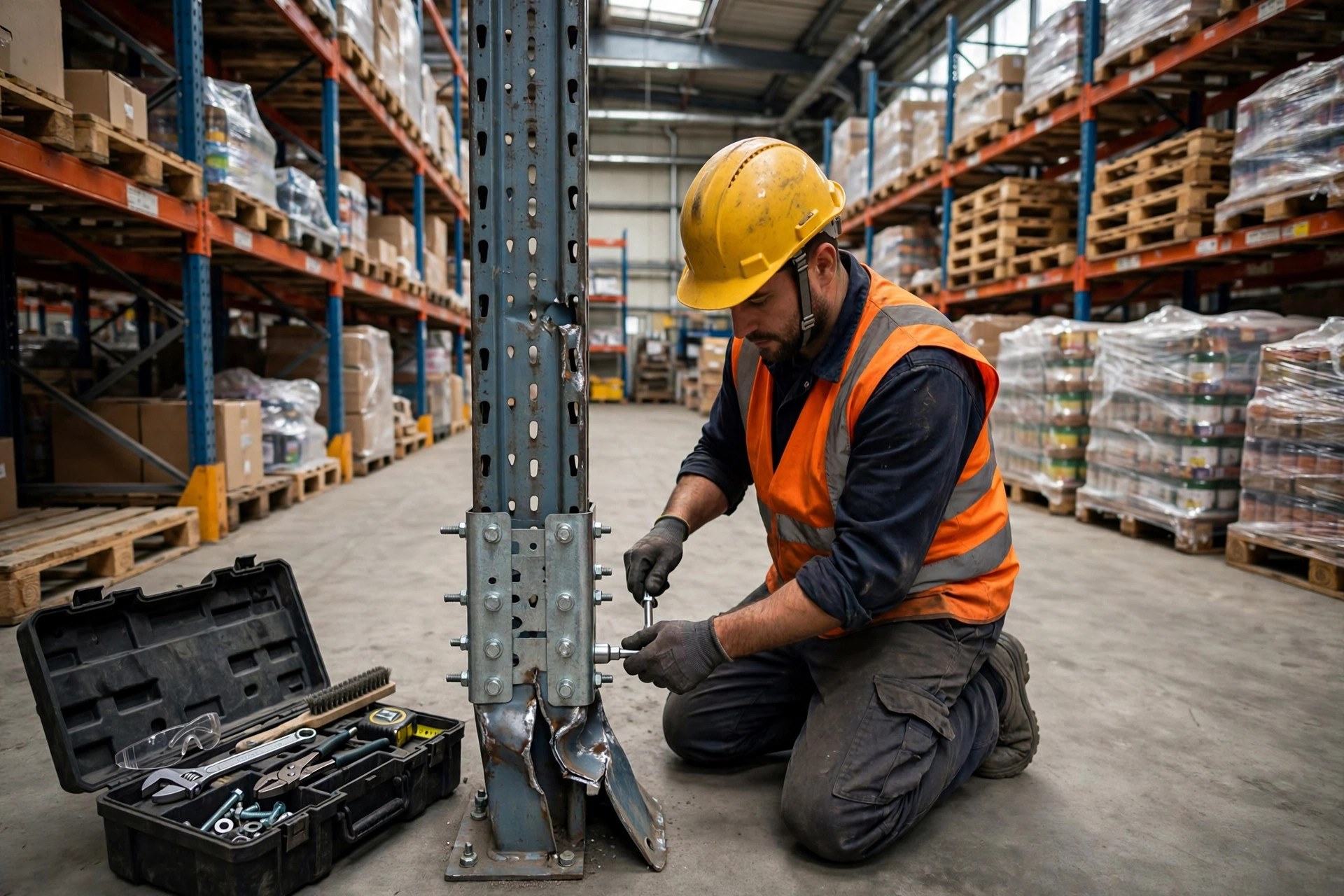
How much does pallet rack repair cost? Here is the bill, straight up: published quotes from US rack-repair vendors put an upright repair at $165–$285 installed, and a brand-new OEM upright replacement at $235–$350 installed. Read as parts-plus-labor, repair beats replacement by under a hundred dollars.
But that is where most people stop reading the bill. What actually determines your spend is never the parts line.
Round one: per-incident math — repair vs. replace
Vendors publish these ranges openly (they move with rack model, freight distance, and local labor rates):
| Repair kit (installed) | New OEM upright (installed) | |
|---|---|---|
| Parts + labor | $165–$285 | $235–$350 |
| Method | Bolt-on, localized | Full frame swap |
| Bay unload | Usually unnecessary | Typically required |
Reading only this table, most managers pick replacement: "It's only a few dozen dollars more, and it's brand new." A 3PL in Ontario, California — 80,000 square feet — did exactly that in 2024. A forklift clipped an end-of-aisle upright. The repair-kit quote was $220; the new upright was $310. The owner picked new. Ninety extra dollars, clean conscience.
The following year, the same spot got hit again.
Round two: the off-invoice costs — unloading, restacking, downtime
Replacing an upright is never just parts plus labor. One major engineered-repair vendor published a side-by-side breakdown (standard 24-inch column repair; their own numbers, so discount the bias — but the cost structure itself is real):
| Cost item | Engineered repair kit | OEM upright replacement |
|---|---|---|
| Parts | $440 | $300 |
| Freight | $500 | $1,200 |
| Equipment rental | $0 | $300 |
| Unloading / restacking | $0 | $60 |
| Dismantle | $0 | $120 |
| Installation | $125 | $150 |
| Per-incident total | $1,065 | $2,130 |
See it? The part itself is barely more expensive — but freight, lift rentals, and pulling every pallet out of the bay and putting it back roughly double the total. A bolt-on repair kit is localized work: the freight stays put, the aisle stays open.
Then there is the uglier line item: downtime. The same vendor disclosed a cold-storage case in a webinar — one bay taken out of service by a damaged upright, total cost calculated at $54,000. Cold product cannot sit on the dock, and temperature control cannot pause. A dry warehouse will not hit that number, but a bay down for two days in peak season — pickers rerouted, replenishment delayed — is real money that finance books under "operations," where nobody ever claims it.
There are also the two options nobody prices honestly. Option one: ignore the damage. Free, until it isn't — OSHA's warehousing National Emphasis Program has rack safety on its list, so "we'll deal with it later" is now a regulatory exposure, not a plan. Option two: weld it in-house. Cheap, fast — and it voids the manufacturer's load rating. No licensed engineer will certify a field weld on a roll-formed column, and your insurer will notice if anything ever falls. A third path some managers take is a used OEM frame, which is cheaper than new — but it must be the same manufacturer and an engineer has to sign off on compatibility. Fine as a stopgap; not a strategy.
Round three: the real budget-killer — the hit, replace, repeat cycle
Back to Ontario. Year two, same spot, another strike. The owner replaced the upright again: $310. Year three, same spot, third strike.
This is the most important math in the whole article. Replacing the upright does not fix why that spot keeps getting hit. End-of-aisle positions, turns, narrow-aisle mouths — forklift traffic patterns do not change because you hung a new frame. That vendor's ten-year comparison puts numbers on it: assume two more strikes at the same location over ten years. The engineered kit, with built-in impact protection, ends the cycle at $1,065 once. Replacing each time runs $2,130 x 3 = $6,390 — about 85% more.
The counterintuitive call: replacement looks like the cleanest option per incident and is the most expensive option over a decade. Vendors will not volunteer this, because replacement is a great business for them — parts, freight, installation, every single strike.
One more number for the safety file: that vendor inspects roughly 150,000 bays a year, and about one in ten hides a high-priority safety issue. A bent upright left alone does not just cost money — it risks the whole row. And there is the aesthetics question to settle honestly: one service company puts it plainly — repair versus replace comes down to aesthetics versus cost, and repair is typically the more economical choice. If the upright is in a customer-facing area, pay for pretty. If it is in the back of the building, pay for math.
The decision line: repair, replace, or go engineered
Three rounds of math, one decision rule: ask whether this spot will get hit again.
| Situation | Move | Why |
|---|---|---|
| Same spot struck 2+ times in the last 3 years | Go straight to the engineered repair kit | $1,065 once vs. $2,130 x n — pays back at n = 2 |
| End-of-aisle, turns, high-traffic spots | Engineered kit, or add column guards | Break the cycle at the root |
| Low-traffic spot, one-off strike | Standard repair kit ($165–$285) | Cheapest, no drama |
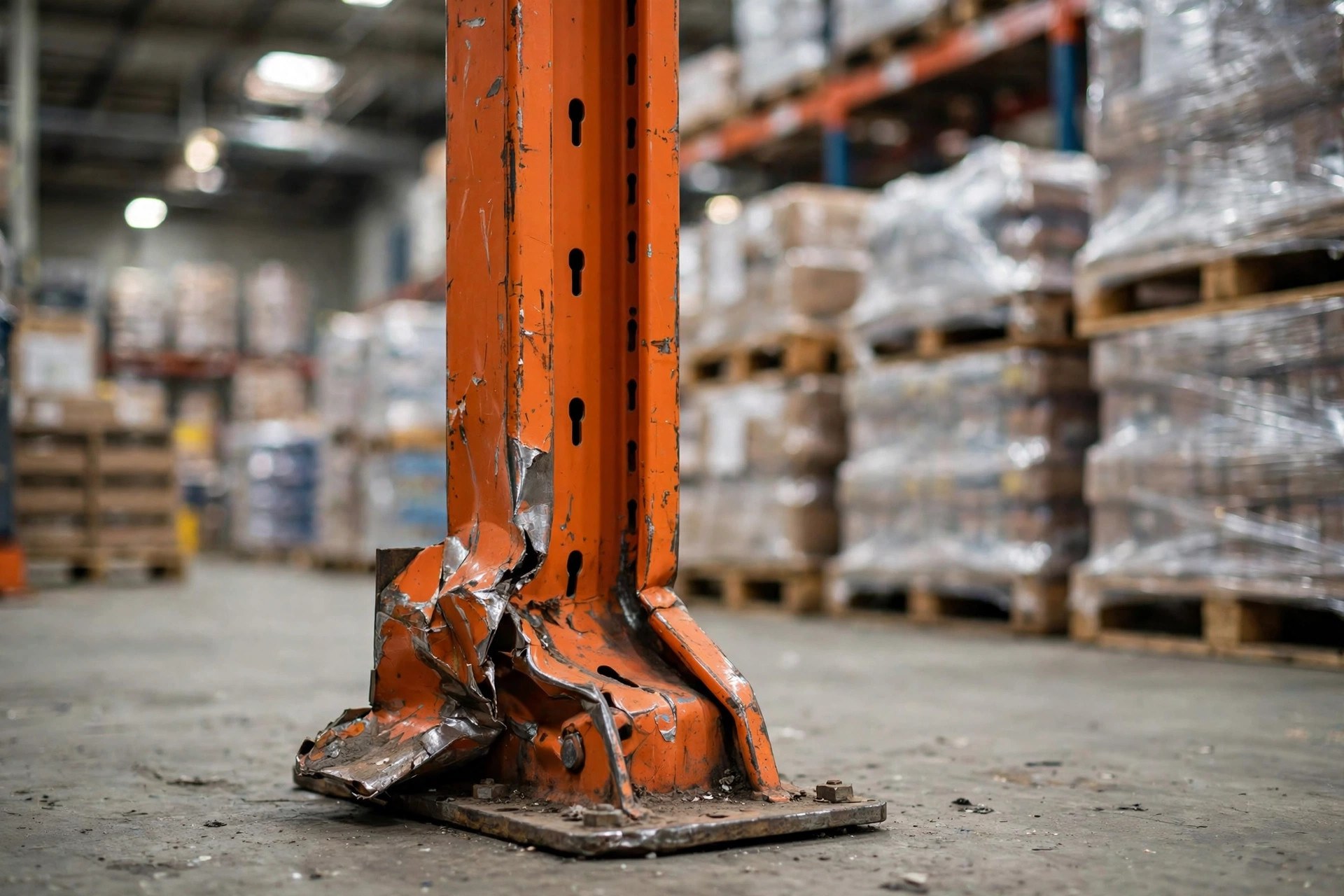
| Torn or severely deformed column | Replace it — and add protection | Don't negotiate with structural safety |
The computable conclusion: pull your last three years of repair records and count strikes at the same location. Call it n. If n is 2 or more, one engineered kit beats replace-every-time on cost. If n is 1 or 0, the standard repair kit wins. In rack repair, the savings lever was never haggling $50 off a vendor quote — it is breaking the hit-replace-repeat cycle. Skip the math, and you will keep signing repair orders. The expensive kind.
By Lao Zhou, Logistics Cost Analyst


