Last summer, a food-distribution client called me up and opened with this: "Da Liu, we're running 500-plus pallets a day between receiving and the second-floor staging area. The forklift drivers keep complaining about queues, and we can't hire for peak season. Should we just put in a conveyor?"
I asked him three numbers: How far is one trip? How many shifts? Will that route still exist in three years? His answers: seventy meters one way, two shifts, and the route hasn't moved in three years. "Okay," I said. "This one is worth doing the math on."
Conveyors Don't Win on Speed. They Win on Never Stopping.
Here's the principle first. Pallet conveyors come in chain and roller flavors, and a chain-driven pallet line runs at roughly 10 to 20 meters per minute — slower than a person walking. A forklift does 15 km/h unloaded and leaves the conveyor in the dust even fully loaded.
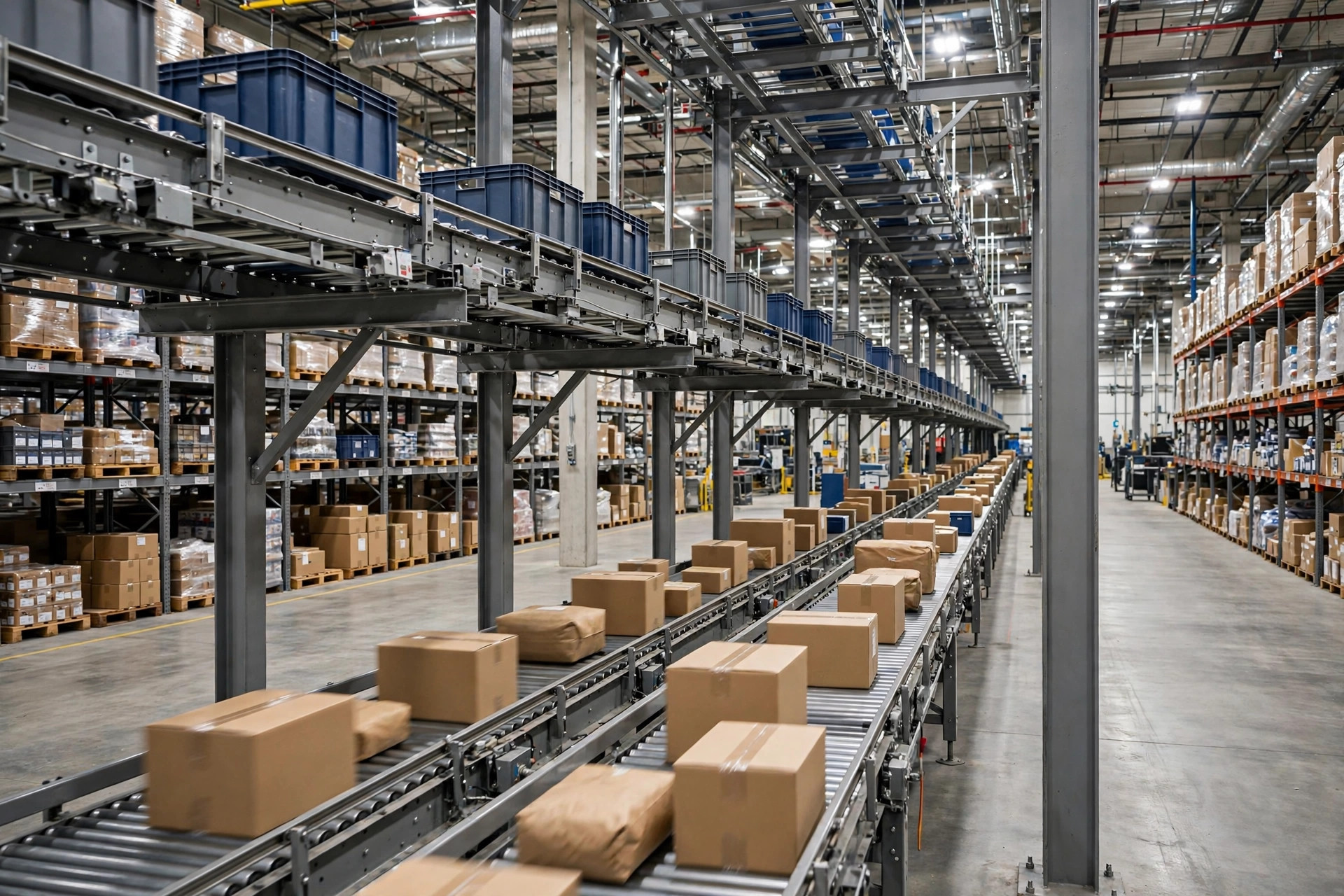
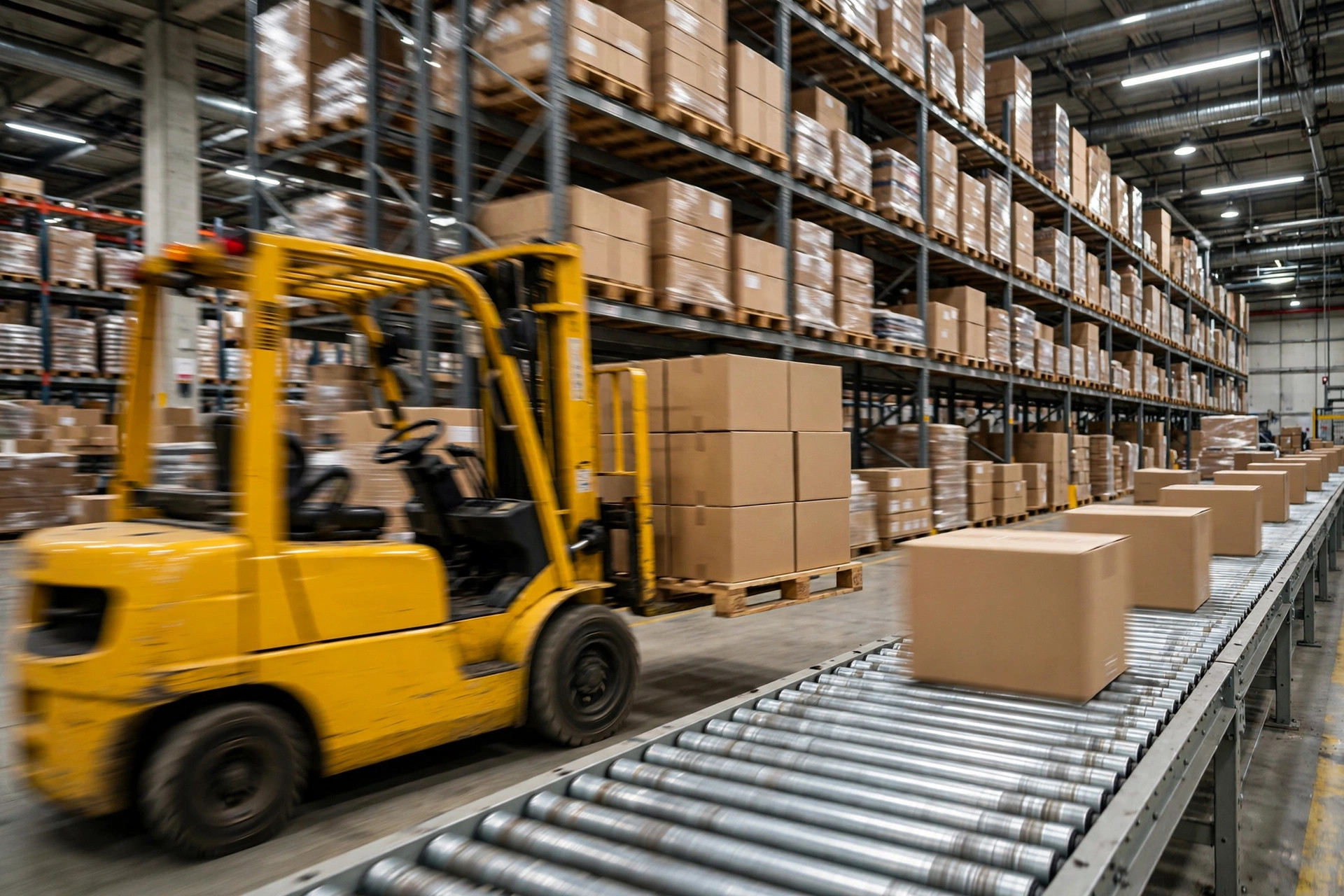
But think of it this way: the forklift is a taxi, the conveyor is a subway. The taxi is faster per trip, but you wait for it, the driver takes breaks, and traffic happens. The subway crawls along, yet a train shows up every minute, eighteen hours a day. The conveyor is that subway: it wins on continuous flow. One forklift round trip — pick up, drive, drop off, return — runs about 2 to 4 minutes depending on distance (rule of thumb). On a conveyor, pallets queue nose-to-tail at a fixed takt. No sick days, no traffic jams, nobody waiting on anybody.
You can think of it as batch handling versus continuous handling. At low volumes, batch wins on flexibility. Past a certain volume, the unit economics of continuous flow start to crush everything else.
The second thing that matters: uptime. A properly designed line should clear 95% system availability, and good ones hit 98% (field experience, not a datasheet number). Sounds low? A forklift fleet is no better — out of five trucks, one is usually in the shop or in scheduled maintenance. The difference is that a conveyor is all-or-nothing: either the whole line runs or none of it does. Keep that sentence in mind when we get to maintenance.
The Breakeven Line: Three Calculations
Calculation one: takt math. The formula is simple:
Forklifts needed ≈ pallets per hour × cycle time (minutes) ÷ 60, times a 1.2 buffer factor.
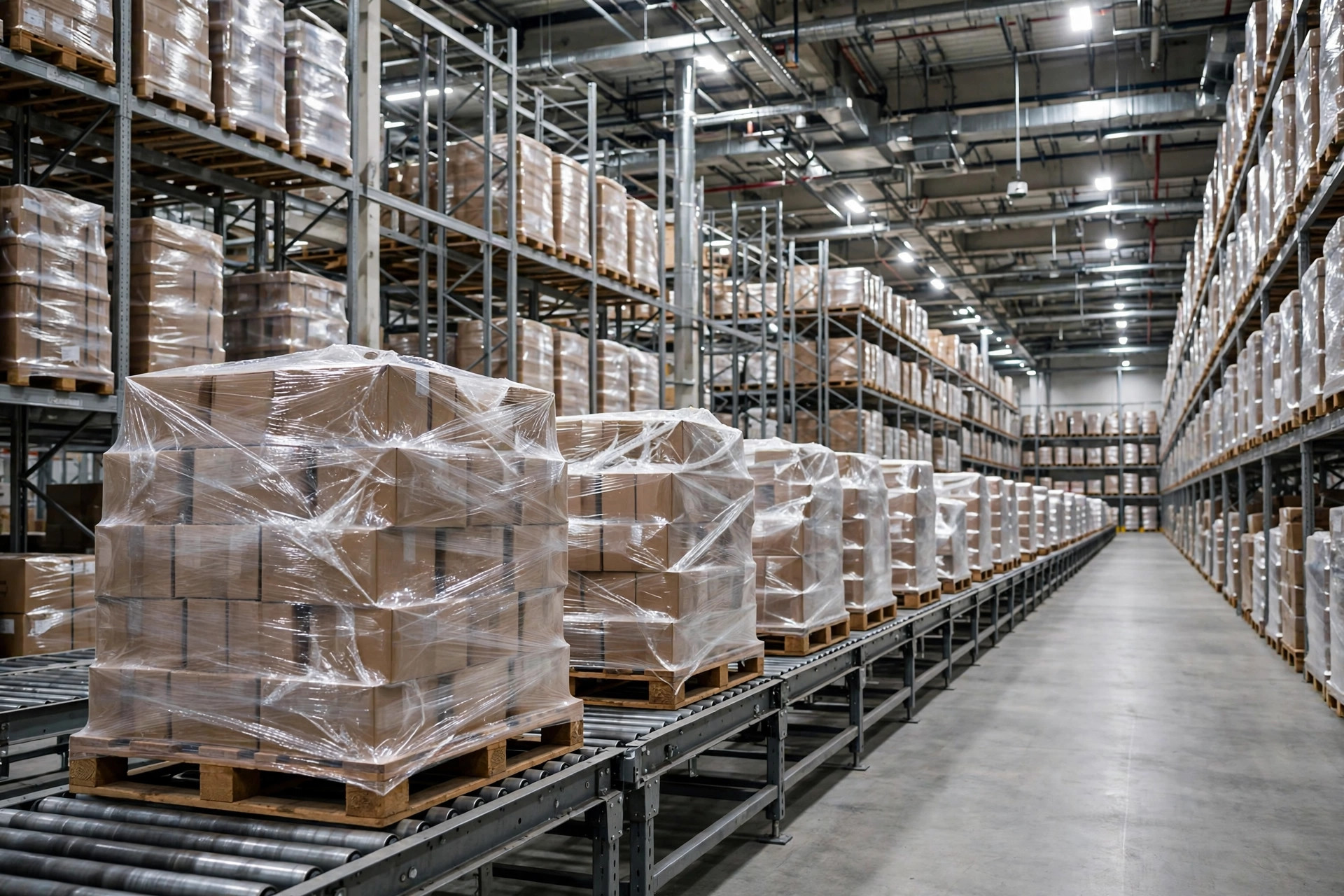
Run my client's numbers: 70 meters one way, about 3 minutes per round trip including load and unload. Five hundred pallets across two shifts (16 hours) is roughly 31 pallets an hour. 31 × 3 ÷ 60 ≈ 1.55, times 1.2 ≈ 1.9. So he needs two forklifts dedicated to that lane full time, and a third when peak season hits. Meanwhile, a 70-meter chain conveyor at 12 meters per minute keeps a pallet in transit for 6 minutes — but with 8 to 10 pallets on the line at once, hourly capacity lands around 60 to 80 pallets. His 31 pallets an hour wouldn't even use half of it.
Calculation two: labor math. This is the big one. The truck is cheap; the driver isn't. A forklift operator's fully loaded annual cost in the US is not a small number (it varies a lot by market — plug in your local wage), and two shifts means two headcounts. The conveyor? The capex is genuinely scary — a 70-meter pallet line, installed and commissioned, is on the order of several hundred thousand dollars (it swings wildly with project complexity). But it replaces ongoing labor cost, plus electricity and maintenance, with annual upkeep running roughly 5 to 8% of the initial investment (field estimate). The back-of-the-envelope version: annual labor savings × 3 years, stacked against total conveyor investment. The rule of thumb I use: fixed route, two or more shifts, and more than 300 pallets per shift-day — that's when the conveyor math starts looking good.
Calculation three: flexibility math. Most people skip this one, but it decides life or death. Once a conveyor goes in, the route is welded in place. The warehouse layout changes, the customer mix changes, the business pivots — and your several-hundred-thousand-dollar subway becomes a very expensive sculpture. A forklift? Receiving today, outbound tomorrow, cycle counts the day after. So the breakeven line needs a hard constraint: that route must stay put for the next 3 to 5 years. If there's more than a 30% chance it moves, don't build the line.
Put the three calculations together and you get a decision table:
| Scenario | Lean toward |
|---|---|
| Fixed route, 300+ pallets per shift-day, two shifts | Conveyor — the math works |
| Fixed route, under 150 pallets per shift-day | Forklift — adding one truck costs an order of magnitude less |
| Route changes often, layout in flux | Forklift — don't even think about a conveyor |
| Peak volume 3× normal volume | Forklifts plus temp labor — sizing a conveyor for the peak is pure waste |
Now let me take a shot at the vanity projects, because I've seen too many. A small 3PL moving 150 pallets a day insisted on a conveyor because "it looks impressive when clients tour the facility." I told him straight: at your volume, one forklift running 150 trips in an 8-hour shift has capacity to spare. Installing a conveyor here is like building a highway for a bicycle — sure, it looks great, and it'll burn your money just as fast. Automation exists to solve problems, not to impress visitors. Below the volume threshold, a conveyor is the most expensive decoration you can buy.
The Maintenance Pits Nobody Puts in the Quote
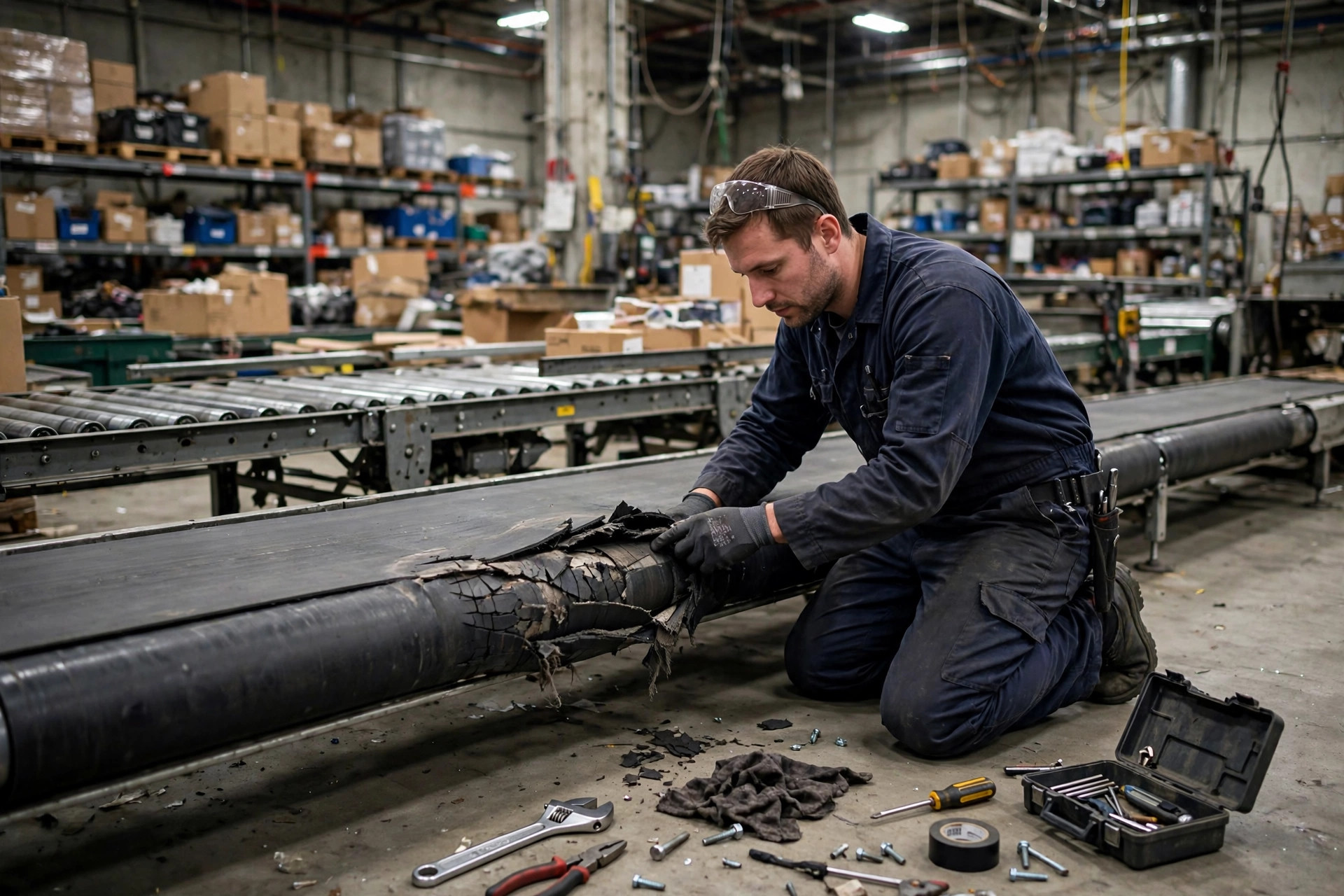
So you decided to build it. Congratulations — the real fun starts now. A conveyor is a series system: one jammed chain section, one dirty photo-eye, and the entire line stops. A forklift fleet degrades gracefully; a conveyor doesn't. So conveyor maintenance isn't about fixing — it's about preventing.
Pit one: chain stretch. Run a chain conveyor for six months to a year and the chain elongates (that's just what chains do). You adjust the take-up, and when the take-up runs out of travel, you replace the chain. Skip the adjustment and you get skipping teeth and jammed pallets — one unplanned stoppage will ruin your week. Chain inspection belongs on the monthly preventive-maintenance list.
Pit two: dirty sensors. Pallet detection and anti-collision run on photo-eyes, and warehouse dust coats them fast. When the false-alarm rate climbs, it's almost always dust. Lesson learned the hard way: sensor cleaning goes on the weekly checklist. Don't wait for a false trip to wipe them down. Half the "this conveyor is always broken" complaints I've investigated ended with a rag and some dust.
Pit three: gearmotors. On heavy pallet lines (1,000 kg per pallet is routine), the gearbox lives a consumable's life. Change the oil by run-hours, not by feel. And the spares list — gearbox, chain, sensors, control module — keep at least one of each on the shelf. Order after the failure and you're staring at a 4-to-6-week lead time with the line down for 4 to 6 weeks. For MTBF figures, a solid integrator will give you measured values after commissioning; if they won't, plan around industry rules of thumb and assume the worst.
Pit four: control logic. What kills conveyors isn't usually hardware — it's logic bugs. Pallets rear-ending each other, deadlocks at merges, an oversized or damaged pallet wedging into a turn. During acceptance, run an "abnormal pallet" test: send crooked, over-height, and busted pallets down the line on purpose and watch whether the system detects and alarms. Plenty of projects pass acceptance on perfect pallets and get schooled by one crooked pallet in week one.
Here's the counterintuitive part: about 70% of a conveyor's true cost is decided before you buy it — in selection, layout, and control-logic design. After commissioning, the only lever left is maintenance. Forklifts are the mirror image: cheap to buy, with the real cost arriving later in labor. Choosing a conveyor means buying out future uncertainty up front and converting it into present-day design quality. Get the design wrong and everything downstream is a pit.
The One Number
Don't let a six-figure quote scare you off, and don't let "automation" hype talk you into it either. Look at one number: daily pallet volume on that fixed route.
More than 300 pallets per shift-day, route stable for three years, two-plus shifts — the conveyor probably pays. Below that, or if the route might move — forklifts. Put the money where the work is.
Whether the money is well spent comes down to that one number: does your volume deserve the subway?
By Da Liu, Automation Engineer