Let me be honest: packing station ergonomics injury prevention was never on my radar.
My thinking back then was embarrassingly simple: a table, a pile of boxes, a person standing there. Done. When my packers complained about sore backs, I figured they just needed to toughen up. Then one peak season, two of them went down in the same week — one threw out his back, one could barely grip a tape gun with her sore wrist — and orders nearly stopped going out. That was the week I realized this was not about toughness. I was subsidizing my costs with my people's bodies.
My Old Packing Station Was a Back Injury Machine
Let me paint the old setup, and see if yours looks familiar.
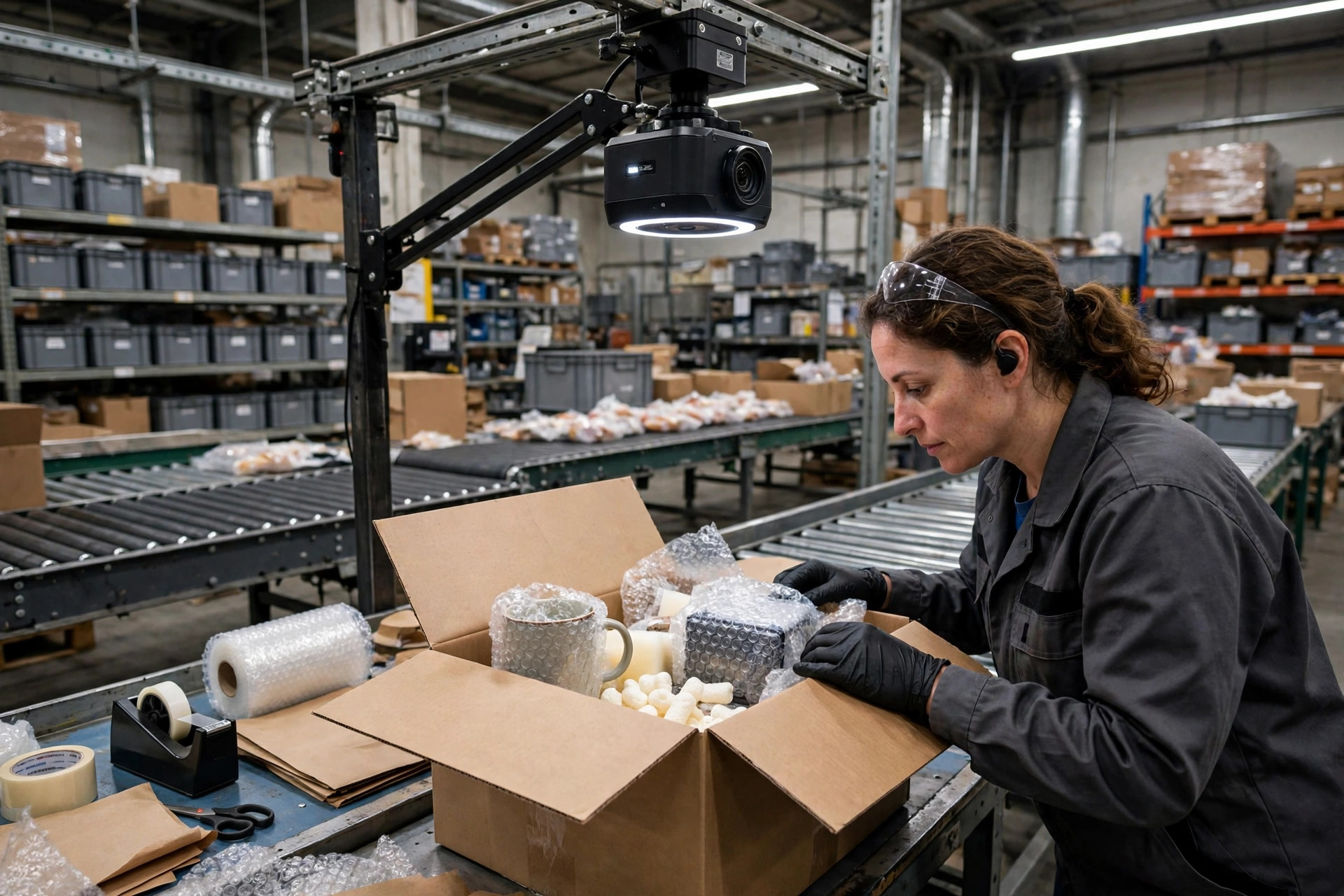
The table was a fixed-height old desk. Too low. Tall staff had to hunch over it all day; shorter staff had to reach up for stock on high shelves. Boxes sat on the floor, so every box meant one more bend. Filler material lived behind the packer, so every grab meant a twist. Tape, labels, and scissors were scattered wherever they happened to land, so every tool meant a stretch.
I actually counted the bends one day. One packer bent over several hundred times in a single shift. That is not work. That is trading a spine for order volume. And the worst part? I thought this setup was saving me money. The table was free, the boxes on the floor cost nothing in shelving. Not a cent extra spent.
Every cent I "saved" came back later, with interest. That is packing station ergonomics injury prevention: free setups charge you later.
Packing Station Ergonomics Starts With Table Height
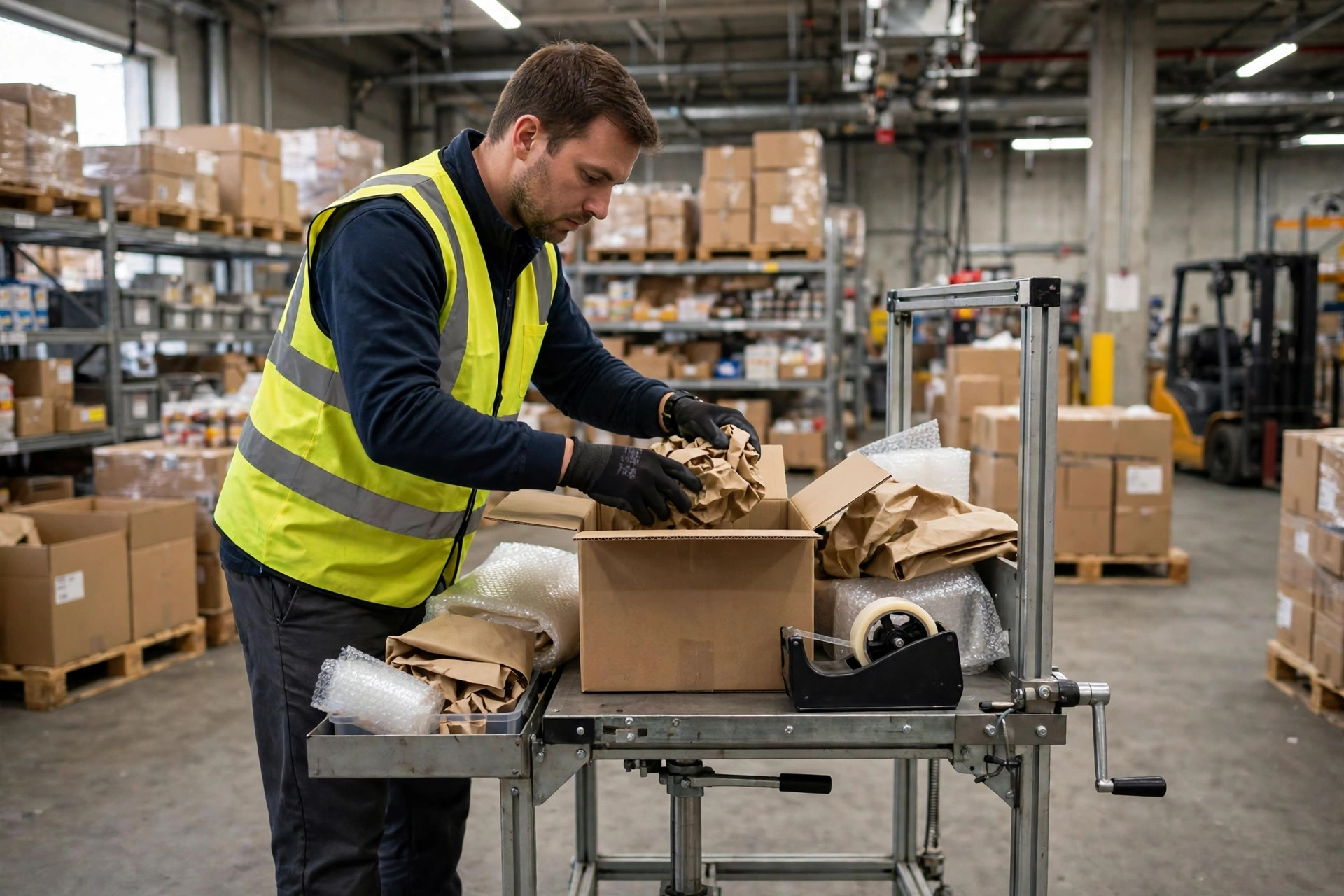
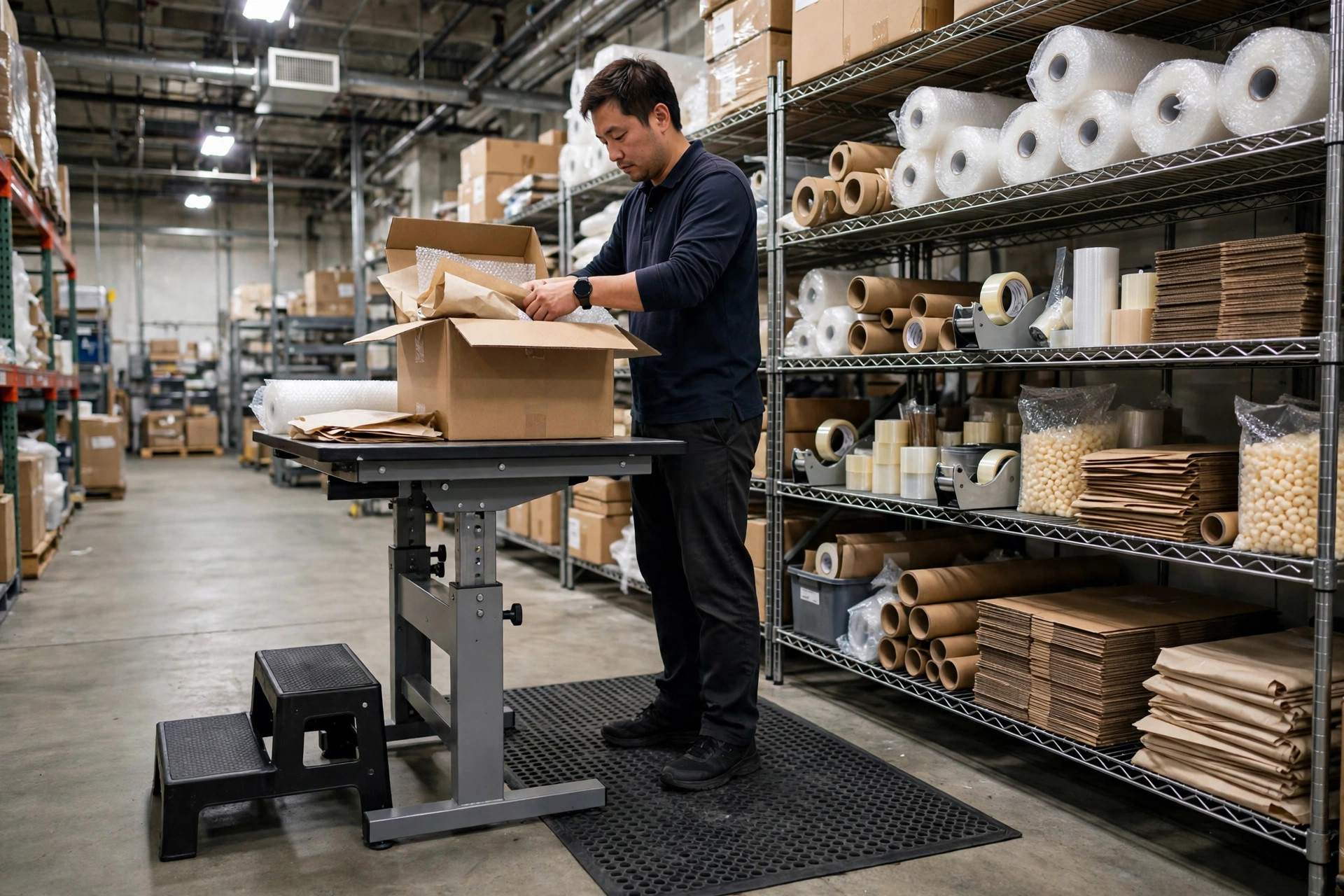
The first fix I made was exactly one thing: an adjustable-height table.
The logic is dead simple. Packing is standing work, so the table has to let arms hang naturally with wrists straight. Too low and you hunch; too high and your shoulders creep up. A fixed-height table cannot fit everyone — put a five-foot-four and a six-foot packer on the same table and one of them is guaranteed to suffer.
I bought hand-crank lift tables, not the electric ones. A table ran me roughly a thousand or two — less than a rounding error on my monthly ad spend. Each person cranks it to their own height at the start of a shift. Ten seconds, done.
Here is the counterintuitive part: the height that "feels most comfortable" is not always the right one. Some people crank the table way up because reaching down feels like effort. A few days later their shoulders start aching — holding your arms up all day is worse than bending. The sweet spot is where your shoulders can fully relax and your forearms sit more or less level. If anything, err slightly low rather than letting shoulders stay raised all day.
And one trade-off you have to accept: the first few days after the switch, packing actually got slower. Everyone had to relearn their movements at the new height. I almost called the whole thing a mistake. Then speed came back, and the back complaints went away first. There is no version where you get faster and more comfortable on day one.
Reach Radius Will Wreck You Faster Than Heavy Lifting
Once height was fixed, I went after reach radius.
My old layout was chaos by accumulation: tape a meter to the left, labels behind the right shoulder, boxes on the floor. Every single order meant stretching, twisting, and bending — a triple combo.
The fix is one rule: everything you grab constantly must sit inside the half-circle you can reach without moving your feet. Boxes go on a shelf, never on the floor. Tape, labels, and scissors get fixed spots on the table within easy reach. Filler goes in a small bin at your side, not in a big tub behind you.
I ran a gloriously low-tech test: I had a packer work ten orders while I counted twists and bends. Before the new layout, twists plus bends ran close to a hundred. After, they dropped to a small fraction of that — big enough that you did not need to count to see it.
One more detail: heavy stuff never goes low. Full cases of supplies and stacks of flat boxes sitting on the floor force a squat-lift every single time. Raise them to waist level and the move becomes a slide, not a lift. Your lower back will notice the difference within a week.
The Lesson From a Friend's Warehouse in Yiwu
Here is someone else's story. Last fall I visited a friend's warehouse in Yiwu. He sells small goods overseas, a few thousand orders a day at peak, a packing team of around a dozen.
His stations were rougher than mine had been: plywood tables at whatever height they happened to be built, everyone hunching. I made an offhand comment about the tables being too low. He shrugged it off: "Low tables never hurt anyone. Everyone works like this."
That winter, three of his packers quit. Two said it straight — their backs could not take it anymore. Recruiting and training replacements took nearly a month to get speed back, and in that month mis-shipments cost him several times what new lift tables would have.
He replaced all the tables eventually. His comment afterward stuck with me: if it was this cheap, why did I pinch pennies on it for so long?
I have run the same math on my own operation. When an experienced packer leaves, you lose their knowledge of your products and your process, and new hires spend weeks making more mistakes. None of that shows up as a line item, but it is all there at month's end.
The Packing Station Ergonomics Fix List, in Three Tiers
You do not have to do this all at once. I ranked the fixes by cost, so climb the ladder as far as your operation needs.
| Tier | What changes | Cost level | What you get |
|---|---|---|---|
| Free tier | Boxes off the floor, supplies moved into the reach half-circle, heavy items raised to waist height | Nothing | Bending drops immediately |
| Cheap tier | Anti-fatigue mats, hand-crank lift tables, tool hooks at the station | A few hundred to a couple thousand | Feet stop aching, no more sharing one bad height |
| Equipment tier | Electric lift tables, conveyor feed, scanner stands | Several thousand and up | Only worth it at serious volume — small shops, skip this |
The free tier can start today. Do not wait. The cheap tier is the sweet spot for most small operations; that is where I stopped, and it was enough. The equipment tier is not a status symbol. If your daily volume does not justify it, the gear just sits there eating money.
Rotation matters too, and it costs nothing. I now rotate people between packing and quality checks, swapping roughly mid-morning. It is a break for the back disguised as a schedule change, and it worked better than I expected.
One more cheap win people ignore: what is under your feet. Concrete all day makes calves and feet complain first, and then the back tightens up in sympathy. An anti-fatigue mat costs almost nothing, and my team felt the difference on day one. Same goes for shoes — soft soles beat hard soles for a full shift standing.
Do Not Just Count Equipment Costs — Count Quitting Costs
A few honest warnings before you start.
First, do not buy the cheapest lift table you can find. If it wobbles or cannot hold the weight, people stop using it after two days, and you have spent money on nothing. Stand at it, crank it, lean on it yourself before buying. If it shakes, walk away.
Second, do not half-renovate. Five stations, two upgraded, three left as they were — the people on the old stations will resent it more than if you had changed nothing. Upgrade everyone together, starting with the free tier across the board.
Third, do not hide behind "young people can handle it." I used to think that. It is nonsense. A twenty-something with a bad back still calls in sick, and young workers quit faster — they have options.
Fourth, do not renovate and forget it. A month later, ask around: is any motion still awkward? Have supplies drifted back to random spots? Stations slide back to chaos on their own. Someone has to tidy the system regularly.
Here is the bottom line: packing station ergonomics injury prevention is not about how fancy your equipment is. It is about whether you count your people's bodies as a cost.
My rebuild took under a month, cost very little, and the results are still holding. No more back complaints, fewer sick days at peak, experienced packers staying put, and orders going out steadier than before.
This one I tested myself, and it works.
By Ah K, E-commerce Seller (5 yrs)