

Here's the thing nobody tells you: OSHA has no warehouse lighting standard. There is no "warehouse illumination regulation" you can memorize. Ask an inspector how many foot-candles your warehouse needs, and he won't pull out a warehouse-specific table — he'll ask three questions instead. Can your people see where they're walking? Can the forklift driver see the pallet corners? And how many burned-out fixtures have you been ignoring?
That is the reality of OSHA warehouse lighting requirements and foot-candles: no single dedicated rule, just two legal lines and one benchmark everyone pretends is a rule. Let me lay all three out, the way I wish someone had done for me before my first retrofit project.
First, the physics: what a foot-candle actually is
Think of it this way. One candle, one foot away, the light landing on your palm — that's roughly one foot-candle. The conversion is simple: 1 foot-candle ≈ 10.76 lux. If you're an engineer from a metric country, lux is more familiar; the inspector, though, speaks only foot-candles.
And here's the distinction that matters: inspectors measure illuminance at the working plane — the light actually landing on the floor, the pick face, the dock plate — not the lumen rating printed on the fixture box. You can think of fixture lumens as engine horsepower and foot-candles as wheel speed. Big horsepower means nothing if the lenses are caked in dust.
Where OSHA's foot-candle numbers actually come from
Line one is 29 CFR 1926.56, Table D-3. I checked the text on osha.gov myself. The numbers: warehouses, corridors, hallways, and exitways indoors — 5 foot-candles. Access ways, active storage areas, loading platforms — 3 foot-candles. Offices and first aid stations — 30 foot-candles.
One big caveat: 1926.56 is a construction standard. It governs construction sites, not your operating 3PL. But inspectors keep it on the table as the "recognized minimum." Five foot-candles is the floor — if you can't clear it, the conversation is over.
Line two is Section 5(a)(1) of the OSH Act, the General Duty Clause: employers must furnish a workplace "free from recognized hazards." When there is no specific standard, inspectors use this one. The logic is brutally simple. A forklift clips a pedestrian at the dock, the spot measures 8 foot-candles, and the recognized practice is 20 — that's a "recognized hazard you failed to abate," and the citation writes itself. Fine amounts get adjusted every year; check the current OSHA penalty schedule.
So where does "recognized practice" come from? ANSI/IES RP-7, the Illuminating Engineering Society's recommended practice for industrial facilities. RP-7 is a paid standard; the figures below are the commonly cited public values — verify against the latest edition. The widely referenced warehouse numbers: bulk storage 10 foot-candles, small-item storage and picking 20–30, shipping and receiving docks 20. RP-7 isn't law, but it is the scale inside the inspector's head.
The line between compliant and usable
Put the three sources together and the real picture emerges:
| Area | Source | Foot-candles | Note |
|---|---|---|---|
| Indoor warehouse, corridors, exitways | 1926.56 Table D-3 | 5 | The inspector's borrowed floor |
| Access ways, active storage, loading platforms | 1926.56 Table D-3 | 3 | Outdoor loading minimum |
| Offices, first aid stations | 1926.56 Table D-3 | 30 | Inspectors see the office too |
| Bulk storage | ANSI/IES RP-7 (reference) | 10 | |
| Pick faces, sort areas | ANSI/IES RP-7 (reference) | 20–30 | Set by SKU size and label detail |
| Forklift aisles, main travel ways | ANSI/IES RP-7 (reference) | 10 | Floor for mixed forklift-pedestrian traffic |
| Dock, loading/unloading (night) | RP-7 + 5(a)(1) | 20 | The inspector's favorite night spot |
| Stairwells, egress paths | RP-7 (reference) | 5–10 | Never below 5 |
| Yard, parking (night) | RP-7 (reference) | 3–5 |
Read it again: 5 foot-candles is the "the inspector leaves you alone" line. Twenty to thirty at the pick face is the "nobody makes errors" line. Clearing 5 saves you fines; reaching 20 saves you mis-picks and injuries.
And on fake requirements: nobody needs the entire warehouse uniformly at 50 foot-candles. That's for electronics assembly and precision manufacturing, not a distribution center. A picker reading labels is fine at 20–30. Push the whole building to 50 and the extra electricity bill will cover half a maintenance tech's salary. Spend money where it matters, not on the number itself.
Self-check these 5 spots against the foot-candle numbers
Spot one: the pick face. 20–30 foot-candles. The barcode scanner needs three tries to read? Before you replace the scanner, measure the pick face. Small-item picking and lot-code reading, aim for 30. Full-pallet work, 20 is fine.
Spot two: the forklift aisles. 10 foot-candles. Aisle intersections are the darkest points — racking blocks the light, and the intersection floor is often a dead spot. Inspectors love standing at intersections with a meter.
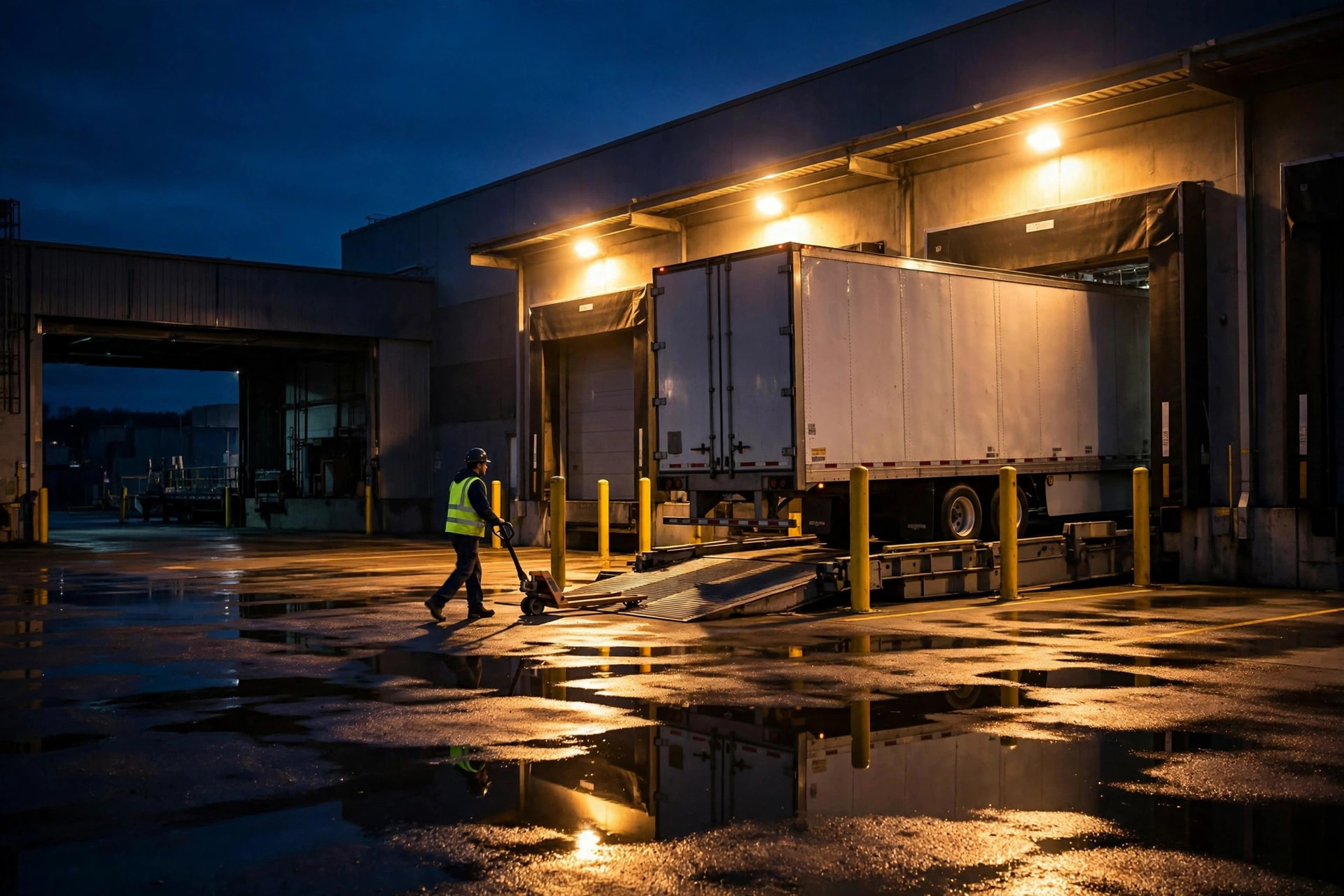
Spot three: the dock. 20 foot-candles at night. The strip between the trailer tail and the dock edge is OSHA's favorite nighttime inspection point. Daylight covers it up; on night shift it can be pitch black.
Spot four: stairwells and egress paths. Five foot-candles minimum. Press the test button on the emergency lights monthly. I've seen units nobody tested for three years with dead batteries. The inspector presses the button, nothing happens, and that's a citation.
Spot five: the yard. 3–5 foot-candles at night. Drop-lot maneuvering, drivers getting out to crank landing gear — all of it depends on this light.
How to measure: the meter doesn't go over your head
Set the meter at working-plane height: 30 inches off the floor for floor work, at pick height for pick faces. Lay out a grid at 10–20 foot spacing and record two numbers per point — the average and the minimum. The inspector cares about the minimum. An average of 25 with a dark corner at 4 is still a problem.
The biggest trap: daytime readings don't count. Skylights inflate the numbers, and if the inspector shows up at night, you're done. Measure both; the night numbers are real. Phone apps are trend-spotters, not evidence — a handheld meter costs a few dozen dollars. Buy one and keep the logs.
The maintenance pits: where LED retrofits go wrong
Dead fixtures nobody replaces are the most common failure mode. A few dead lamps in a row and the whole row's uniformity collapses — your minimum readings will be under the dead lamps.
LED retrofits have three specific traps. First, 6500K cool-white lamps with cheap drivers produce visible flicker. Point your phone camera at the fixture — scrolling bands on the screen means the flicker is bad. Flicker doesn't hurt the lamp; it hurts eyes. Pickers complaining of headaches and misreading scanner screens? Check the lights before you blame the equipment.
Second, mixed color temperatures. Old 4000K lamps mixed with new 6500K ones make the aisle half yellow, half white, and forklift drivers' eyes keep re-adapting. That increases the incident risk instead of reducing it. Third, dirty lenses. In dusty environments, a year without cleaning routinely costs you well over ten percent of your illuminance. Cleaning lenses is an order of magnitude cheaper than replacing fixtures — the easiest math in this whole article.
Two jobs I've personally seen go sideways
In 2024, a 120,000-square-foot 3PL in California's Inland Empire got an OSHA visit at 9 PM. OSHA doesn't keep office hours. The dock measured 8 foot-candles; the trailer tails were nearly black. A serious citation under 5(a)(1) arrived a week later. The fix cost over $40,000: six dock floodlights plus forty dead high-bay fixtures replaced. The owner told me: "If I'd known $40K buys three years of peace, I'd have done it last year."
In 2022, on a project I worked, a food 3PL in Ohio retrofitted 300+ high-bays to LED in one shot. The lumen count passed, but they bought cheap — 6500K with uncertified drivers. Nobody complained it was "dark," but within three months four pickers reported headaches and scanner misread rates climbed. They re-did it in two phases with 4000K, dimming, and flicker-certified drivers. Problem gone. The lesson: passing the illuminance number doesn't mean the eyes are comfortable.
The counter-intuitive one
The most dangerous place in a warehouse isn't the darkest place — it's the half-dark place. A driver stepping from a 40-foot-candle pick face into a 5-foot-candle aisle needs seconds for his pupils to adapt, and during those seconds he's half blind. So uniformity (brightest point divided by darkest point) matters more than the absolute number. The industry rule of thumb for travel areas is a max-to-min ratio under 4:1. Find your brightest and darkest points tonight; if the ratio is over 10, go fix the lighting.
Whether the money was worth it comes down to one number: can the minimum illuminance at the dock at night hold steady at 20 foot-candles. If it can, the money was well spent. Miss it by a single foot-candle, and you're just saving up for the inspector's fine.
By Da Liu, Automation Engineer



