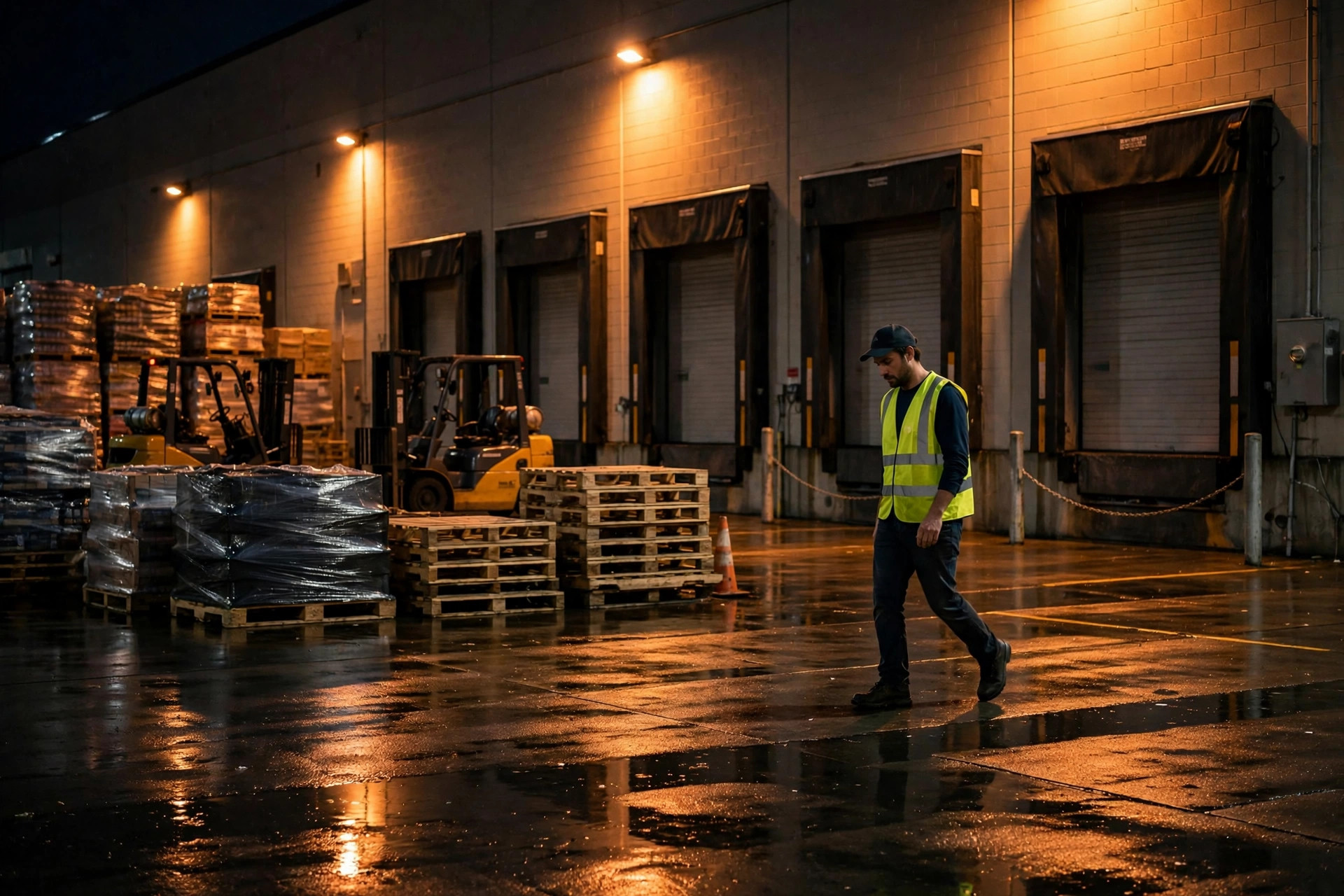
In the fall of 2024, a 120,000-square-foot 3PL warehouse in California's Inland Empire was staffing up for peak season, pulling in temporary workers from a staffing agency by the dozen. An OSHA compliance officer spent two hours walking the floor; a few weeks later, citations arrived at two companies: the warehouse operator and the staffing agency that supplied its people. The operator's first reaction was that the workers belonged to the agency, and so did their training — why was the operator being cited? The agency's reaction was the mirror image: the operator ran the floor and created the hazards — why was the agency being cited?
The dispute landed squarely on a body of enforcement logic OSHA has been applying for more than two decades: the multi-employer citation policy. Under this policy, when a hazard appears at a shared worksite, OSHA does not simply cite whoever "had the accident." It first assigns each employer on site a role, then holds each to the obligations of that role. There are four: the creating employer, which caused the hazardous condition; the exposing employer, whose employees are exposed to it; the correcting employer, contractually responsible for fixing it; and the controlling employer, with general supervisory authority over the site. Enforcement follows a two-step sequence: determine the role first, then ask whether the employer met the duties attached to it.
The doctrine dates to a 1999 compliance directive (CPL 2-0.124) written for construction sites, where general contractors layered subcontractors and someone had to answer for who owned a given hazard. Over the past decade and a half, the American warehousing labor model has quietly come to resemble a construction site: a 3PL operator runs the building and the process, a staffing agency supplies the people, and the cargo owner periodically walks in for counts, installs, and inspections. Three parties, one floor, naturally blurred authority — the job-site rulebook carried over, almost intact, into the warehouse.
Two citations, one walkthrough: the four roles
Temporary workers have been on OSHA's radar as a high-risk population for years. In April 2013 the agency launched the Temporary Worker Initiative, and then–Assistant Secretary David Michaels stated the since-quoted principle: staffing agencies and host employers share control over temporary workers and are therefore jointly responsible for their safety and health. A July 2014 memorandum to regional administrators formalized the joint-employer reading. In OSHA's eyes, there has never been such a thing as a temp worker who "belongs" to only one side.
Then, in July 2023, OSHA issued a National Emphasis Program targeting warehousing and distribution centers, making the sector a formal enforcement priority. Read the timeline in order and the logic completes itself: 2013 established shared responsibility, 2023 aimed enforcement at warehouses, and the decade between refined how the four roles get assigned. For 3PL operators, the intersection runs straight through peak-season staffing.
Mapped onto the typical 3PL floor, the four roles distribute roughly as follows:
| Role | Typical player in a 3PL-temp setup | What keeps you out of the citation |
|---|---|---|
| Creating | Rack installers, a client's contractor adding conveyor, whoever stacked the pallets badly | Don't create the hazard; fix it immediately if you do |
| Exposing | The staffing agency (its temps work in the hazard zone); the operator (its own people are exposed too) | Once aware: correct it if you have authority; if not, demand correction from the creating or controlling employer while protecting your people — up to removing them |
| Correcting | Whichever party the contract designates, usually the operator | Discover and abate hazards on the schedule the contract sets |
| Controlling | The 3PL operator (sets schedules, directs work, can stop a job) | Exercise reasonable care: inspect periodically, run a safety compliance program, follow up on corrections |

Why the 3PL warehouse is this policy's natural habitat
Return to that Inland Empire facility. The violations were not exotic: a fire exit partially blocked by pallets, several rack uprights missing column protection. Two citations followed. The operator was tagged as controlling and exposing — it ran the site and its own employees worked there. The agency was tagged as exposing — nearly 80 of its temps worked in the affected areas, and its onboarding records contained nothing about the site-specific risks of that warehouse.
Buried in that outcome is the first structural cause: the training gap. What a staffing agency delivers is general safety training; the site-specific risks — the pedestrian-forklift traffic pattern, the height restriction on one rack row, the temporary pick zone opened for peak — can only be taught by the operator. OSHA has always required both, and contracts that dump "training" wholesale onto the agency quietly drop the site-specific half.
The second structural cause is subtler, and it involves the third party: the cargo owner. A recurring pattern runs like this — a retail client sends its own contractor into the warehouse to add conveyor or reconfigure racking; the contractor's electrical work is noncompliant and creates a hazard (creating); the 3PL, as the controlling employer, fails to catch it on inspection. Citations go to the contractor and the 3PL. The client is not cited directly, but the equipment is its, and so is the downtime. Among the three parties, there is no true bystander.
The contract clause OSHA doesn't read
Here is the most counterintuitive point in the whole picture. Many 3PL and staffing contracts contain a sentence to the effect of: "The agency assumes all on-site safety responsibility." Whoever drafted it imagined it as a shield against OSHA. But role assignment turns on de facto control — who schedules, who directs the work, who can stop a dangerous job — not on what the contract says. Contract language carries almost no weight in OSHA's two-step analysis.
That does not make the contract useless; it relocates its usefulness to after the citation lands. Indemnification clauses let one cited party seek recovery from the party truly at fault; a written designation of the correcting employer pins down who fixes what and by when. But all of that happens downstream of the citation. Expecting a contract to keep OSHA from citing you in the first place is the single largest misunderstanding of this policy.
The second counterintuitive judgment concerns the operator's own inspections, and it is a genuine trade-off. The more a 3PL inspects, the more firmly it establishes itself as the controlling employer — thorough logs are documentary proof that "you could have found and fixed hazards." But the alternative is worse: never inspecting leaves the operator exposed as both an exposing employer that knew or should have known and a controlling employer that failed reasonable care. The real choice was never "inspect or don't inspect." It is whether every inspection record is paired with a closed-loop correction record. The first without the second is evidence handed to the inspector.
If the safety provisions of a staffing contract are to mean anything, five elements are worth writing in: first, written role designation — the correcting employer, which hazards each party fixes, on what timeline; second, a split training duty — the agency handles general training with records, the operator delivers site-specific training before the first shift, signed and filed; third, inspection and stop-work authority — the operator may inspect at any time and halt dangerous work, the agency pulls its people; fourth, incident reporting and joint investigation — mutual notification within 24 hours, shared records; fifth, insurance and recovery — who carries workers' comp, how indemnification reads, with each party answering its own citation first and settling allocation afterward. Penalty amounts adjust periodically — consult OSHA's current published schedule — but the framework does not depend on the numbers.
The trend: citations are moving from the careless to the in-charge
Three trend judgments follow. First, enforcement is shifting from citing whoever "caused it" toward citing whoever "ran it" — the controlling employer's share is rising, and the 3PL operator, as the natural site controller, sits first in line. Second, temporary-worker protection will tighten, not loosen: the 2013 initiative has never been rolled back, and the 2023 warehousing NEP delivered inspection resources to the warehouse door; their intersection is peak-season staffing at 3PLs. Third, safety provisions will migrate from boilerplate at the back of staffing contracts to front-loaded negotiation items — staffing agreements without a safety exhibit will become progressively harder to sign.
One longer-horizon judgment: OSHA will eventually publish warehousing-specific guidance on temporary worker safety, as it has for construction — less a prediction than a reasonable extrapolation of the existing timeline. Only a matter of when.
Which leaves an open question: as the 3PL warehouse increasingly resembles a platform — cargo owners, staffing agencies, equipment vendors, carriers all working the same floor — will a doctrine designed for construction sites force warehousing to invent a new model of site safety governance? "Who gets the citation" is the surface question. The deeper one is this: on a floor where no one is the sole employer, whose business is safety?
By Dr. Chen, Supply Chain Researcher