One Wednesday morning earlier this year, I walked into my office and found a glossy "forklift operator license" sitting on my desk. Next to it, a business card from an OSHA inspector.
He'd visited the day before and asked for the training records of one of our temp workers. HR had proudly handed over the certificate from the staffing agency. The inspector glanced at it and set it aside. "This only proves he took an online course," he said. "OSHA doesn't issue licenses. I need your records — your training, your evaluation." That was the beginning of my real education in what the OSHA forklift training requirements actually demand.
My stomach dropped. Luckily our records were complete. He spent ten minutes flipping through them and left. But that visit taught me something every warehouse manager in the US should know cold: one of the biggest compliance myths in our industry is that buying a "forklift license" makes you compliant. It doesn't. Here's what the OSHA forklift training requirements actually demand, and how we run it on our floor.
How the Myth Almost Bit Us
Last peak season, November through December, the staffing agency sent us more than twenty temp workers. Every one of them arrived with a "forklift license" — a two-hour online course, pass guaranteed. Our shift lead, trying to keep up, handed out keys and put them to work.
In mid-December, a temp backing up in a narrow aisle nearly pinned a picker between the racking and the truck. No contact — a near miss. But it scared us straight. Under 29 CFR 1910.178(l)(4), an accident or near miss by itself triggers refresher training. Worse, when we audited the files, several of those temps had never completed the full three-part training. The online certificate was all they had.
Now the story that actually ended in a citation. A food distribution warehouse in the next county over — last fall, a temp driving a sit-down counterbalance clipped a rack upright at the dock. Product everywhere, nobody hurt. OSHA came in, pulled the records: seven temps operating trucks, four with nothing but agency certificates, zero hands-on training or evaluation records from that warehouse. The citation was serious-level, and a single serious violation can run well into five figures — check OSHA's current penalty schedule on osha.gov, because the numbers move. The part that really hurt came after: every temp was grounded the same day, peak-season staffing collapsed overnight, and the overtime they burned through cost more than the fine.
The Training Requirements, Step by Step: Instruction, Hands-On, Evaluation
The regulation, 29 CFR 1910.178(l)(2), is blunt: training must combine formal instruction, practical hands-on training, and an evaluation of the operator's performance in the workplace. An online course covers exactly one of the three. The other two have to happen in your building, on your trucks, with a qualified person running them.
Formal instruction covers roughly twenty topics listed in (l)(3) — truck-related (load handling, stability, inspections, fueling and charging) and workplace-related (pedestrians, narrow aisles, floor conditions, ramps). We built our own classroom deck, and every topic gets a photo from our own floor. When we teach pedestrian awareness, we show the dock-door camera still from our own near miss. People pay attention when it's their own building in the picture, not a textbook.
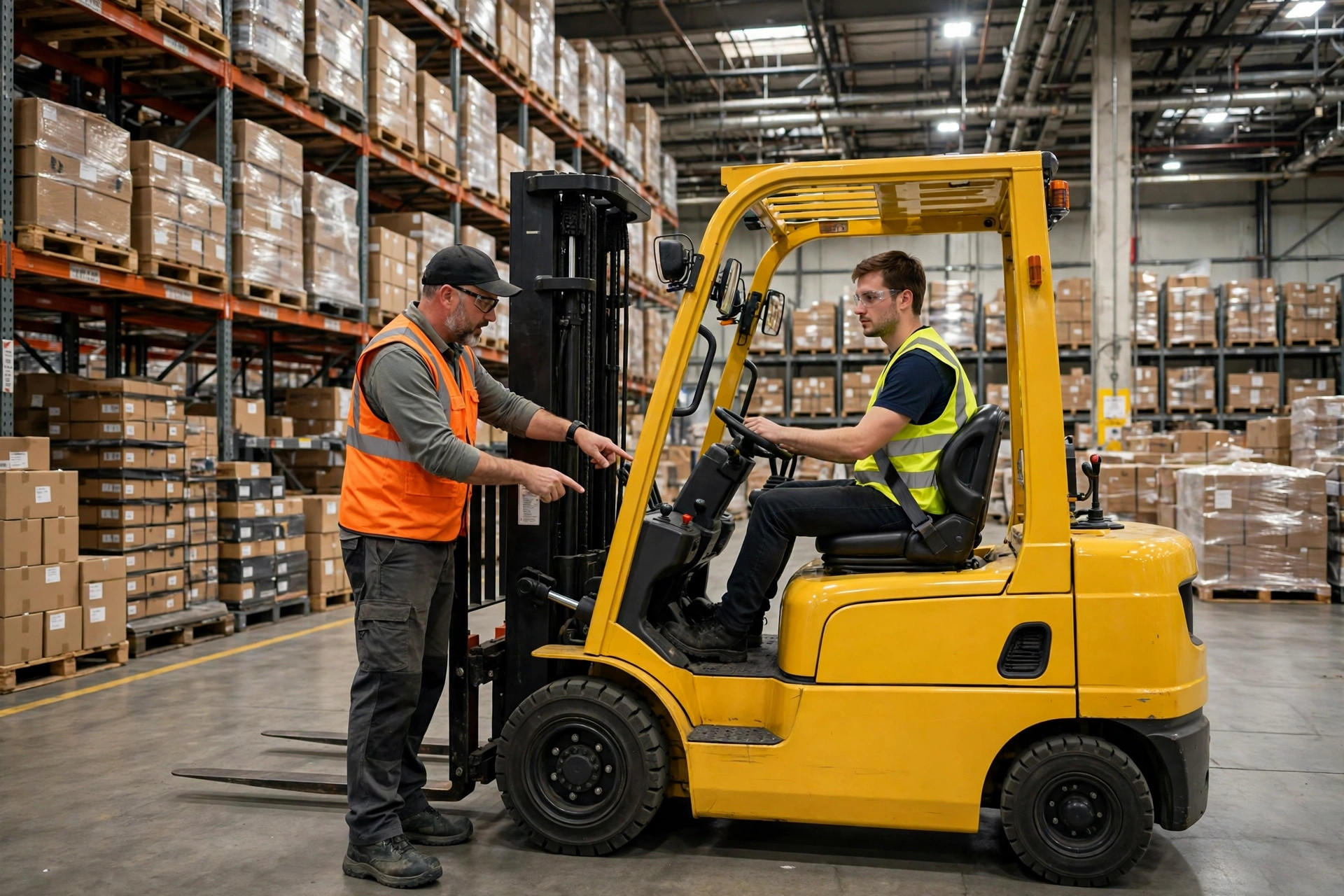
Practical training means the trainer demonstrates first, then the trainee practices under direct supervision until the trainer signs off. The non-negotiable part: it must be on our truck, in our aisles. A temp trained on a counterbalance at some training center still can't run our reach trucks in a nine-foot aisle. Different machine, different building, different skills.
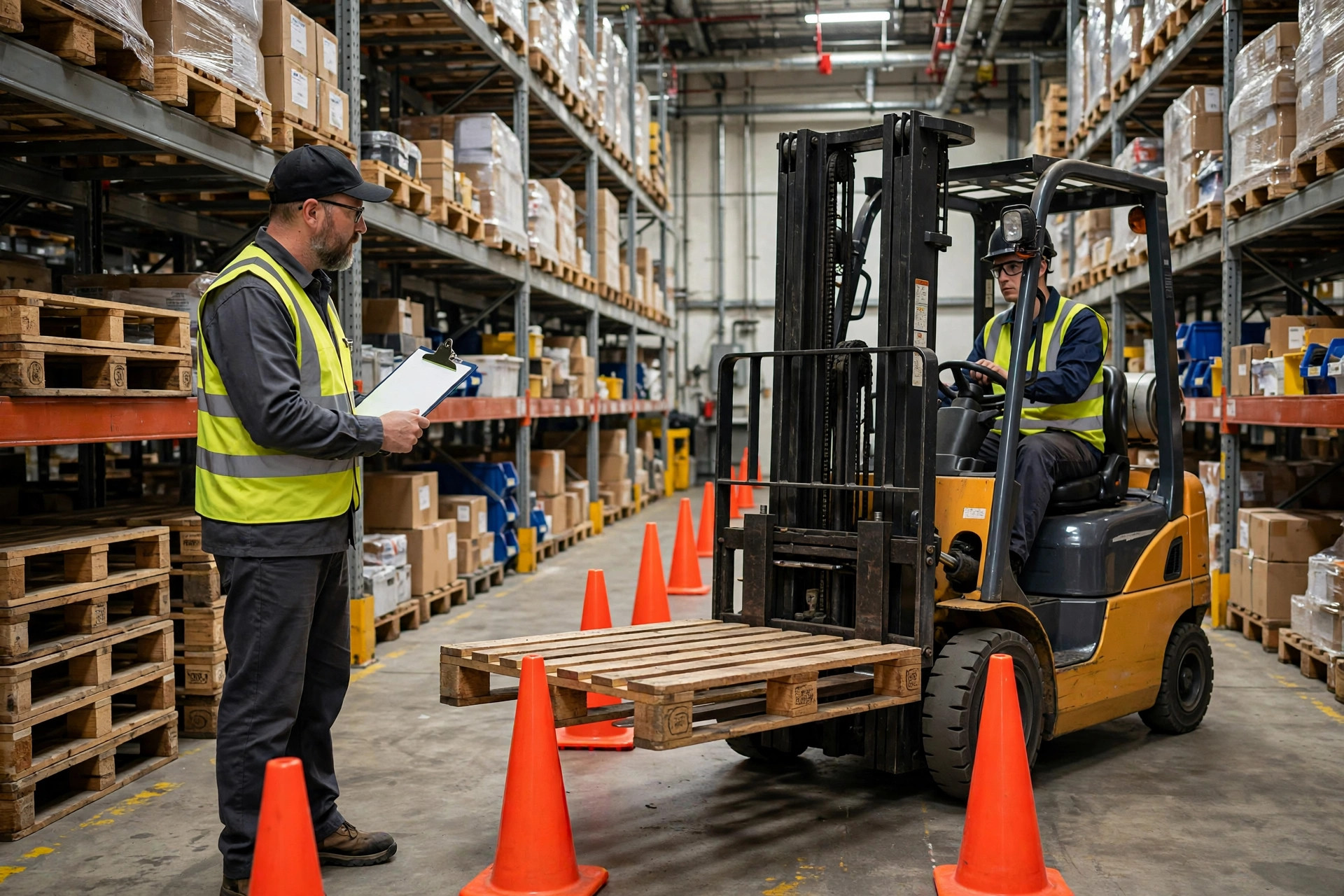
Evaluation means the trainee runs a complete cycle solo — slalom, pick, putaway, battery station — while the trainer watches and doesn't touch anything. Pass, and both sign. Then the employer certifies per (l)(6): operator name, training date, evaluation date, and who conducted them. Paper copy plus a scan, filed with HR and safety. That piece of paper is the only "license" OSHA recognizes.
Two Dead Ends We Tried First
Version one: let veteran operators mentor newbies verbally. Failed. What one veteran taught didn't match the next — one guy's trainee could slalom cones, another's never learned the pre-shift inspection. No standard, no accountability. And the veterans hated it: "Mentoring eats into my piece rate — why should I?" We fixed the people side before the process side: training hours are paid separately from piece rate, trainers get a stipend, and if a trainee has an incident, the debrief doesn't punish the trainer. Once mentoring was blame-free, people actually taught.
Version two: outsource the whole thing to a training company that comes on-site to evaluate. Expensive, and they evaluated on equipment that wasn't ours. Certificates came back, but the operators still couldn't run our narrow-aisle trucks. Money spent, risk unchanged. We dropped it.
What we do now is a five-step onboarding checklist, same for full-timers and temps, no exceptions:
- Open a file first: name, date, truck class, trainer. Nobody touches a truck before the file exists.
- Classroom: cover the (l)(3) topic list, internal quiz, 80 to pass, retake if you fail.
- Hands-on: trainer demos, trainee practices under supervision — on our trucks, in our aisles — until the trainer nods.
- Workplace evaluation: one full solo cycle, dual sign-off.
- Employer certification: the four (l)(6) elements on file, paper plus scan.
How Often: Three Years Is the Floor, Five Triggers Mean Right Now
This is the part of the OSHA forklift training requirements most warehouses forget. Paragraph (l)(4)(iii): each operator's performance must be evaluated at least once every three years. At least. Three years is the floor, not the goal. Whenever another manager asks me how often refresher training is actually required, my answer is: every three years at minimum, and immediately whenever one of the five triggers below fires.
Then there are five triggers that demand refresher training immediately, no waiting: the operator is observed driving unsafely; the operator is involved in an accident or near miss; an evaluation shows unsafe operation; the operator is assigned a different truck type; or workplace conditions change — a new narrow-aisle zone, a racking re-layout, a move from indoors to a sloped outdoor dock.
Our system flags every operator's refresher date sixty days out, and shift leads see it when they build the schedule. The crew we hired three years ago? Every one of them got re-evaluated this year. Nobody slipped.
The Uncomfortable Truth: "Just Ten Minutes" Still Needs the Full Program
This is the most important sentence in this article. There is no exemption for "just moving one pallet" or "only ten minutes." The moment someone's hands are on the controls, they're an operator, and they need the full three-part program.
When a staffing agency tells us "our people are all certified," fine — we accept their certificate as the classroom portion and save two hours. But hands-on training and the workplace evaluation are non-negotiable, done in our building on our trucks. It's written into our agency contract now.
The math is simple. An online "license" costs tens of dollars. Running the full program ourselves costs a couple hundred dollars per person in labor. A single serious citation runs well into five figures — before you count downtime, overtime, and the insurance hike. You don't need to run that math twice.
So here's my reminder to fellow managers: go open your filing cabinet this week. Check three things — do your temps have evaluation records, did the crew hired three years ago get their refresher, and did you retrain after the last truck change or layout change. Whatever's missing is exactly what an inspector will ask for. This isn't about spending money. It's about not gambling.
By Chen Feng, Warehouse Operations Manager