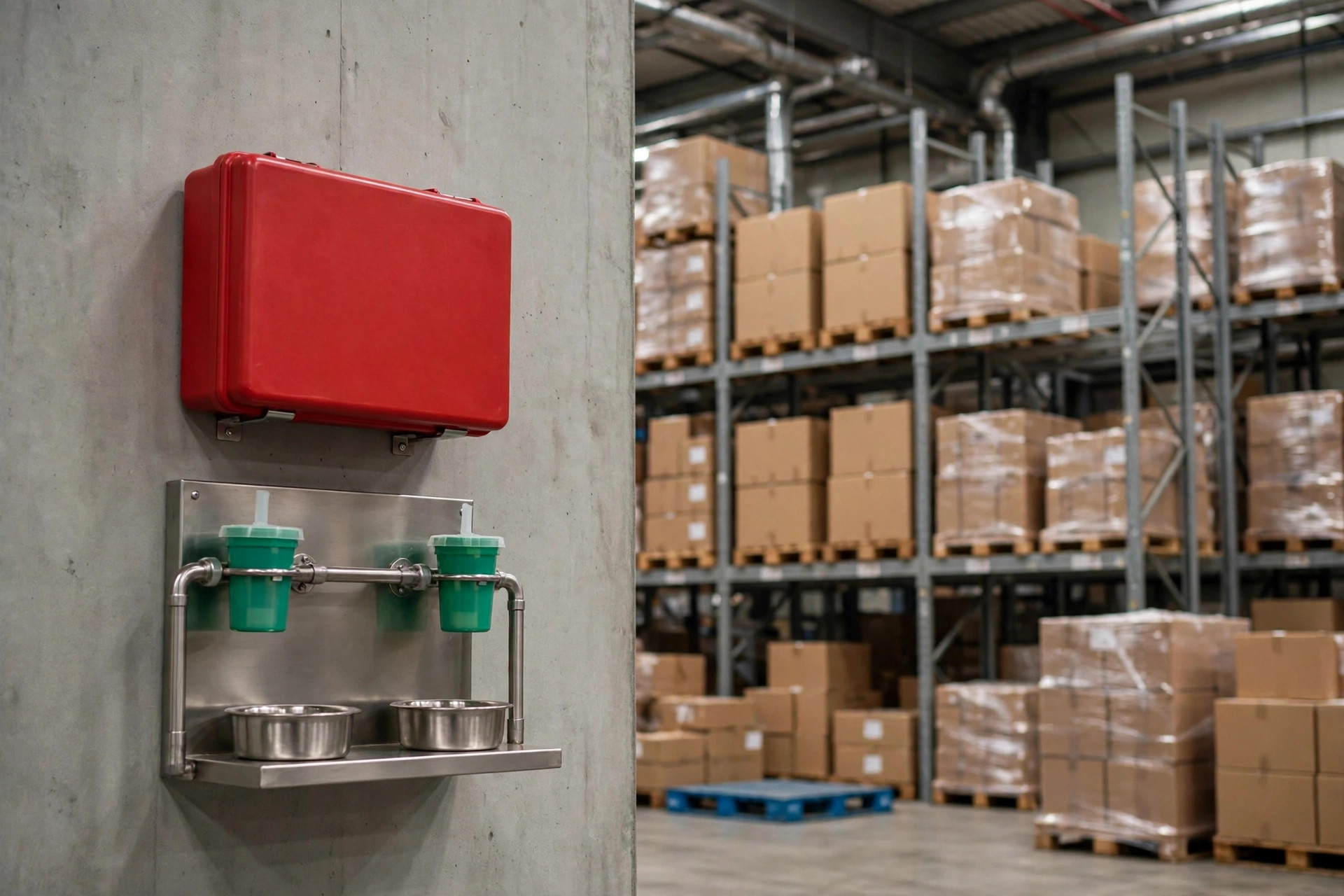
I'm telling you — after fifteen years on the road, what scares me most isn't a blowout on the highway. It's waiting at a warehouse dock for a load while somebody gets hurt nearby and nobody knows what to do. Most folks have never even heard of osha first aid requirements, let alone the three paragraphs of 1910.151. So let me break it down the way it actually happens.
Something I Saw With My Own Eyes
Last summer, Texas, a distribution warehouse serving a grocery chain. Over 100°F outside (about 38°C), and I'm in line waiting to get loaded. A kid in his early twenties is working the dock, and all of a sudden he goes pale and drops straight backward — heatstroke, out cold.
Seven or eight people stood around him. Not one of them moved to help. Somebody yelled "call 911," somebody ran for the shift lead, and the lead showed up just as helpless, pouring a bottle of water on the kid's face. The ambulance took twenty minutes — the warehouse sits out in the suburbs, and ambulances don't hurry out there. The kid turned out fine, woke up on his own. But for twenty minutes, everyone just stood there staring. If it had been worse? I don't want to think about it.
Another time, somewhere in the Midwest, a forklift driver got his foot crushed under a pallet — swollen up like a balloon. Somebody remembered the first aid kit on the wall. Opened it up: bandages expired two years ago, the antiseptic bottle bone dry, a few band-aids left. They had a kit the way a scarecrow has a brain — for show.
The third one was the closest call: a battery-charging area, a worker splashed with electrolyte in the eyes, screaming in pain. A place like that is supposed to have an eyewash station. Nobody on the floor knew where it was. They ended up rinsing his eyes with a garden hose — with water pressure that kept cutting out. He got lucky. A little more splash and he'd have lost the eye.
Here's what those three stories tell you: in too many warehouses, first aid is a decoration — a box on the wall you can point at when the inspector comes, and nobody touches otherwise. And osha first aid requirements exist precisely because of that kind of decorative first aid.
What OSHA First Aid Requirements Actually Say
OSHA 1910.151 — the medical services and first aid rule — is three short paragraphs. Here's the plain-English version:
(a) The employer must ensure medical personnel are readily available for advice and consultation. Translation: when something happens, there has to be someone knowledgeable you can reach — a contracted clinic's phone number, an on-site nurse, a real infirmary in a big facility. Not a phone number on a poster nobody's ever called. Someone who actually picks up.
(b) Where no clinic or hospital is in "near proximity," someone must be trained in first aid — and adequate supplies must be on hand. This is the big one. What counts as "near proximity"? Per OSHA's own interpretation letters: in high-hazard workplaces, medical aid must be reachable within 3 to 4 minutes; in less hazardous ones, within 15 minutes. Miss those windows and paragraph (b) kicks in — every shift needs certified first-aiders, and the kit has to be stocked. Warehousing counts as a medium-hazard industry, and most warehouses sit in suburbs and industrial parks where an ambulance genuinely might not make 15 minutes. So don't gamble — paragraph (b) was practically written for warehouses.
(c) Where eyes or bodies may meet corrosive materials, the work area must have eyewash and drenching facilities. Translation: battery-charging stations (that electrolyte is sulfuric acid), heavy-duty cleaners, chemical storage — the eyewash goes within get-there-right-now distance. Note the wording: within the work area. Not "somewhere in the building."
See the pattern? OSHA doesn't care whether you hung a box on the wall. It cares whether, in the first few minutes after something goes wrong, somebody knows how to help and has something to help with.
Meeting OSHA First Aid Requirements: The Warehouse Checklist
Knowing the rule isn't enough — it has to live on the floor. Here's the checklist I pieced together talking to warehouse managers. Buy to it, inspect to it:
| Item | How | How often to check |
|---|---|---|
| First-aiders per shift | At least 2 certified per shift (Red Cross first aid + CPR/AED), names on the shift roster | Certs run 2 years; flag renewals 3 months out |
| First aid kit | Stock to ANSI Z308.1 Class B (Class B is for higher-risk, higher-headcount workplaces — that's a warehouse), wall-mounted, marked on the evacuation map | Open and inventory monthly; restock and sign off |
| Eyewash station | Battery and chemical areas — within a 10-second walk, no exceptions | Flush 3 minutes weekly to prevent rust and clogs |
| AED | One at the front office, one at the dock; everyone knows where | Batteries last 2–4 years depending on model; expiry sticker on the unit |
| Drills | 15 minutes quarterly: somebody collapses — who calls, who grabs the kit, who meets the ambulance | 5-minute debrief after |
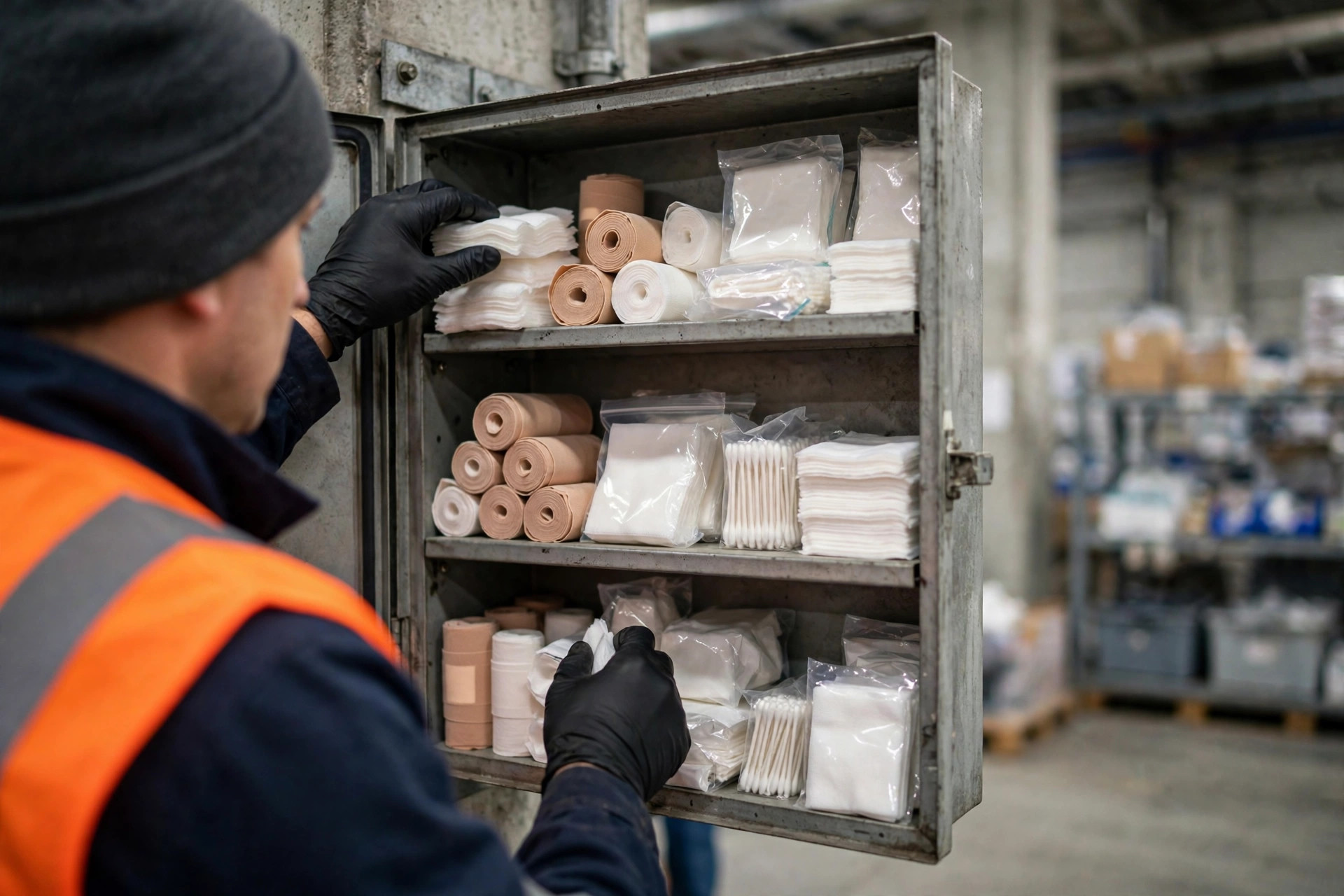
The AED question comes up a lot, so let's do the math: a serious OSHA violation carries a maximum penalty north of ten thousand dollars per violation (adjusted for inflation yearly — check OSHA's site for the current figure). Equipping a mid-size warehouse with everything above — kits, eyewash upkeep, an AED, training — runs a few thousand dollars a year. You don't need me to finish that arithmetic. And that's before a real injury brings work stoppages, lawyers, and settlements that make a few thousand look like pocket change.
Two counterintuitive truths. First, "just call 911" is wrong. What osha first aid requirements demand isn't the phone call — it's on-site response capability inside 3–4 minutes (high hazard) or 15 minutes (everyone else). If the ambulance needs twenty, those twenty uncovered minutes are the violation. Second, a bigger kit isn't a better kit, and an uninspected kit is a prop. Two-year-expired bandages are worse than nothing — they hand you a false feeling of "we're prepared" right up until the moment you discover you're not.
A Few Parting Words for Shippers and Warehouse Owners
We drivers have a habit: walk into a strange warehouse, first thing we do is scan for the fire extinguisher, the first aid kit, the AED. Fifteen years on the road teaches you — you never know if today's the day you'll need one.
Three things for warehouse owners. One: don't treat first aid as inspection theater. OSHA grades you on those first few minutes, not the box on the wall. Two: don't certify just one person per shift — certify two. What if your one certified guy calls in sick? Three: put the monthly kit check in somebody's performance review, or it will never happen.
One thing for shippers: when you're vetting a 3PL, walk the floor and look at the first aid station. A warehouse too lazy to maintain its kit — do you really trust them with your freight?
The old saying goes: better safe than sorry. First aid gear sits useless 99% of the time — but that other 1% of the time, it's somebody's life. Don't wait for an accident to remember the box on the wall.
By Shifu Zhao, Trucking Veteran (15 yrs)