
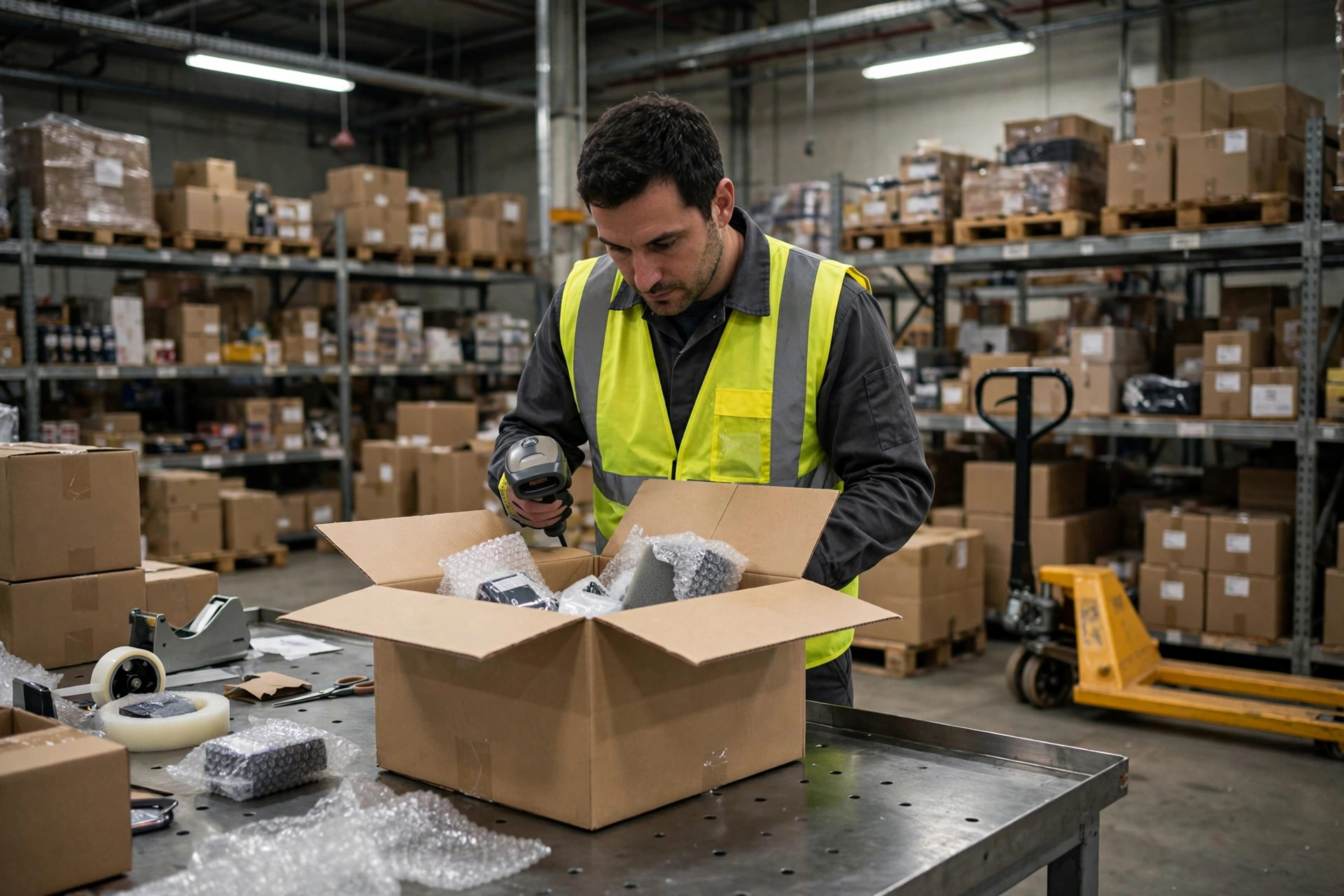
Monday, 6:30 AM. I push open the door to the returns area and UPS and FedEx parcels are stacked waist-high — peak season ended two weeks ago and the returns wave is just getting started. Old Liu is already at it with the night-shift crew. He turns around and yells: "Feng, dozens of return orders are sitting in the OMS again, nobody's approving them!" Straight talk: this one's outside my lane. I'm a warehouse manager, not an OMS consultant. But after years of getting beaten up by returns, I know how a return order flows through the OMS and how the warehouse side catches it — better than a lot of office folks. Here's how we do it in our warehouse now.
The Counterintuitive Part: The Warehouse Is Never the Bottleneck
Most people assume returns are slow because the warehouse is slow at unpacking and inspecting. Wrong. We measured it: from parcel arrival to inspection done, we average under 30 hours (our warehouse's own data from January to June 2026, for reference only). The real choke point is that return order sitting in the OMS: the customer clicked "return," CS never approved it, and the order just lies there in "pending review" while the warehouse can't even see an order number. Parcels pile up for three days and nobody dares touch them — no order, no receiving. Those three days have nothing to do with the warehouse. Nobody in the system clicked "approve."
Remember this one: the warehouse controls only receiving and inspection — but even nailing both can't save an order that's been rotting in the OMS for three days. Want it faster? Go look at how many orders are stacked up in "pending review" first.
The Return Order Status Flow: Seven Steps From Creation to Refund
A return order lives and dies in seven steps. Here's how it actually runs in our building:
Step one, creation. The customer starts a return — clicks return on the marketplace, fills out a website form, or calls customer service. The OMS generates a return order with status "pending review." The warehouse knows nothing at this point. The goods might already be on a truck, or might not have shipped yet.
Step two, review. Customer service checks the return policy: still under warranty? Past the window? Reason legit? Approved orders move to "approved"; rejected ones close out. The most overlooked and most easily jammed step in the whole chain. When CS gets busy, the review queue can sit for two or three days and nobody sees it as a problem — until customers start screaming about slow refunds.
Step three, release to the warehouse. The OMS pushes approved return orders to the WMS, which generates a receiving task. Anything skipping this step gets treated as an "orderless return." This gate has to be airtight, or everything downstream turns to mush.
Step four, receiving. The parcel arrives, we scan the return order number or the shipping label, and record quantity discrepancies on the spot. Receiving answers one question: did the goods arrive? Whether they're any good is inspection's problem.
Step five, inspection. Unpack, check condition, photograph everything. Grade A (like new) goes back to sellable stock; Grade B (damaged packaging, minor flaws) to the discount area; Grade C (broken, missing parts) gets scrapped or sent back to the vendor. One iron rule: inspectors report facts, they don't make disposition calls. How much to refund, whether to exchange — that's customer service deciding in the OMS.
Step six, putaway or disposal. Grade A goes back on the shelf and the WMS writes the inventory back; B and C go to their destinations. Inventory numbers follow what the WMS actually received — the OMS side doesn't edit them by gut feel.
Step seven, refund. The OMS triggers the refund or exchange only after receiving the inspection results. The order is non-negotiable: inspection results first, refund talk second. Refund before inspection and what if the box comes back empty?

Where the OMS Meets the WMS: Three Handoff Points That Break
For a return order to survive all seven steps, the OMS and WMS have to shake hands at three points. We've been burned at every one:
First handoff: timing of the release. The rule is "release only after approval." We learned this the hard way: CS once told us verbally "the goods are almost here, just receive them," and the order got rejected later. The freight sat in our building as an orphan for two weeks with nobody claiming it. Now it's an iron rule: no release from the OMS means no order, and no order means no receiving — at most we hold it in staging, off the books. Orderless returns get stopped at the door, period. Loosen this gate and everything after it is guesswork.
Second handoff: how inspection results get sent back. The warehouse sends back facts; the OMS makes the judgment. The inspector's job is: what condition, what's missing, how many photos. How much to refund or whether to exchange — that's CS applying the rules in the OMS. We used to let the shift lead "suggest" a disposition as a favor, and then CS wouldn't honor it and the customer complained, and we got it from both sides. Now it's cleanly split: the warehouse sends back facts and photos, and takes zero disposition authority.
Third handoff: the order of refund versus inventory write-back. Refunds wait until inspection is done and inventory is written back. The nightmare scenario is the "empty refund" — the OMS refunds first while the goods are still on a truck, or they arrive broken, and the money's already gone. Standing deal with CS: until inspection results come back, the refund button stays gray. Nobody gets trigger-happy.
Two True Stories: Wherever the Order Stalls, People Start Fighting
First story, March 2026, our California warehouse. CS had a new hire and nobody owned return reviews — 47 return orders sat in "pending review" for 3 days (our warehouse's own records, for reference only). Parcels kept piling up and the crew kept asking: "Are we receiving this batch or not?" CS was getting hammered by customers about slow refunds and turned around to blame us: "Why is your receiving so slow?" We got into it on the phone until I sent a screenshot of the OMS review queue, and the CS lead finally saw the problem was never in the warehouse. Ever since, the first item in our morning huddle is: pull up return orders sitting unreviewed for over 24 hours and drop the screenshot in the CS group chat.
Second story: the orderless return. Last year a customer didn't like what they bought and just shipped 12 cartons straight back to our shipping address — no return order in the OMS at all. The warehouse was baffled: whose is this? CS dug around and found the order, but with no return policy applied and no refund amount decided, the whole thing deadlocked for half a month (our warehouse's own records, for reference only). Twelve cartons squatting in staging, nobody daring to touch them, until the customer escalated to the marketplace and CS rushed a special approval. After that we made a rule: orderless returns get photographed at receiving, stored separately, and somebody has 24 hours to create the order in the OMS — if it can't be created, it ships straight back. Say the ugly part up front and there's less fighting later.
How We Do It Now
After years of getting kicked around by this, our returns line runs on rails now. Non-negotiable:
Morning huddle looks at orders first, not freight. Unreviewed return orders over 24 hours old get screenshotted into the CS group chat, tagging the CS lead. Orders don't move, freight doesn't help.
The returns area is physically split three ways: a pending-review zone (nothing gets opened without an order), an inspection zone, and a disposition zone. Freight in the pending zone gets tagged "awaiting order" — nobody opens it early, no matter how curious.
Photo standards for inspection: every Grade C item gets at least 3 photos — overall shot, damage close-up, serial number or label — sent back to the OMS with the inspection results. Photos are the warehouse's insurance policy; when the arguing starts, they do the talking.
Weekly reconciliation with CS: OMS statuses versus actual receipts, differences cleared same day. Nothing rolls past the weekend.
One reminder for fellow warehouse folks: returns run on two legs — the order in the system and the freight in the building. One lame leg and the other can't run no matter how strong it is. Next time returns are slow, don't yell at the warehouse first. Go check the OMS — is that order still lying in "pending review" with nobody paying attention?
By Chen Feng, Warehouse Operations Manager




