Here's the punchline: if your waves keep fragmenting and your routing rules keep fighting each other, don't blame the engine. Nine times out of ten, your order tagging system is a mess. Get order tagging wrong, and waves and routing both fall apart. I've said that to clients at least five times in the last two years, and every room nodded.
March 2024, a DTC beauty warehouse outside Los Angeles called me in for a rescue. Roughly 4,000 orders a day, OMS less than a year old. The symptoms were textbook: the daily wave count had crept from 6 to 22, pickers complained about walking the same order three times, and pack stations were buried under cartons waiting for order completion. The owner's first instinct was that the wave algorithm was broken and it was time for a new system. I pulled a month of order tags and found 43 of them, with four spellings of the same thing: "VIP", "vip大客户", "VIP客户!!!", "vip_urgent". The wave strategy said VIP orders get their own wave, but the rule only recognized the first spelling — the rest scattered into regular waves. One key account's orders got split across five waves, and the complete-order rate dropped to barely 60%. The week we fixed the tag mapping, waves dropped back to 7. I've seen this exact failure three times. Same root cause every time.
Order Tags Own Five Jobs — Nothing More
A tag is not a note. It's a rule input. Before an order enters a wave, it gets tagged, and order tagging answers exactly five questions:
- Channel: where did this order come from? DTC site, Amazon, TikTok, wholesale, retail stores. Channel decides the promised service level and the label template.
- Speed: how urgent is it? Same-day, next-day, standard 3–5 day. Speed is the number-one input for wave scheduling.
- Customer tier: what is this order worth? Regular, VIP, big B2B account. Tier decides whether it gets its own wave and whether QC gets stricter.
- Product attributes: how hard is it to pick? Fragile, liquid, oversized, serialized. Attributes decide the pick path and the pack method.
- Exceptions: anything weird about it? Address under review, payment pending, short on stock. Exception orders must be quarantined — they never enter a normal wave.
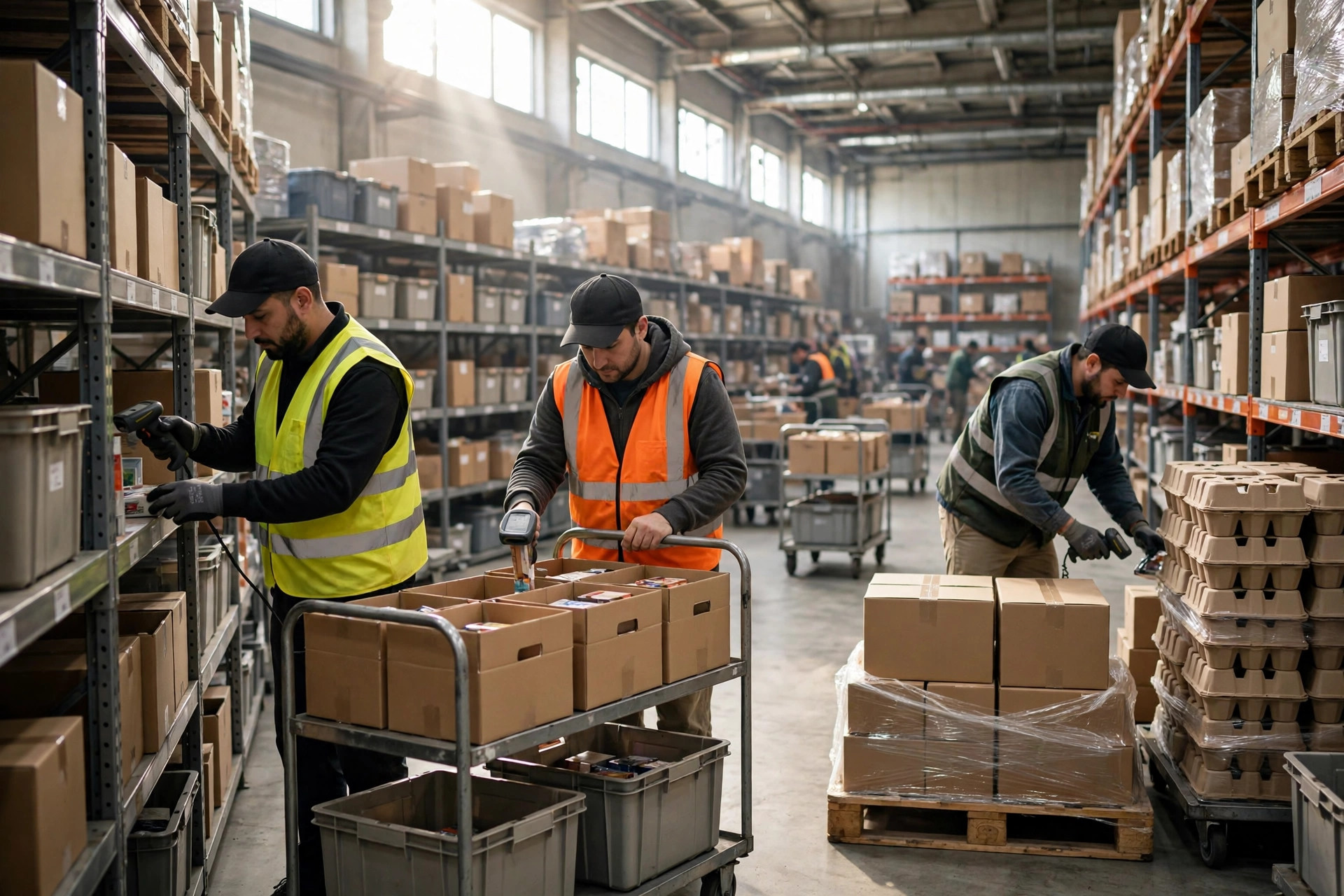
Note the distinction: the five dimensions are the tagging jurisdiction, not "five tags per order." An order's tag set is its value on each dimension — something like [channel:DTC, speed:next-day, tier:regular, attribute:fragile, exception:none]. Clean, mutually exclusive, enumerable. Those three properties are the lifeblood of any tagging system.
How Bad Order Tagging Wrecks Your Waves
A wave strategy is, at its core, "group orders with similar tags." A typical wave rule reads like this: same-day orders release every 2 hours; Amazon orders get their own wave because labels and SLAs differ; oversized orders run as full-pallet waves, never mixed with small parcels.
Let the tags rot, and the waves rot with them. Three classic ways to die:
First, free text. One "VIP" written four ways means the rule catches one and the other three leak into regular waves. Thirty orders from one customer split across five waves, and the pack team spends the shift hunting for cartons.
Second, cross-wired dimensions. Someone marks "rush" under customer tier, someone else marks it under speed, and the wave rule that pulls by speed only catches half. In 2023 I saw this at a 3C accessories warehouse: customer service hand-tagged 200-plus orders with an "urgent" note tag, the wave engine didn't recognize the field at all, all 200 shipped on standard timing, and nobody noticed until the complaints exploded.
Third, tags that only grow. Promo tags from last year's sale — "618", "blackfriday", "clearance" — never get retired. A year later there are 60-plus tags, the wave strategy still references 8 dead ones nobody applies anymore, and half the rules are spinning on empty.
Here's the counterintuitive part: the biggest enemy of a tagging system isn't missing tags — it's too many tags. Across 30-plus go-lives, every warehouse with more than 20 tags had fragmented waves. Tags are rule inputs. Garbage in, and no amount of clever rules saves you.
A Tag Naming Spec You Can Steal
Tag naming is a mandatory line item on my go-live night checklist. Here's the spec I use on live projects:
Rule 1: fixed format <dimension>:<value>. For example, ch:dtc (channel: DTC site), sla:nextday, tier:vip, attr:fragile, ex:addr_review. Values in lowercase English abbreviations — no mixed languages, no full-width/half-width character traps. Five dimensions, period. No inventing a sixth.
Rule 2: tags come from a dropdown, never typed by hand. The tag field in the OMS must be an enum, and API writes get whitelist validation. One hand-typed tag and dirty data starts breeding. I've seen this exact failure three times, and every time it started with "customer service wanted to be quick."
Rule 3: max 8 values per dimension, max 20 tags total. A new value needs approval: who requested it, why, and which wave or routing rules it touches. A tagging system without an approval process goes feral within three months.
Rule 4: one mapping table, readable by humans and systems alike.
| Tag | Wave strategy it drives | Routing rule it drives |
|---|---|---|
| sla:sameday | Release every 2 hours, priority before cutoff | Same-day carriers only, no rate shopping |
| ch:amazon | Own wave, separate label template | Route per marketplace SLA, auto-upgrade on breach |
| attr:oversize | Full-pallet waves, never mixed with smalls | LTL / big-and-bulky lanes only |
| ex:addr_review | Enters no wave, waits in quarantine pool | Routing paused until manual release |
| tier:vip | Own wave, tightened QC | Speed first, higher freight acceptable |
Pin this table in the project docs. Change the table first, then the system. The day the table and the system disagree is the day your next rescue call starts.
The Rescue Math: What Fragmented Waves Actually Cost
Time to do the math. What does wave fragmentation really cost? Take that LA beauty warehouse: 4,000 orders a day, waves ballooning from 6 to 22. Every wave is a full release-pick-verify-pack cycle, so 16 extra waves meant 16 extra line changeovers at pack-out every day. With 12 packers and 15 minutes per changeover, that's 48 labor hours a day burned on waiting for waves, hunting cartons, and reconciling split orders — roughly six people spending a whole shift producing nothing.
Routing conflicts cost even more. After the tags rotted, they had a "local order routed cross-country" fiasco: a wholesale bulk order that should have gone on the private fleet got tagged ch:whole_sale (one stray underscore) instead of ch:wholesale. The route missed, fell back to the default parcel routing, and a 200-pound shipment went parcel at more than triple the fleet rate. A month of those fiascos burned tens of thousands of dollars in freight. Every shortcut the tags saved got repaid double in shipping cost.
The rescue runs in three steps, in this order:
- Freeze: convert the tag field to an enum and stop new dirty data. Keep adding rogue tags and nobody can save you.
- Clean: merge the historical tags — 43 down to 18. Keep the mapping table on file, keep old tags for 90 days of traceability, then retire them.
- Rebind: rebind every wave strategy and routing rule to the new tags using the mapping table. Regression-test each rule: create 20 test orders and verify wave assignment and routing.
Go-Live Night Checklist: Order Tagging Edition
Every OMS go-live night, I walk this checklist. I don't sign off with a single box unchecked:
- Five dimensions only, max 8 values each, 20 tags total
- Tag fields are enums everywhere, API writes whitelist-validated, no hand typing in the UI
- Format
<dimension>:<value>, all lowercase English, no spaces, no special characters - Tag-to-wave and tag-to-routing mapping tables finalized and matched line by line against system config
- Orders with exception tags (ex:*) confirmed to enter no wave; the quarantine pool has an owner
- Regression with created orders: at least 3 test orders per tag, wave assignment and routing all correct
- Old-tag retirement has an owner; promo tags ship with a retirement date
A tagging system costs two days of spec work at go-live and saves three months of firefighting after. Waves and routing are obedient executors — the tags are the ones giving orders. Clean tags, tidy waves. Dirty tags, and no algorithm on earth bails you out.
By Lin Xiao, WMS Implementation Consultant