The Most Underestimated Time Sink in Receiving
The part of inbound operations that quietly eats the most time is rarely the unloading itself. It is document verification. Bills of lading, packing lists, commercial invoices — every forwarder and every carrier uses a different layout, and the copies a warehouse actually receives are often phone photos of wrinkled paper, faded faxes, or printouts with handwritten annotations scrawled over the typed text. Staff key every field in by hand. A skilled clerk tops out at 40 to 60 fully processed shipments a day — while peak-season volume is routinely double that.
Precisely because the pain is so concrete, OCR for trade documents has become one of the first AI applications to face a real-world verdict in the warehouse. But there is a misread number at the heart of this market: the "99% recognition accuracy" on a vendor's datasheet and the "field usability rate" a warehouse actually experiences are frequently two different numbers.
The Data: Character Accuracy, Field Accuracy, and Usability Are Three Different Things
Three concepts need to be separated. Character recognition accuracy is the share of individual characters read correctly. Field accuracy is the share of complete fields — a bill of lading number, a container number — in which every character is correct. Field usability rate is the share of extracted fields that can flow into the system with no human touch at all. Published vendor whitepapers and POC reports commonly claim 95 to 99% character accuracy on clean scans of printed Latin alphanumeric text. But a warehouse's real input is phone photos, carbon copies, and stamps overlapping text, and character-level accuracy dropping to around 90% in those conditions is not unusual. The more important effect is the decay from characters to fields: one wrong character in an 11-digit container number makes the entire field unusable, and on a packing list with 20 fields at 95% accuracy each, the probability that the whole document is correct is only about 36%. That is why a vendor's "99%" and a warehouse manager's "it doesn't work that well" can both be true — they measure different things. The metric with real project value is field-level accuracy: for key fields like B/L number, container number, gross weight, and piece count, published POC data mostly lands between 92 and 97% once template adaptation has been done; skip the adaptation, and figures below 85% are entirely common.
Case One: A Los Angeles Transload Warehouse, Where the Review Workflow Ate Most of the Gains
In early 2025, a transload warehouse near the Port of Long Beach asked me to review their OCR project: 120 to 150 inbound shipments a day, each carrying 3 to 5 pages of documents, handled by four clerks dedicated to data entry plus temporary peak-season staff. The solution auto-extracted key fields (B/L number, container number, gross weight, piece count), each scored with a confidence value, pushing sub-threshold fields to a human review queue.
Three months of measured data showed a first-pass rate of about 94% on key fields, review workload down to roughly a third, and entry-error complaints falling from a dozen-plus per month to single digits. But the inflection came only in month three, when they rebuilt the review SOP. The original process was "re-read every field the system pushes over" — data entry wearing a different hat. The redesign — "only review fields below the confidence threshold, with the source image snippet shown side by side" — is what actually lifted throughput.
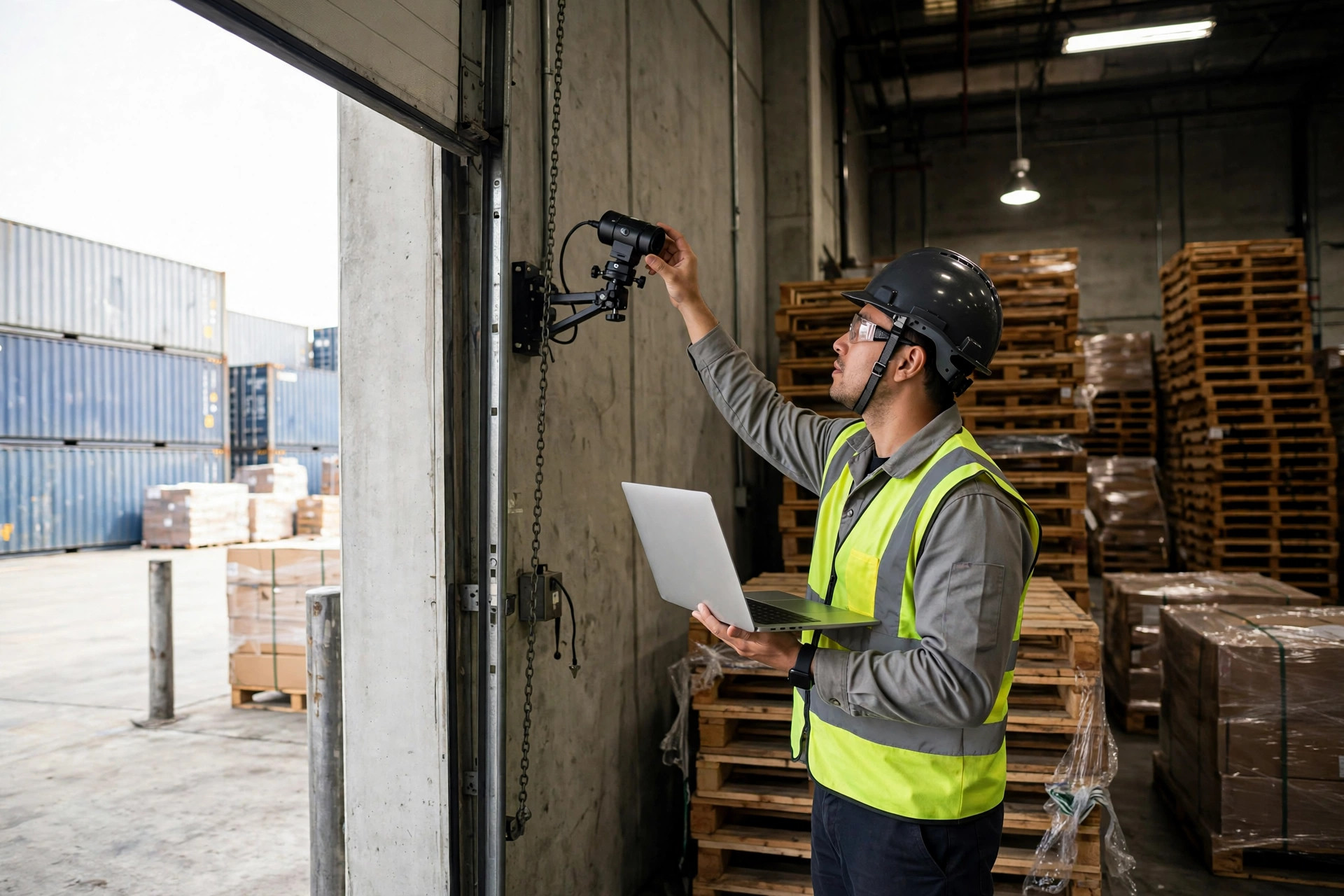
The attribution here is unambiguous: the bottleneck in an OCR project is rarely the recognition engine. It is the review workflow design. Whether recognition runs at 94% or 96% matters far less for labor efficiency than whether the review interface is usable and the thresholds are set sensibly. Many warehouses treat OCR as a pure technology purchase — buy the engine, expect the results — and miss the process-redesign half of the project entirely.
Case Two: A Dallas 3PL, and the Cost of Skipping Template Adaptation
In the second half of 2024, a Dallas-based 3PL rolled out OCR for an auto-parts client's packing lists, and it became a cautionary tale. The lists were printed from Excel exports: dense grid lines, mixed units (PCS, CTN, SET), merged cells. The team ran the generic model with no field-mapping templates for that supplier. In the first week, quantity rows were routinely misaligned, "200 PCS expected" became "200 CTN" in the system, and receiving variance rates went up instead of down. The floor demanded a rollback to manual entry.
The fix took three weeks: a dozen-odd field-mapping templates for that client's high-frequency suppliers, plus a unit-normalization dictionary. The lesson is direct: OCR is not a pair of "universal eyes." It is a pair of eyes that recognizes what your suppliers' documents look like. Warehouses with a concentrated, stable set of supplier layouts see results fast; with hundreds of suppliers and wildly varying formats, the template-adaptation workload can exceed expectations — and that cost belongs in the ROI model before approval, not after go-live.
Running the Numbers: The Biggest ROI Is Not the Saved Wages
The table below compares manual entry against OCR-plus-review, using US warehouse clerk labor costs (roughly $20 to $28 per hour) and figures from published project reports. Treat these as reference magnitudes:
| Comparison | Manual Entry | OCR + Human Review |
|---|---|---|
| Processing time per shipment | 12–18 minutes | 3–5 minutes |
| Direct labor cost per shipment | About $4–$7 | About $0.80–$1.50 (review plus software amortization) |
| Key-field error rate | About 0.5–1% | About 0.2–0.5% (depends on review rigor) |
| Upfront investment | None | License or usage-based fees + 2–4 weeks of template work |
| Exception discovery point | During putaway or stocking | 2–4 hours before unloading |
The last row hides a counterintuitive judgment: the largest value of OCR is not labor savings — it is moving error discovery from the receiving floor to before it. In the manual era, a mismatch between the bill of lading and the packing list is often discovered at sortation, when half the container is already unloaded. OCR runs the cross-check before unloading starts, and exception tickets go out 2 to 4 hours earlier — cutting dock waiting charges, rollover risk, and rework. In the projects I have reviewed, the avoided exception costs have frequently contributed more to ROI than the saved wages. An ROI model that only counts "headcount reduced" systematically undervalues this technology.
One Trade-off: There Is No Optimal Threshold, Only a Matching One
Every OCR deployment has to choose a confidence threshold, and it is a classic seesaw. Set it at 95%, and the review queue is deep — low error rates, but limited efficiency gains. Drop it to 85%, and the queue is light — attractive efficiency numbers, but slipped errors land in inventory and become much bigger problems. There is no universally optimal threshold; there is only the threshold that matches your operation's error tolerance.
A practical approach is tiering: critical fields where one wrong character invalidates everything — B/L numbers, container numbers — get strict thresholds; fields where errors have room for correction can run looser. The threshold should not be fixed at go-live. Start strict, accumulate a month of review data, compare intercepted true errors against ones that slipped past, and then decide where to relax. Data-driven threshold tuning separates an OCR project that works from one that works well.
Where This Is Heading: From Recognition to Understanding — But Review Stays
According to the public roadmaps of the leading WMS and document-automation vendors, OCR is moving from character recognition toward layout understanding: LLM-based document comprehension is improving extraction from multi-page tables, overlapping stamps, and handwritten notes, and generalizing better to unseen layouts. Template-adaptation workloads should gradually shrink.
My judgment is that the human review step will not disappear for at least the next two to three years — it will only change shape, from data entry to exception arbitration. First, the long-tail distribution of document formats means models will always encounter unseen layouts; the last mile cannot be closed by the model alone. Second, document errors are asymmetric in cost: one misread container number can strand an entire box. Keeping a human as the final arbiter in high-cost-error scenarios is rational, not backward.
An Open Question
What bears watching is the adoption speed of electronic bills of lading. If eBLs go mainstream and structured data flows directly, is OCR in cross-border documents transitional or long-term infrastructure? The answer probably depends on how fast e-document standards converge — and the industry's decade-long track record on convergence is not encouraging. Until then, OCR remains the most realistic path to digitized document flow — provided it is run as a "recognition plus process" project, not purchased as software.
By Dr. Chen, Supply Chain Researcher