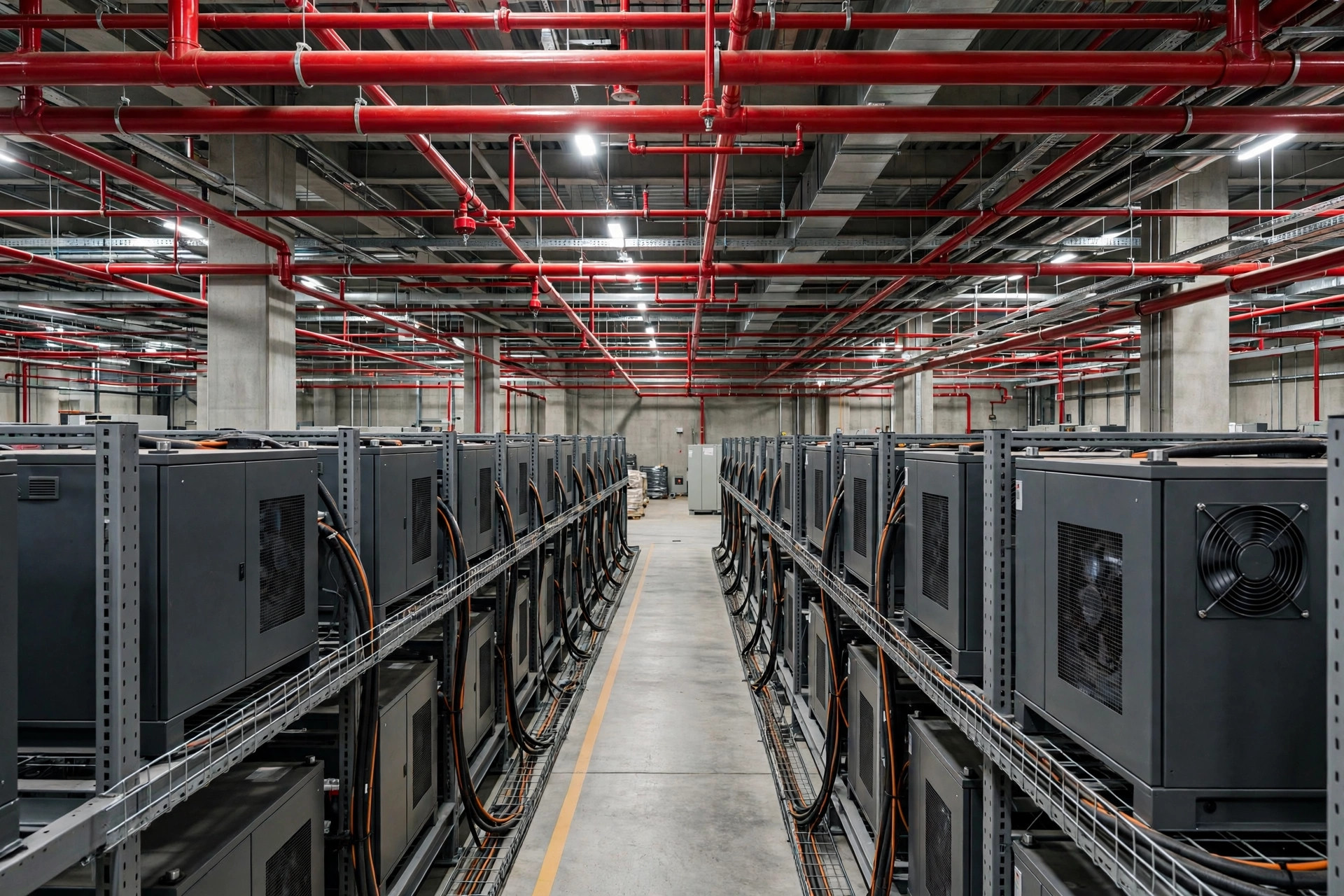
Here's an analogy to start. Think of a lithium battery as a sealed can of energy. It sits there quietly — until one cell "catches a fever" and goes into thermal runaway, dragging the neighboring cells with it. One pops, then the whole row pops. Like a pot of popcorn where one kernel sets off the entire batch — which is exactly why NFPA 855 treats battery storage as its own subject.
Three or four out of every ten consulting calls I get these days open with the same line: "Liu, we've got lithium batteries in the warehouse now, the fire department came by, they want corrections — what do we do?" So let's break it down: what NFPA 855 and IFC 320 actually require for lithium battery warehouse storage, and where the money goes.
First, the blunt truth: these codes don't care how many battery "units" you store. They care how many kWh (kilowatt-hours) you store. Warehouses track pallets and pieces; the fire code tracks kWh. That's hurdle number one, and plenty of operations die on it — they can't even tell you their total kWh.
NFPA 855's three lines: 20, 50, 600
NFPA 855 is the U.S. standard for installing stationary energy storage systems. The chapter covering ESS installations (Chapter 14 in the 2020 edition — chapter numbering shifted in the 2023 edition, so check against the version your AHJ adopted) runs on three lines. Memorize three numbers:
Line one: 20 kWh. That's the entry line. Once your aggregate lithium-ion storage exceeds 20 kWh, NFPA 855 and the fire code officially apply to you. For scale: a common e-scooter battery holds roughly 0.5 to 1 kWh — stack a few dozen in the warehouse and you've crossed the line. And note: that's aggregate, not per unit.
Line two: 50 kWh. That's the grouping line. Batteries must be stored in groups not exceeding 50 kWh each, with a default 3-foot (about 0.9 m) separation between groups and between groups and walls. What's the 3 feet for? Stopping one burning row from taking the next row with it. If you have UL 9540A large-scale fire test data proving it won't propagate, you can negotiate tighter spacing with your AHJ (the Authority Having Jurisdiction). But remember: the test report was paid for by the battery manufacturer, not by you. Waving a years-old manufacturer report at an inspector usually gets you sent home.
Line three: 600 kWh. That's the fire-area line. The default cap per fire area for lithium-ion is 600 kWh. Cross it and you're into 2-hour fire separation, mechanical ventilation (sized for off-gassing during thermal runaway — the code threshold is 25% of the lower flammable limit), explosion control (NFPA 68 venting or NFPA 69 prevention), and sprinklers per NFPA 13 — the commonly cited baseline density is 0.3 gpm/ft². Confirm exact figures against the code text and your local AHJ.
Cleaner as a table:
| Your total | What the code wants | Liu's translation | | Single cells ≤ 300 Wh, original retail packaging | Exemption tier, treat as ordinary goods | Convenience-store mode: the power-bank shelf | | Aggregate over 20 kWh | NFPA 855 and IFC 320 kick in, fire plan required | Time to do the math for real | | Any group over 50 kWh | Split into groups, 3 ft between groups and to walls | Don't put all eggs in one basket | | Over 600 kWh per fire area | Separation + ventilation + explosion control + sprinkler upgrade | Bring out the heavy gear |
Here's the counterintuitive call: a lot of people think "we installed sprinklers, we're compliant." Wrong. Sprinklers are the admission ticket — they're there to keep fire from spreading, not to extinguish it (you can't water-extinguish thermal runaway; you can only cool and isolate). The real exam questions are spacing and separation. An AHJ inspector walks in and checks three things first: did you group them? Is the spacing right? Are you over 600?
What IFC 320 adds for lithium battery storage
The 2024 International Fire Code consolidated lithium-ion and lithium metal battery storage into a new Section 320 (powered micromobility devices like e-scooters got their own Section 322). IFC 320 complements NFPA 855, and these are the clauses inspectors love to cite:
First, maximum storage per control area — calculated in kWh, not pallets or pieces. This one has tripped up countless teams. Second, physical distance or fire-rated barriers between the battery zone and combustibles, exits, and high-value equipment. Third, mechanical ventilation for rooms over the threshold — designed for gas output during thermal runaway, not normal battery heat. Fourth, fire detection and suppression matched to your actual battery chemistry. Fifth, emergency response planning: what happens during thermal runaway, who isolates the affected rack, whether staff can operate the suppression gear — written down and drilled.
And one most people miss: returned or damaged batteries get stricter treatment. A damaged cell is far more likely to enter thermal runaway than a healthy one, and the code treats it accordingly. If you run a 3PL: your returns area is probably the highest-risk zone in the entire building.
Where the money actually goes: four line items
Is it worth it? Look at one number — your total kWh. Once you know it, the table above tells you what you owe. I've broken this down for clients more times than I can count. The money goes to four things:
Line item one: the "slot tax" of spacing. Three feet times dozens of rows equals real pallet positions you can't sell. That's invisible money, and it's the most expensive kind.
Line item two: separation walls and ventilation. Two-hour fire barriers, mechanical ventilation — hard retrofit costs, one-time.
Line item three: sprinkler and detection upgrades. Retrofit to NFPA 13 densities, add in-rack sprinklers where required.
Line item four — and the easiest place to get burned: test reports and AHJ negotiation. A UL 9540A large-scale fire test for one configuration isn't cheap, and the report is tied to that exact configuration. New cell generation, new cabinet, old report stops working. Showing up to this year's inspection with the manufacturer's report from years ago gets you one question from the inspector: "The configuration doesn't match, does it?"
Time to shoot down a pseudo-solution: vendors sell "explosion-proof cabinets" marketed as "buy the cabinet, pass inspection." Come on. A cabinet handles one cell; the AHJ evaluates the whole system — your total, your grouping, your spacing, your separation. Every single one. Anyone counting on a cabinet to carry the inspection is going to die on inspection day.
Two true stories, both about not knowing the kWh
First: a 3PL client last year, storing power-tool and e-scooter batteries. I asked, "What's your total kWh?" Ten seconds of silence around the conference table. Nobody knew. The WMS had pieces and pallets — no kWh. We did the math: Wh per unit times quantity came to just over 380 kWh. Good news: under the 600 line. Bad news: the returns area had damaged batteries mixed in, so the AHJ still required isolation and a response plan. After that, they added one field to the receiving form: Wh per unit. The WMS accumulates the total and warns at 500 — don't wait until 600 to notice.
Second: an AHJ inspection. The client presented the battery maker's UL 9540A report. The inspector flipped two pages and asked, "This tested the old cell generation. You're receiving the new generation now. Does this report still match?" Silence. Options: retest, or widen spacing to the code default. Remember: the report is married to the configuration. New generation means renegotiation.
So back to the opening analogy: a lithium battery is a sealed can of energy. Your first job isn't buying cabinets or installing sprinklers. It's picking up a calculator, adding up the Wh of every battery in the building, and getting your kWh. That one number decides everything downstream.
By Da Liu, Automation Engineer