A seller friend in Shenzhen, in the home goods category, got a 1-star review after last Black Friday: "Missing parts in the box, contacted the seller, no reply for three days." By the time he saw it on day five, the review had 17 "helpful" votes, and that listing's conversion rate had visibly dropped.
The postmortem was almost funny: nothing was missing — the manual just didn't explain clearly, and the buyer never found the parts. But the golden 48-hour window was gone, and explanations after that convince far fewer people.
With negative reviews, response speed is everything. The 48-hour playbook below comes from watching several large sellers run it. Steal it wholesale.
Hours 0-2: Don't reply yet. Gather evidence.
Your first instinct will be to respond immediately. Resist it. Do three things first: screenshot everything (review text, timestamp, buyer ID), pull the logistics and warehouse records for that order — which batch, which warehouse shipped it, what QC logged — and establish whether the complaint is actually true.
This step decides everything after. If it's your fault (wrong item, missing parts, damaged packaging), you go the "own it and make it right" route. If it's buyer confusion or a malicious review, you go "clarify and appeal." Pick the wrong route and harder work only makes things worse.
One hard rule: Amazon explicitly prohibits offering refunds, coupons, or incentives in exchange for removing or revising reviews. Don't touch that line. And don't contact the buyer with offers during evidence-gathering — get the facts straight first.
Hours 2-12: Public reply plus private outreach, both legs at once
The public reply is written for every future buyer who reads it, not for the reviewer. Three sentences is the template: acknowledge the bad experience (no arguing), state what you're doing about it (show action), leave contact info (show sincerity). Never argue with a buyer in a public reply — you can win the argument and lose the business.
Private outreach goes through the official buyer-seller messaging system. Keep the tone soft and the offer concrete: reship, refund, or replace — put the options on the table directly instead of making the buyer work for it. In my experience, sellers who present a concrete solution within 48 hours see the highest rate of buyers voluntarily revising or removing reviews.
Hours 12-48: Trace it back to the warehouse. Stop the next one.
This is the step most sellers skip, and the one I want to dwell on. Once the review is handled, ask: could this happen to the next order?
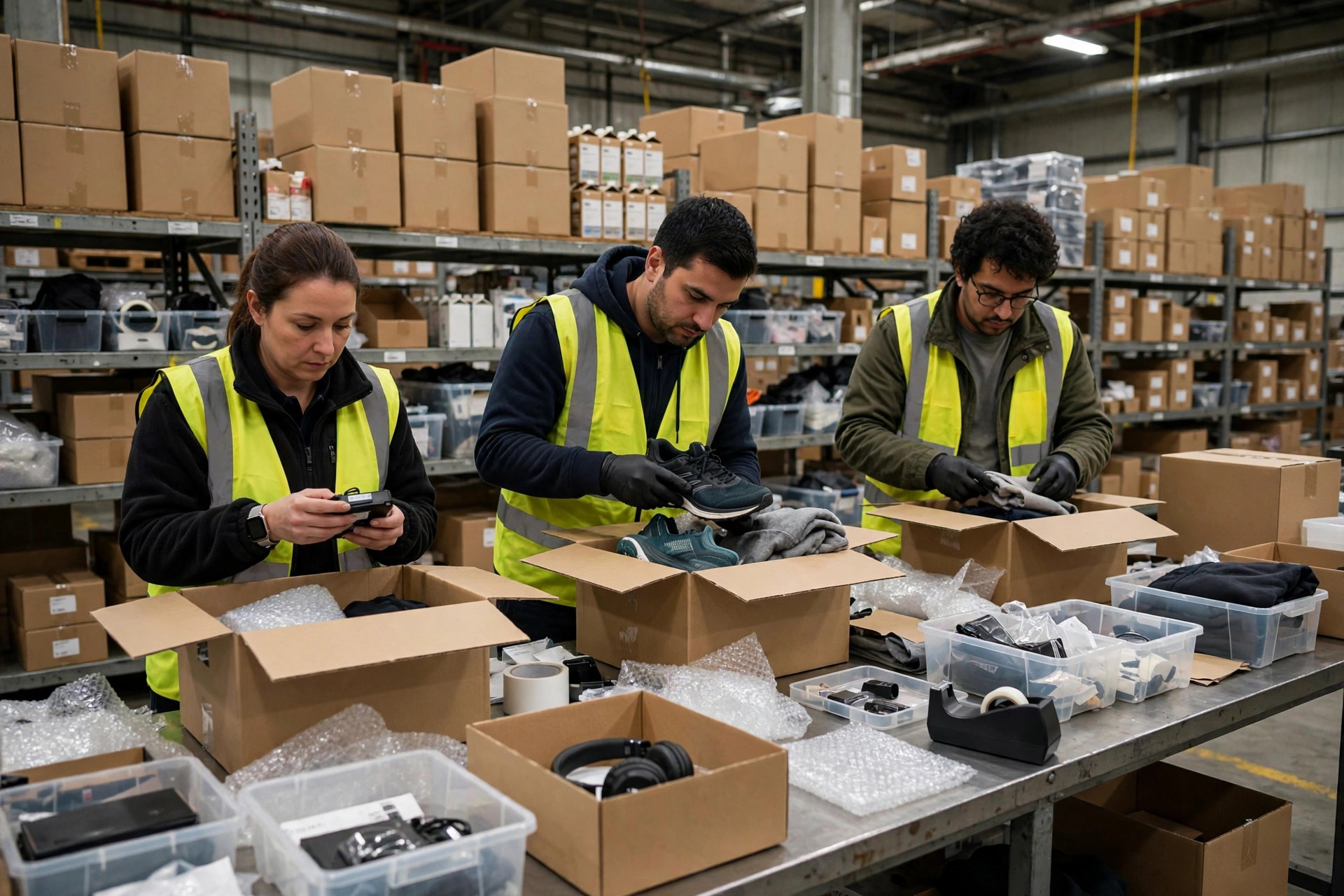
If parts went missing, audit the packing station SOP: are accessories added at pack-out or pre-installed? Does the verification step use a checklist? If packaging arrived crushed, check your FBA inbound carton spec against last-mile sortation abuse. One client of ours traced a "box arrived crushed" review back to three-wall corrugate that couldn't survive parcel sortation — after switching to five-wall, that entire category of reviews went to zero.

Behind nearly every negative review sits a hole in some warehousing or supply chain link. Fight the fire without plugging the leak, and the same spot burns again next month.
High-complaint categories: intercept them in the warehouse
Some categories generate reviews structurally — customer service can't bail fast enough, so you intercept upstream in the warehouse.
Fragiles: "arrived broken" will always dominate. The fix isn't in the reply template, it's in the packaging — double-wall corrugate, corner protectors, "fragile" label placement. I watched a ceramics seller drive breakage from 8% to under 1%, not by switching carriers but by upgrading inner boxes from single to double wall and sizing up the outer carton. A few thousand a month in packaging cost — but with fewer bad reviews, ad conversion climbed, and the total math won.
Multi-part products: unclear manuals are the root of all evil. The warehouse-side fix is the "family photo" — lay out all parts against the checklist and photograph at pack-out, archived 30 days. Buyer claims missing parts, you send the photo, half the disputes end on the spot. The other half are genuinely missing — then trace back to the verification step.
Apparel and footwear: size chart versus reality mismatch produces endless reviews. For these categories, run first-article verification in the warehouse: before a new batch goes live, pull one unit, measure it physically, and check it against the listing. Mismatch? Fix the listing before shipping — don't wait for reviews to educate you.
The compliance red line on review solicitation, in one sentence
Amazon's rule is simple: you may remind buyers to leave reviews, but you may not exchange anything of value for positive reviews or review removal. Package inserts can say "contact us first with any issue" — never "cash back for 5 stars." Post-purchase emails can ask "happy with the product?" — never "change it to five stars and we'll refund $5."
Big sellers trip on this line every year. The platform keeps escalating enforcement against paid review removal — warnings at minimum, account suspension at worst. Betting the account for a few reviews isn't worth it.
Compliant review generation is three moves: a solid product, good service touchpoints in the package, well-timed post-purchase emails. Slow, but safe.
Is there a "safe line" for negative review rate?
People ask all the time: what review rate counts as dangerous? Honestly, there's no universal red line. Platform algorithms don't publish thresholds, and tolerance varies wildly by category and price point.
But one rule of thumb works across categories: the depth of your positive-review pool determines your resilience. A listing with 2,000 reviews at 4.6 stars barely feels a new 1-star. A new product with 40 reviews at 4.8 stars can drop to 4.3 on a single 1-star — and traffic gets cut in half.
So the new-product mission isn't "zero negative reviews," it's "build the pool deep, fast." Within compliant bounds, switch on every legitimate touchpoint in the first 30 days: existing-customer emails, social channels, package inserts. A deep pool turns the occasional 1-star into a ripple; a shallow pool turns it into a tsunami.
Negative reviews also have a shelf life. A 1-star from three months ago and one from last week damage conversion very differently. A steady inflow of new positives dilutes old negatives over time — which is why routine, everyday review generation matters ten times more than firefighting after a bad review lands.
After 48 hours: Turn the review into listing fuel
Take every misunderstanding the review raised and fix it in the listing. Buyer says "the manual wasn't clear"? Add a "what's in the box" family photo to the image stack. Buyer says "smaller than expected"? Move the dimensions graphic to image slot two. Negative reviews are the most honest user research you'll ever get — more accurate than any survey.
And keep compliant review-generation running as routine: package inserts (no incentives mentioned — just "contact us first if anything's wrong"), post-purchase emails, customer service touchpoints on the packaging. With a deep enough pool of positive reviews, the occasional one-star can't crater you.
One last thing: negative reviews aren't scary. What's scary is the review arriving while your warehouse, your customer service, and your operations each do their own thing, with nobody treating it as a 48-hour mission to close the loop. Make it a rule starting today — every negative review gets evidence, reply, and root-cause tracing within 48 hours. Not many sellers can actually do this.