On September 1, 2026, aviation workers in Kenya ended a two-day strike. That same day, the Kenya Flower Council issued a statement: roughly 1,000 tonnes of flowers and fresh produce were stuck in the backlog at the airport, with more held back at farm packhouses, and clearing it "will take several days." This is not a trade story. It is about the most fragile link in the Nairobi flower cold chain: the airport export warehouse — the place where, when planes don't fly and reefer trucks queue up, 0–2°C either holds or it doesn't, and where the real losses get tallied.
The export timetable of a rose: from pre-cooling to pallet build-up
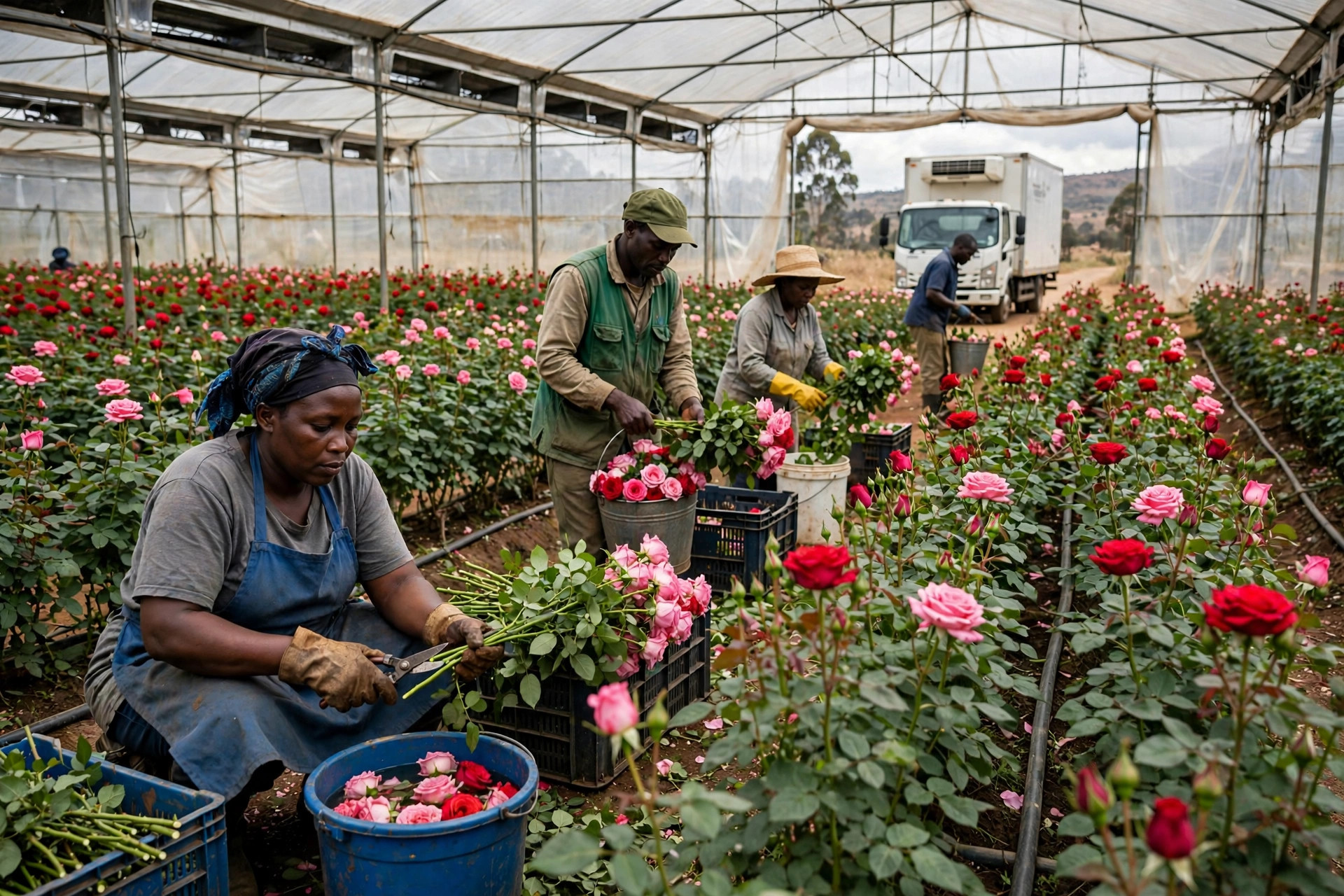
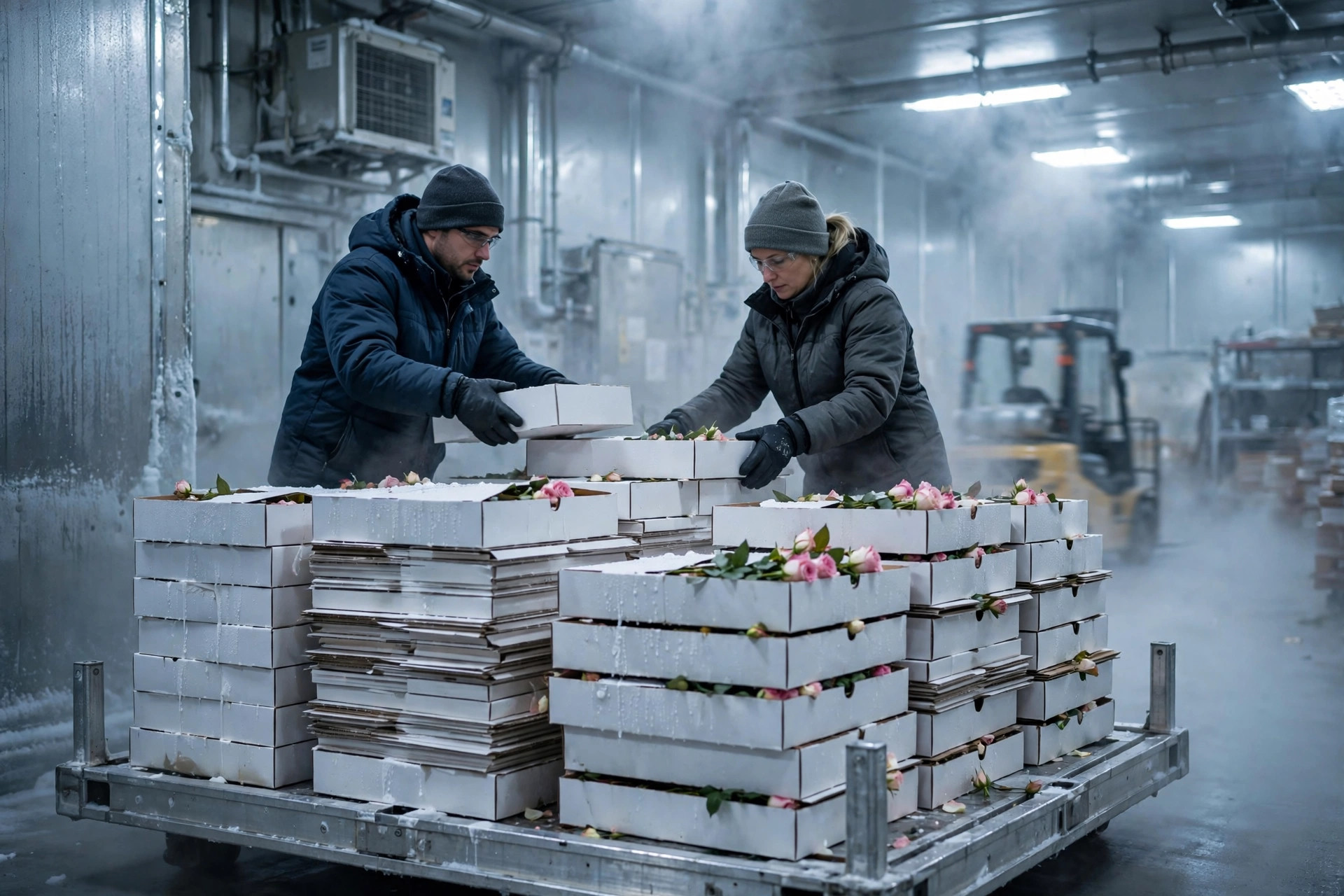
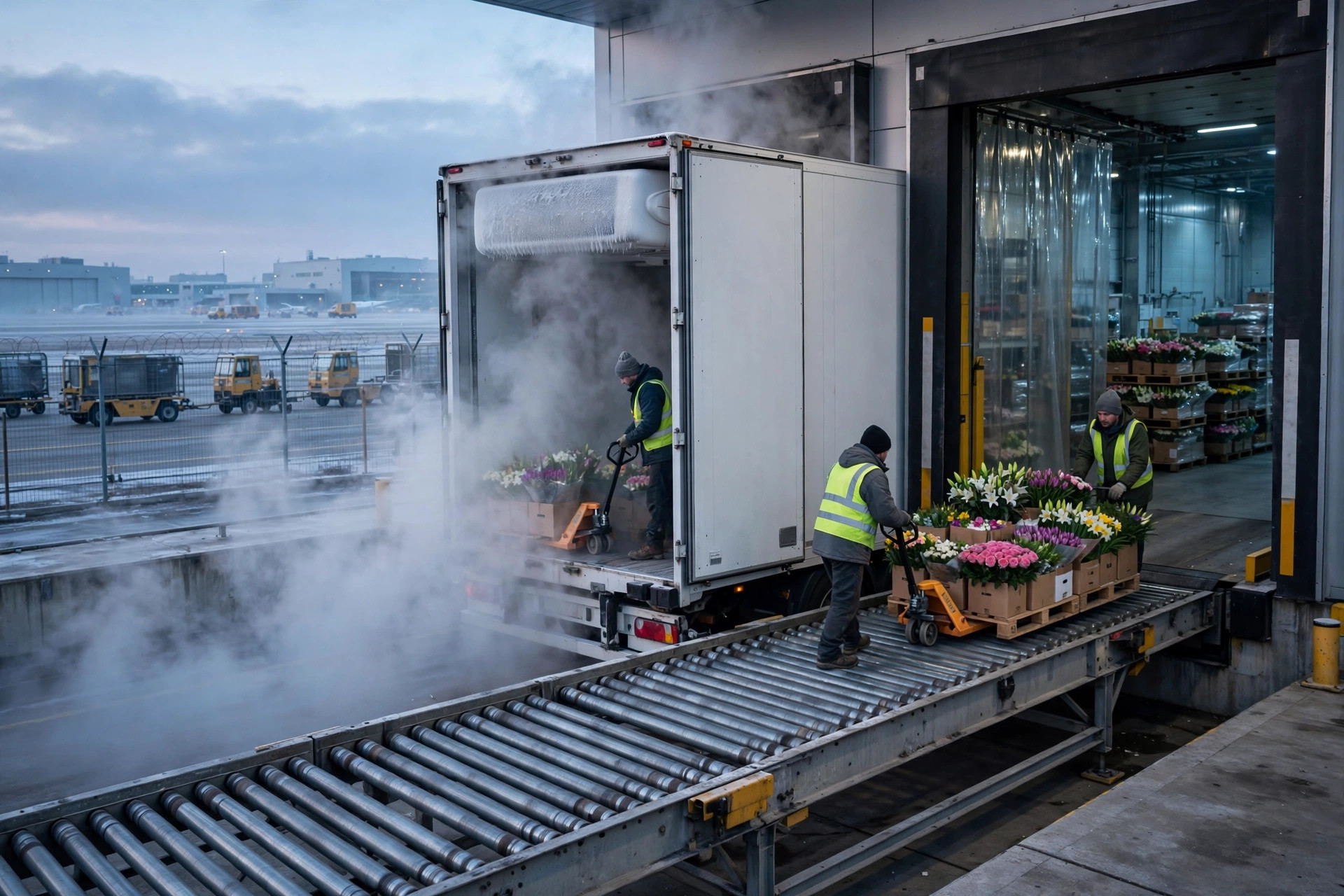
Phenomenon. Kenyan roses are cut at dawn in the highland greenhouses around Naivasha and must be pre-cooled the same day. The real time pressure hits at the airport: within hours of arrival at the cargo terminal, boxes must be received, temperature-screened, built up onto aircraft pallets — stacked to ULD dimensions, netted, weighed — and moved into the cold store to await the flight. Nairobi's flower cold chain export warehouses compete on these few hours of handoff.
Data. According to IATA's report based on Global Trade Tracker data, the global air-transported flower trade reached $3.7 billion in 2024, with Kenya holding 16.1% — up from 8.6% in 2003. Kenya doubled its share in two decades not by growing better flowers, but by building a faster, more reliable export chain. Jomo Kenyatta International Airport (JKIA) has about 1.2 million tonnes of annual cargo throughput capacity, of which 35% is allocated to cold storage (India Sea Trade News). In other words, the airport has structurally bet more than a third of its cargo capacity on the cold chain.
Attribution. One underappreciated fact: roses account for 66% of Kenya's flower export value (industry data via Bird Story Agency). With a single category dominating this heavily, the export warehouse's temperature zoning, pallet build-up flow, and flight scheduling can essentially be customized for roses — economies of scale, but also concentrated risk. The 0–2°C line is drawn for roses.
The temperature ledger of the Nairobi flower cold chain: why 0–2°C
Take Swissport's Nairobi cargo terminal as the reference case (per its May 2023 official release, reported by Aviation Pros): a 750 sqm interconnected cold storeroom holding up to 110 aircraft pallets — roughly the load of just over three Boeing 747 freighters. Four of its six cold rooms are dedicated to perishables (+2 to +8°C); two serve pharmaceuticals (CRT +15 to +20°C, COL +2 to +8°C). The terminal also installed a vacuum cooler: two main-deck pallets, from 24°C to 2°C, in 22 minutes.
A temperature-zoning table as it works in practice:
| Zone | Target | What goes in | Why it's zoned this way |
|---|---|---|---|
| Rapid pre-cool | Vacuum cooler, 24→2°C in 22 min | Arrivals running warm | Buy time: faster pre-cooling means fewer cold-store hours |
| Main flower store | 0–2°C | Roses and other cut flowers | Roses are 66% of exports; the store is built around them |
| Build-up / transit | +2 to +8°C | Pallets being built | Brief exposure; tolerance can be slightly relaxed |
| Pharma (same terminal) | COL +2–+8°C / CRT +15–+20°C | Vaccines etc. | Physically segregated from flowers |
Trend read: investment gravity in cold chain is shifting from "cold-store square meters" to "pre-cooling speed." The significance of 22 minutes is not electricity saved — it is pallet-hours saved. 110 pallet positions is a hard constraint; every extra hour a pallet sits in the cold store is an hour the next truck waits. Pre-cooling is the highest-ROI link in the chain per dollar invested. That is the real logic behind Swissport's vacuum cooler.
The two strike days: a stress test of the Nairobi flower cold chain
In early September 2026, air traffic controllers led a two-day strike over collective bargaining and union fees. The airport stood still.
Data. The Fresh Produce Consortium of Kenya (FPC) estimated exporters lost $2–3 million per day (roughly Ksh 259–388 million); the Kenya Flower Council reported about 1,000 tonnes stranded at the airport with more held at farm packhouses; emergency cold-storage surcharges during the strike ran $0.10–0.20 per kilogram (Reuters via Zawya). JKIA normally handles roughly 7,000 tonnes of cargo a day, most of it fresh produce from Kenyan farms — a two-day stoppage bottled up nearly a third of a week's perishable throughput on the ground.
Costing one cold-chain break (all derived from public figures):
- Revenue lost: 2 days × $2–3M/day = $4–6M
- Extra cold storage: 1,000 tonnes × $0.10–0.20/kg = $100k–200k
- Time cost: the KFC said clearing the backlog "will take several days" — missed flights don't wait, and roses that miss Valentine's or Mother's Day windows can only be dumped into local markets at a discount
Here is the counterintuitive finding: during those two days, temperature never actually broke. The cold stores were full, the refrigeration ran, the vacuum cooler worked — 0–2°C held. The real damage was outside temperature: the flight schedule collapsed. Flowers don't wait for planes; a rose that misses its window sells at a discount no matter how perfect its cold chain. That is why, after the strike, the KFC called not for "more cold stores" but for a National Aviation Contingency Protocol for perishable exports (The Online Kenyan, September 2026). Cold-chain people discovered, for the first time, that their biggest risk is not the refrigeration plant — it is whether the airport opens its doors.
This is the trade-off at the core: Kenya has concentrated 16.1% of the world's air-flower trade on one airport (JKIA), one transport mode (air), one category (roses at 66%) — maximum efficiency, matched fragility. Diversification costs money; concentration courts risk. There is no textbook answer, only a cyclical one.
Peak season: 9,000 tonnes before Valentine's Day
Consider the opposite case. Ahead of Valentine's Day 2026, Swissport moved 9,000 tonnes of roses through Nairobi (ATQ News). The peak-season playbook is counterintuitive: don't stockpile — run pre-cooling and build-up as a production line. Trucks are temperature-screened on arrival; warm loads go straight into the vacuum cooler; 22 minutes later they enter build-up; finished pallets roll directly into the 0–2°C main store to await flights. Kenya Airways moves about 550 tonnes of cut flowers a week in peak season (ATQ News): flights are scheduled by the week, flowers arrive by the hour, and the entire buffer lives in the terminal's 110 pallet positions plus the vacuum cooler.
Attribution, in one line: Nairobi's real moat is not 1.2 million tonnes of airport capacity or 750 sqm of cold store — it is the time-coupling of five links: farm pre-cooling, reefer truck, terminal pre-cooling, pallet build-up, flight. Slow any one link by thirty minutes and the whole chain loosens.
Two open questions for the industry. First, sea-freighted flowers are being trialed — Swissport Kenya's own management concedes sea freight needs "significant technological advancements in cold chain management and handling processes" to match air quality (India Sea Trade News). If sea takes 10–20% of volume in three to five years, does Nairobi's hour-precision export warehouse system need a second, day-precision workflow? Second, the KFC's proposed National Aviation Contingency Protocol is really asking: for a country that has staked a 16% global share on a single airport, what is plan B — Addis Ababa, Johannesburg? There is no answer yet. But after those two days in September 2026, everyone has started doing the math.
By Dr. Chen, Supply Chain Researcher