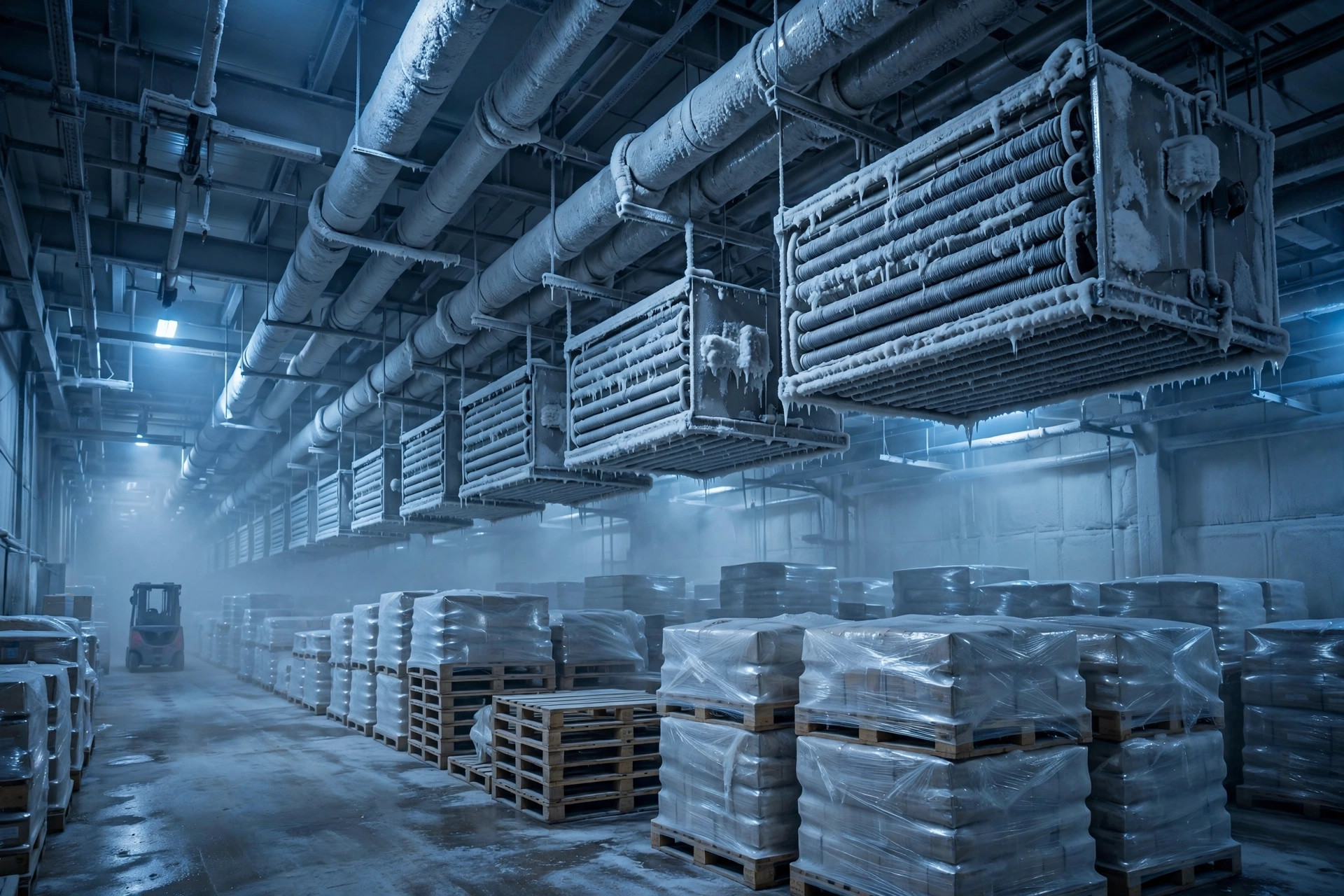
We have a client who nearly had a heart attack last summer because of the cold storage warehouse they rent — a twenty-year-old ammonia refrigeration system, and the warehouse manager had never heard of ammonia refrigeration warehouse safety requirements osha psm, the federal rule that already covers his building.
The client imports frozen seafood and leases a 90,000-square-foot cold storage facility in Ontario, California. During our annual vendor review I asked, almost as an afterthought: "How many pounds of ammonia in your system, and who's maintaining your PSM program?" Three seconds of silence. Then the manager said, "We've got about 12,000 pounds, I think… what's PSM?"
I laughed — not at him, it's a reflex in our business. That warehouse was 99% certain to be covered by federal regulation, and nobody there knew it.
The 10,000-Pound Line: Is Your Ammonia Refrigeration Warehouse Covered by OSHA PSM?
Here's how it works. OSHA's 29 CFR 1910.119, Process Safety Management, lists anhydrous ammonia in Appendix A with a threshold quantity of 10,000 pounds (about 1,943 gallons). Cross that line and the entire PSM program applies automatically — whether your sign says "food cold chain" or "chemical plant." OSHA counts pounds, not signs.
Half the people searching ammonia refrigeration warehouse safety requirements osha psm are really asking one question: "Am I covered?" The answer is brutally simple: go weigh the ammonia in your system. And note that EPA runs a parallel program — the Risk Management Program under 40 CFR Part 68 — with the same 10,000-pound threshold, plus a Risk Management Plan that includes worst-case release scenarios. Two agencies, two sets of obligations, no way around either.

PSM has 14 elements, and cold storage operators trip over the same handful: process hazard analysis (revalidated at least every 5 years), written operating procedures, mechanical integrity (compressors, piping, valves — with maintenance records), management of change, and compliance audits (at least every 3 years). One more number for context: humans can smell ammonia at around 5 ppm, but OSHA's permissible exposure limit is 50 ppm as an 8-hour average, and NIOSH sets the immediately-dangerous-to-life-or-health level at 300 ppm. Smelling it doesn't mean you're safe.
Two counterintuitive points for owners tempted to get creative:
First, splitting your system into two smaller ones to dodge the threshold doesn't work. OSHA defines "process" broadly — interconnected vessels, or separate vessels close enough that one release could involve them, get their quantities added together. Inspectors have seen that trick before.
Second, when the landlord owns the system and you operate the building, PSM lands on the operator. Plenty of 3PLs lease entire cold storage facilities and run them themselves; the landlord will happily shrug, and all 14 elements sit on your desk. Before you sign, get one thing straight: who is the regulatory owner of this ammonia system? Put it in your due diligence checklist before it goes in your contract.
Here's a real enforcement case that still stings. A cold storage company was hit with 14 violations and a $132,800 fine, including 4 willful items, and landed in OSHA's Severe Violator Enforcement Program. The worst line in the citation file: a 2010 compliance audit had flagged 22 corrective items, and 12 were still open on inspection day. An audited program you never fix is just a signed confession sitting in a drawer.
What Compliance Actually Costs: Look at the Fines First
In this business we talk money without the dance. Start with the fine schedule:
| Item | Number |
|---|---|
| OSHA penalty: serious, per violation (max) | $16,550 (2025 level) |
| OSHA penalty: willful / repeated, per violation (max) | $165,514 |
| Real case: one cold storage company fined | $132,800 (14 items, 4 willful) |
| Seven New England companies | $580,000+ in penalties, $750,000+ in compliance spending |
| CERCLA / EPCRA release reporting line | 100 lbs — report immediately |
(Penalty maximums adjust annually for inflation; check OSHA's site for the current figures.)
Most warehouse owners treat PSM compliance as pure cost. Let me reframe the math. Getting caught is just the opening act: once you're tagged a severe violator, enterprise vendor audits screen you out. And if something actually releases — anything over 100 pounds triggers mandatory reporting, the news cycle starts, and every client's product in your building has to move on emergency terms. Transfer costs, breach penalties, brand damage — the fine is the rounding error.
Here's the counterintuitive part: a warehouse that can produce its PHA report and a compliance audit from the last three years wins bids. PSM compliance isn't a cost center, it's a customer-acquisition asset. Clients pay a premium for a warehouse that won't make the news. I've told warehouse owners this a hundred times; the few who listened all landed enterprise accounts.
Ammonia Refrigeration Warehouse Safety Requirements: Three Questions for Your Next Contract
Below is the shipper-side, practical version of ammonia refrigeration warehouse safety requirements osha psm. Before you lease or renew a cold storage contract, ask the warehouse these three questions:
One: "How many pounds of ammonia in your system — above or below the PSM threshold?" Make them confirm the number themselves. If they can't answer, they've never done the inventory.
Two: "Can you show me the cover page of your latest process hazard analysis and your three-year compliance audit?" You're not reading the content, you're checking existence. A warehouse with a real program has both on file and can send a cover page in a minute. Hesitation is your answer.
Three: "Add a clause: if a refrigeration compliance issue shuts you down, who pays to move my product?" Put the risk in the contract. It's the question operators fear most and the one shippers should ask first. When things go wrong, your product sits in their building, and emergency transfers run into serious money — unwritten, that's your bill.
Our Ontario client put all three into their renewal. The warehouse spent months with a consultant getting its PHA and operating procedures in order — and guess what? The next year they bid on a grocery chain contract with that compliance file and won. Compliance is a cost on quiet days and a ticket on loud ones.
Next time you negotiate a cold storage contract, ask these three questions.
By Susan, 3PL Sales Director