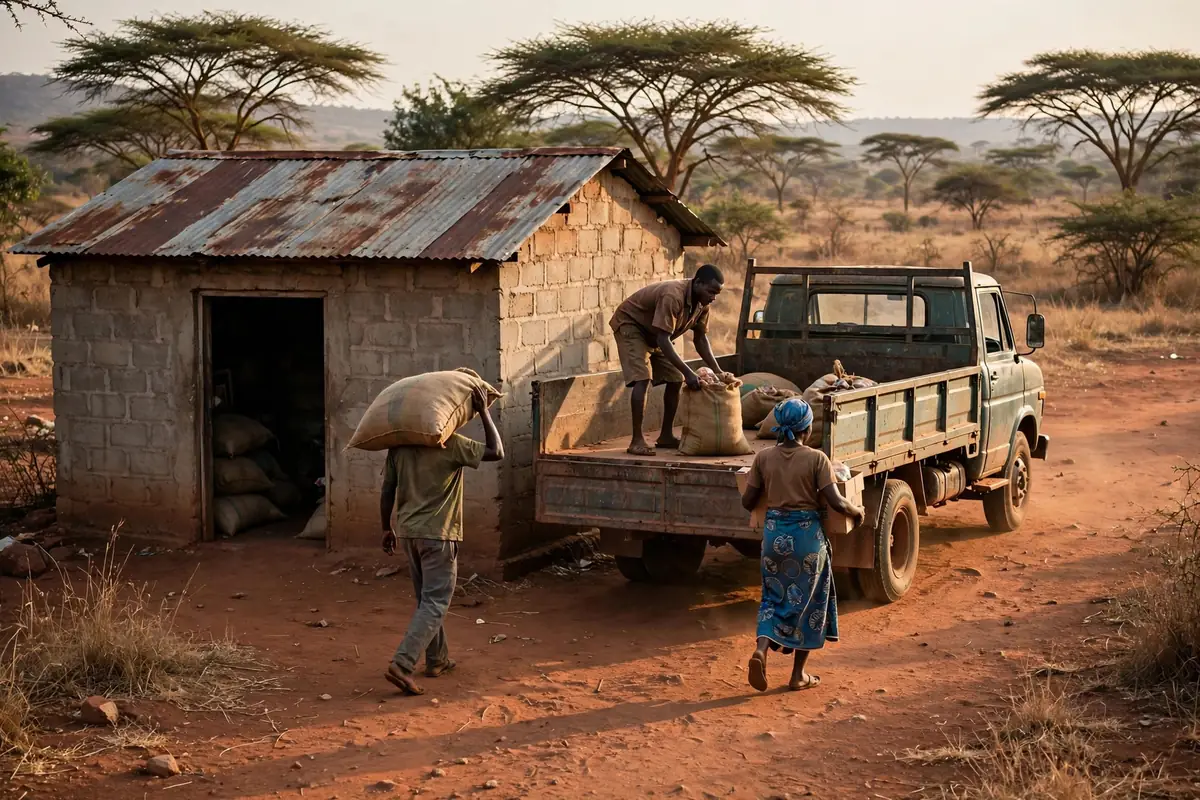
Let me start with the fact that makes my wallet ache: Malawi does not have a single meter of coastline. If you want to sell goods there, everything you stock travels the malawi landlocked warehouse transit corridor — borrowed ports, borrowed highways, borrowed border posts, one leg at a time. I run a small warehouse of my own, about three thousand square meters on a good day, and borrowed roads are exactly the kind of cost that keeps me up at night. A small warehouse like mine cannot afford to burn money, and in a landlocked market the freight bill always hides extra layers. But here is the flip side: because replenishment is slow and expensive, the big players stay away, and the gap they leave is precisely where a careful small operator can live. This piece does the math the small-warehouse way — which corridor, which city, how much stock — with every number kept at magnitude level only. For anything specific, check the latest local situation before you commit.
Choosing the corridor: which transit route feeds your malawi warehouse
Malawi's cargo mainly enters through a handful of gates: Beira and Nacala in Mozambique, Dar es Salaam in Tanzania, and, for those willing to haul further, Durban in South Africa. Here is a magnitude-level comparison; schedules, fees, and transit times change, so treat this as a framework and verify against the latest local situation.
| Corridor | Distance level | Road and border impression | Best fit |
|---|---|---|---|
| Beira into Blantyre | Among the shorter options | Road-based, busy border traffic, watch the rainy season | Small distributors focused on the south |
| Nacala toward Lilongwe | Shorter, with a rail story | Capacity is thinner, consolidating a full load takes patience | Steady cargo for the center and north, if you can wait |
| Dar es Salaam into the north | Longer | More border steps, pairs well with northern trade | Sellers already sourcing on East African routes |
| Durban into Malawi | The longest leg | Mature port and highways, but a very long haul | High-value goods where stability beats savings |
Now the counterintuitive part: the shortest corridor is often not the cheapest one. Nacala looks lovely on a map, but capacity is thin. A small seller who cannot fill a truck waits around for consolidation, and the freight saved evaporates while shelves sit empty. The Beira route, with denser traffic, can turn small batches faster. My rule is to price the whole chain, not the freight line: border delays, rainy-season detours, and waiting time all belong in the same ledger. And keep a second corridor warm. If your main route jams, a backup route you have actually used before is worth more than any discount.
Blantyre or Lilongwe: splitting the warehouse work
Once the corridor is chosen, the next question is where the boxes sleep. Blantyre in the south is the old commercial hub, dense with wholesale markets and closer to the Beira-side border. Lilongwe, the capital, holds government buyers, aid projects, and growing retail, and it dispatches naturally toward the north. Big companies build a proper warehouse in both cities. We cannot afford that, and honestly we do not need to. The small-operator version is one real warehouse plus one shadow point: rent a modest space where your goods move fastest, and in the other city keep only a tiny forward corner — or negotiate a dispatch shelf with a trustworthy local wholesaler and pay a handling fee per order. Both cities stay supplied; you pay roughly one and a half rents instead of two.
A hypothetical example: a small distributor of solar lamps and phone accessories sells mostly around Blantyre. He keeps eighty percent of stock in his Blantyre warehouse and only fast-moving models in Lilongwe, topped up by a weekly scheduled truck. In peak season a hot model sold out in Blantyre for three days; he pulled emergency stock down from Lilongwe overnight. The transfer cost more than a normal restock, but far less than losing the wholesale customers. The lesson is that a two-city split is not about dividing stock evenly — it is about letting each city rescue the other. Rehearse the transfer route before you need it.
Small batches, often: inventory rules for a landlocked warehouse market
Slow replenishment tempts people to stockpile half a year of goods. That is the most expensive mistake a small seller can make here. Stockpiling lowers stockout risk, yes, but it turns your cash into shelf decoration. In a market with limited purchasing power, a model refresh, a currency swing, or a late rainy season can strand that pile. Stockouts and overstock are two ends of a seesaw; a small warehouse should sit closer to the stockout end. A stockout costs a few orders. Overstock eats the cash flow that keeps you alive, and we small warehouses cannot afford to burn money.
My working rules are three. First, sort the catalog into three tiers: runners get small batches restocked frequently along the corridor schedule; margin items get moderate cover watched weekly; experiments get sample quantities only, reordered after they prove themselves. Second, let the trucks set your rhythm — a corridor with frequent departures lets you shrink each batch, while a sparse corridor justifies slightly larger ones. Third, once a month, walk the shelves and name the sleeping stock out loud; anything untouched for a full replenishment cycle gets bundled or discounted immediately. On the malawi landlocked warehouse transit corridor, the priciest segment is not the freight — it is the silent weeks when goods have arrived but refuse to sell.
Another hypothetical example: a seller of small farm-tool parts stockpiled heavily before the rainy season, betting on peak demand. The rains came late, planting slipped, and his goods sat for over a month while rent and tied-up cash ate most of the margin. His neighbor ordered in three small waves instead, checking the sky before each reorder. Her per-batch freight was higher; her total profit was better. That is the entire philosophy: pay a little more per batch to buy the freedom to change your mind.
Street-level advice for small sellers eyeing this market
A few closing notes from one small operator to others. Rent before you buy, and stay asset-light until the market makes sense. Find a local partner or a reliable clearing agent — half of border know-how lives in paperwork, the other half in relationships — but supervise the work you pay for. Always leave a corridor-volatility cushion in your quotes; rainy seasons, congested borders, and sudden reroutes are regular guests, and a quote with no cushion means you swallow every surprise. And treat collections as seriously as inventory: ask early about local credit habits, because selling less beats chasing bad debts. Understood properly, the malawi landlocked warehouse transit corridor is not a curse. It simply forces you to count every cost more carefully than coastal players do. They win on scale; we win on flexibility and thrift. A small warehouse has its own way of living — doubly so in a landlocked country.
By Xiao Ma, Small Warehouse Owner