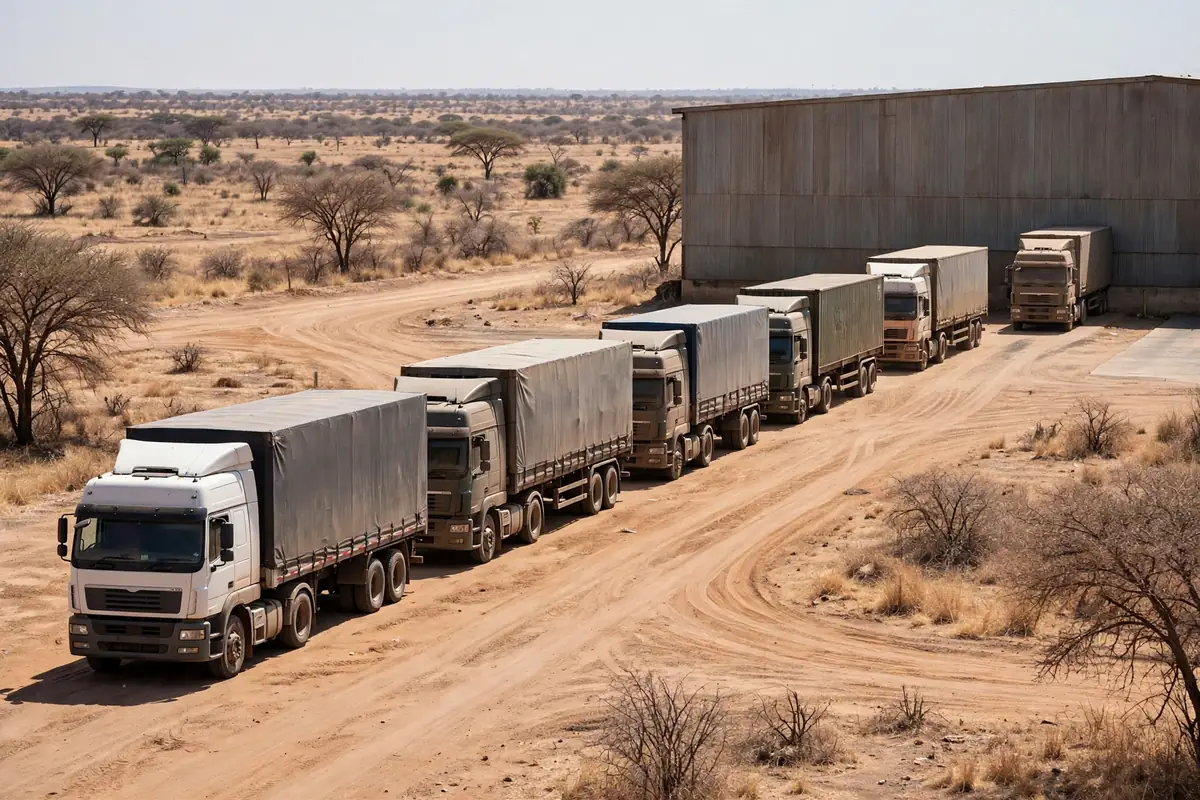
We had a client in mining supplies who opened his first gaborone botswana warehouse logistics conversation with one question: how cheap is the rent? I stopped him there. Botswana is landlocked. Your cargo lands at Durban in South Africa, then travels roughly a thousand kilometres by road before it reaches Gaborone. Whatever you save on rent can disappear in a single bad week on that corridor. In a landlocked market, you price the corridor first and the building second.
His situation is a useful illustration. Illustrative scenario: in late 2023 he was supplying filters, pump parts and protective gear to mines in southern Botswana, shipping everything direct from a warehouse in Johannesburg. Orders were small, frequent and urgent. A small stock point in Gaborone looked obvious — closer to the mines, faster delivery, and a chance to serve local retail distribution on the side. The logic sounded neat in a boardroom. On the ground, Gaborone sits in the south-east of Botswana, close to the South African border. That is genuinely close to southern customers. It is not close to the northern mining belt at all.
Price the corridor first: gaborone botswana warehouse logistics starts in Durban
A landlocked warehouse has five cost layers before a single carton reaches a customer: port handling, clearance, the long-haul leg, border formalities and local distribution. Each layer has a fee, and each layer can delay you. We built the client an illustrative costing table — the figures below are a worked example for structure only, not market quotes; always price against current local quotations.
| Cost element (illustrative example) | Ship direct from Johannesburg | Stock in Gaborone | What actually changes |
|---|---|---|---|
| Linehaul | Low per shipment, no replenishment leg | Higher, offset by full-truck replenishment | Local stock only pays if replenishment is batched |
| Rent and local labour | None | A fixed monthly commitment | You pay in quiet months too |
| Customs broker and border costs | Scattered, per shipment | Centralised, lower per unit | Depends entirely on broker quality |
| Inventory carrying cost | Low | Noticeably higher | Slow-moving parts hurt most |
| Delivery reliability | Volatile, cross-border | Stable, local dispatch | This is the real return on the warehouse |
The table changed his mind about his own project. A Gaborone stock point does not save rent money; it saves emergency air-freight rescues and lost orders. If your freight is planned, bulk and predictable, direct shipping may still win. If orders are fragmented and your customer measures downtime in money, local stock earns its keep. That is the counter-intuitive point most first-time entrants miss: the enemy of a Gaborone warehouse is not high rent, it is low turnover. A spare part that moves twice a year is sleeping capital, wherever you store it.
The second client: distribution radius is density, not geography
We had another client, a consumer goods brand, with a different lesson. Illustrative scenario: in 2024 he planned to cover all of Botswana from one Gaborone warehouse and drew a very large circle on the map. I made him draw a smaller one. Population and retail demand in Botswana concentrate heavily along the eastern corridor, with Gaborone and its surrounding towns forming the densest delivery zone. Westward lies the Kalahari; northward the distances stretch and order density falls away quickly. A circle on a map is free. A truck running that circle is not.
He changed the model. The Gaborone site would handle store replenishment and e-commerce distribution for the east and south, while northern key accounts were served by consolidated direct loads through a partner facility in the Francistown direction, outside his own network. Distribution cost stayed under control and store availability actually improved, because replenishment frequency near Gaborone could run higher. In negotiation terms: your service radius is not how far you are willing to drive, it is how much order density you have to justify the frequency. Promise a radius your density cannot fund and you will quietly lose money on every route.
Mining follows yet another radius logic. Botswana's mines are dispersed — there are operations in the south and major mining areas far to the north — so a Gaborone warehouse cannot honestly promise uniform national response times. The workable model is contractual, not geographic: forward-stock fast movers near the mines you actually serve, pool slow movers in Gaborone, and set safety stock backwards from the response times written into your supply contracts. I stop sales teams from writing nationwide next-day promises into mining contracts whenever I can. They are easy to sign and miserable to perform.
Dry port, bonded or plain warehouse: gaborone botswana warehouse logistics as a three-question decision
Gaborone has dry-port and container-terminal functions, which matter a great deal in a landlocked country: containers can move inland from South African ports and complete part of the formalities near the customer instead of at the coast. But dry port access, a bonded facility and a plain warehouse are three different tools, and I give clients three questions to separate them. First, does your cargo sell immediately on arrival, or does it wait for customer release before duties are settled? Second, do you genuinely have mining or re-export orders that need bonded treatment? Third, is your monthly container volume large enough to carry the management and compliance cost of bonded operations?
Bonded space sounds sophisticated — duty deferral, flexibility for re-export — but it is not free. Registers, stock counts and customs supervision all need competent people. At low volumes, the financing you save can be smaller than the complexity you buy. The mining client above chose a plain warehouse working with the dry-port terminal, reserving bonded arrangements for occasional large projects. It was not the glamorous option. For his volumes, it was the right one. And that leads to the second counter-intuitive judgement in this market: what landlocked operations usually lack is not bonded status, it is a customs broker who gets the border paperwork right the first time. One wrong document can park a container for days, and the delay costs more than any duty timing trick will ever save you.
So interview brokers like you mean it. Ask how many containers they actually move on the Durban–Gaborone lane each month, who physically handles a border hold, and whether exception charges are quoted before or after the fact. A vague answer is a price you have not been shown yet.
Three clauses where contracts quietly go wrong
First, lead times. Split the port-to-warehouse leg from the warehouse-to-customer leg in the contract, and measure them separately. A single blended lead time across a border is a dispute waiting for a date. Second, peak clauses. Mine shutdown and maintenance periods can spike demand for parts sharply; labour and vehicle capacity for those windows should be locked in advance, or you will pay spot prices with no alternative. Third, exit terms. How stock is disposed of, and who pays to move it back south, is a conversation for the day you sign — not the day you part.
That first client did open in Gaborone in the end: a modest site, fast-moving mining parts and retail lines only, slow movers left in Johannesburg. A year later he told me the real return was not freight saved. It was the night a mine called and his local team had the part on site within hours. That certainty, he said, is what lets him hold his prices. Warehouse contracts, in the end, are never really about the rate card. They are about who pays for uncertainty.
Next time you negotiate a contract, remember to ask these three questions: what does one bad week on this corridor cost me, does your broker have people at the border, and can we split the lead-time promise into legs we can actually measure? Ask those, and gaborone botswana warehouse logistics stops being a rent discussion and becomes a business you can price.
By Susan, 3PL Sales Director